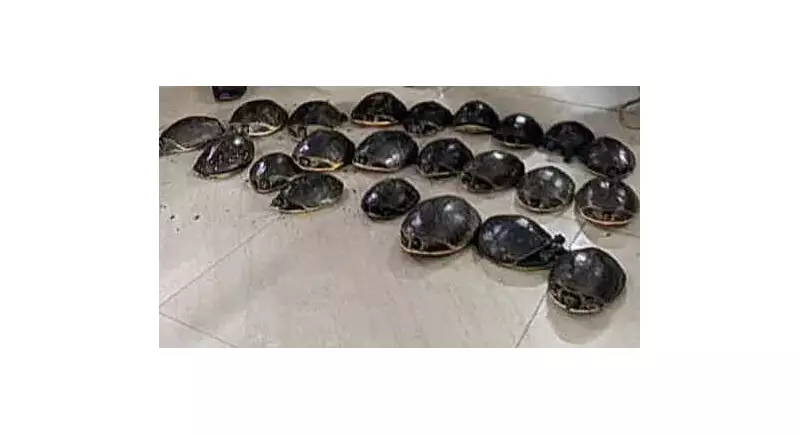
In a significant wildlife rescue operation, railway authorities in Howrah recovered a large consignment of live turtles from the city's bustling railway station. The incident, which highlights the ongoing illegal trade of protected species, led to the seizure of 165 Indian flapshell turtles but no immediate arrests.
Covert Surveillance Leads to Discovery
The operation unfolded on Friday afternoon when a joint team comprising officers from the Railway Protection Force (RPF), Government Railway Police (GRP), and the Crime Investigation Branch (CIB) initiated a covert surveillance mission on the platforms of Howrah Railway Station's Old Complex. Their vigilance paid off around 2:50 PM when they noticed several unattended bags in a suspicious condition.
The bags were located near the CTI outdoor office, adjacent to platform number 12. Upon inspection, the officers made a startling discovery: the bags were filled with live turtles, each individually wrapped in nets. The reptiles were identified as Indian flapshell turtles, a species often trafficked for the exotic pet trade and other purposes.

No Claimants, No Arrests
Following the discovery, the officers maintained a watch over the unattended luggage for a considerable period, hoping the culprits would return. However, no one came forward to claim ownership of the bags containing the protected wildlife. Due to the absence of any claimant, authorities were unable to make an immediate arrest at the scene.
The entire process of seizure was conducted meticulously, following the GRP's standard operating procedure, and was recorded on video for documentation. The Railway Police have now launched an investigation to trace the individuals responsible for this illegal act. A key part of this probe involves reviewing CCTV footage from the station premises to identify the persons who abandoned the bags.
Rehabilitation and Ongoing Investigation
After the seizure, the forest department was promptly informed and took custody of the rescued turtles. The 165 Indian flapshell turtles were subsequently transported to the Garchumuk Rescue Centre for care, rehabilitation, and eventual release back into their natural habitat.
While the timely intervention by the RPF and GRP saved these creatures from an uncertain fate, the case underscores the persistent challenge of wildlife smuggling through railway networks. The investigation remains active as authorities piece together evidence from the scene and digital recordings to apprehend the traffickers involved in this brazen attempt.