UP Government Sanctions Rs 1,204 Crore for Land Acquisition to Link Ganga and Yamuna Expressways
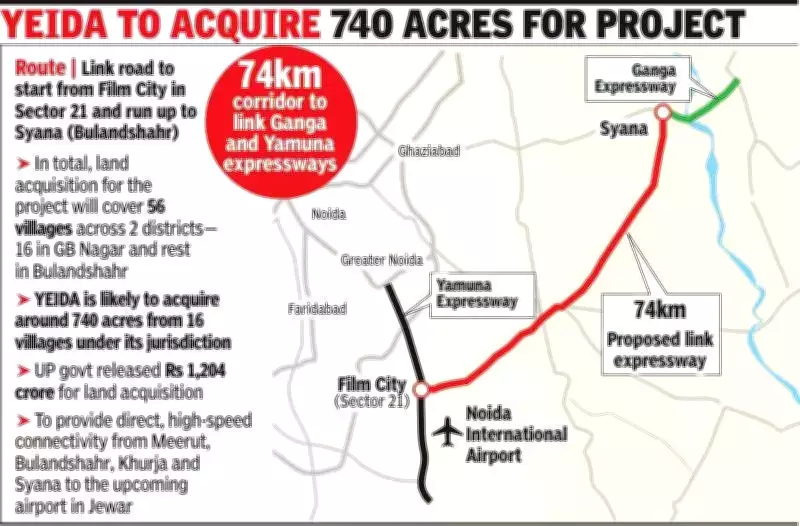
The Uttar Pradesh government has taken a significant step forward in enhancing regional connectivity by releasing a substantial sum of Rs 1,204 crore specifically for land acquisition. This funding is earmarked for a major infrastructure project: a 74.3-kilometer access-controlled greenfield expressway designed to seamlessly stitch together the existing Ganga and Yamuna expressways. This new corridor promises to create a faster, more direct road link to the upcoming Noida International Airport, marking a pivotal development in the state's transportation network.
Project Details and Financial Approval
The financial sanction was granted with the governor's formal approval and officially released by the state's infrastructure and industrial development department. This action followed a formal proposal submitted by the UP Expressways Industrial Development Authority (UPEIDA), which has been designated as the nodal executing agency for the project. According to an official order, the Rs 1,204 crore has been approved within the 2025-26 financial year budget, allocated explicitly for purchasing land located within the jurisdiction of the Yamuna Expressway Industrial Development Authority (YEIDA).
The overall project cost is estimated to be approximately Rs 4,000 crore, with this initial release covering the critical land acquisition phase. The acquisition process will span a total of 56 villages across two districts: 16 villages in Gautam Budh Nagar and the remaining 40 villages in Bulandshahr district. Within Bulandshahr, the villages are distributed across multiple tehsils, including 14 in Khurja tehsil, with the rest spread throughout Bulandshahr, Syana, and Shikarpur tehsils.

Land Acquisition and Execution Timeline
This recent approval formalizes the acquisition process that YEIDA initially announced last year. At that time, YEIDA indicated plans to acquire about 740 acres of land from 16 villages under its jurisdiction, with an estimated cost pegged at around Rs 1,200 crore. The execution plan involves a coordinated effort:
- YEIDA will complete the land acquisition within its notified area.
- The Bulandshahr district administration will simultaneously finalize acquisition proceedings on its side.
- Once acquired, the land parcels will be handed over to UPEIDA for the subsequent phases of the project.
Upon receiving the land, UPEIDA will be responsible for detailed design work, tendering processes, and overseeing construction. The authority will also manage the integration of this new link with the existing expressway network, ensuring that all timelines and cost norms are strictly adhered to throughout the project lifecycle.
Expressway Alignment and Technical Specifications
Officials have confirmed that the alignment for the expressway has been meticulously finalized. The corridor is set to commence at the 44.3-kilometer point on the Ganga Expressway, located near Syana. It will then proceed to merge with the Yamuna Expressway at the 24.8-kilometer point, close to YEIDA Sector 21. This strategic routing is designed to optimize connectivity and reduce travel distances significantly.
Approximately 20 kilometers of the total corridor will fall within YEIDA's area, which includes a nearly 9-kilometer elevated section to navigate complex terrain or existing infrastructure. The project plans incorporate several advanced features to enhance functionality and safety:

- A 24-meter-wide service road in Yamuna City to facilitate local access and reduce congestion on the main expressway.
- Construction of two road overbridges to ensure seamless overpass connectivity.
- Implementation of multiple underpasses to maintain uninterrupted traffic flow and improve safety at intersections.
Expected Benefits and Regional Impact
The new expressway is anticipated to deliver a multitude of benefits for commuters, industries, and the broader regional economy. One of the primary advantages will be a substantial reduction in travel time for residents from western Uttar Pradesh, who will gain a new, high-speed route that bypasses congested areas. This is expected to decongest key industrial stretches, particularly around Yamuna City, by diverting traffic onto the dedicated corridor.
Enhanced airport access is another critical benefit. The expressway will significantly improve connectivity to the Noida International Airport for traffic originating from major areas such as Meerut, Bulandshahr, Khurja, and Syana. Furthermore, it will strengthen transportation links towards Agra, Greater Noida, and the Delhi-Mumbai Expressway, creating a more integrated regional road network.
From an industrial perspective, the corridor is projected to ease pressure on Yamuna City's industrial sectors by providing an alternative route for freight and passenger movement. This will support more efficient cargo movement to the airport, boosting logistics and trade activities. The project aligns with broader goals of promoting economic growth, improving infrastructure resilience, and fostering sustainable development through reduced congestion and enhanced connectivity.