The Telangana government made a significant announcement on Saturday. They revealed plans for the Munneru-Palair link scheme. This major project will transform water management in three key districts.
A Gravity-Based Solution for Water Woes
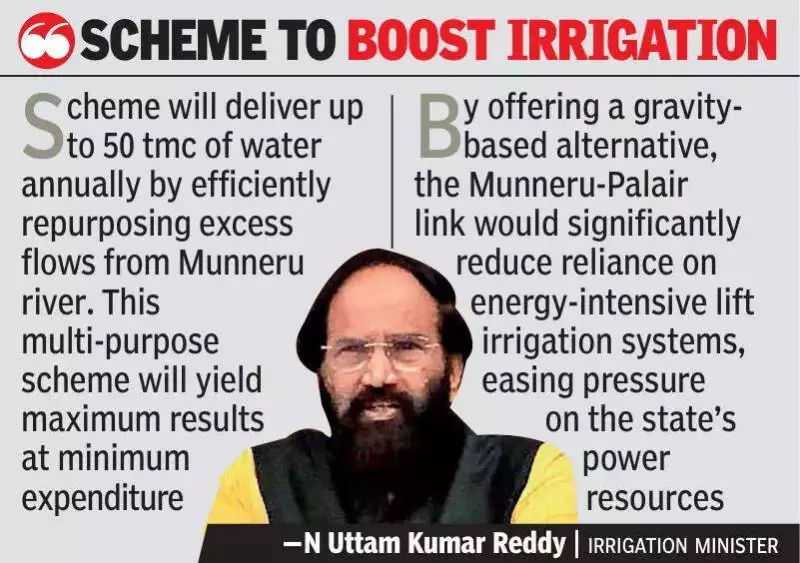
Irrigation Minister N Uttam Kumar Reddy presented the details. He explained that the scheme is designed as a gravity-based irrigation and drinking water project. It specifically targets Khammam, Suryapet, and Mahabubabad districts.
The core idea is simple yet powerful. The project will capture surplus floodwaters from the Munneru river. These waters have historically gone underutilized, often causing damage instead of providing benefit.

Turning Problems into Sustainable Solutions
Minister Reddy highlighted the dual nature of the Munneru river's impact. Large parts of the proposed ayacut have remained drought-prone for years. At the same time, the same river has caused recurrent flash floods, particularly in Khammam district.
"This multi-purpose scheme will yield maximum results at minimum expenditure," the minister stated confidently. He emphasized that the project turns a long-standing problem into a sustainable solution.
The scheme promises to deliver up to 50 tmc of water annually. It does this by efficiently repurposing excess flows that currently drain into the Bay of Bengal without benefiting the region.
Technical Details and Implementation
Explaining the technical aspects, Uttam Kumar Reddy provided specific numbers. The Munneru-Palair gravity scheme utilizes the river's annual flood surplus, estimated at 50 to 60 tmc.
The water diversion will begin at an existing check dam. This dam is located at Mulkanoor village in Garla mandal of Mahabubabad district. From there, the water will feed into the Palair balancing reservoir link canal.
A natural elevation difference of about 4 metres between the river and the canal bed enables purely gravity-driven flow. No pumping is required, which represents a key advantage of the design.
The proposed link canal spans 9.6 kilometers. Engineers have designed it to handle a discharge capacity of 4,500 cubic feet per second.
Financial Approval and Construction Timeline
The government already cleared the project in May last year. They sanctioned Rs 162 crore for its execution. Construction is expected to begin shortly, according to official statements.
One of the most compelling benefits involves cost savings. The minister projected annual savings of Rs 120 crore in electricity costs. This results from reduced reliance on energy-intensive lift irrigation systems.
Substantial Benefits for Agriculture and Drinking Water
The scheme will provide substantial irrigation support. It is expected to supplement irrigation for 76,308 acres under Sri Ram Sagar Project stage II during kharif season. Additionally, it will support 46,712 acres under distributory block minor in Suryapet district.
Another 46,712 acres under DBM 71 will also receive support from this project. These numbers demonstrate the wide-reaching agricultural impact.
For drinking water needs, the project allocates 4.70 tmc of water per annum from the Palair reservoir. This water will meet requirements under the Mission Bhagiratha schemes in all three beneficiary districts.
Addressing Historical Devastation
Minister Reddy spoke directly about the devastation caused by repeated floods. He noted that the Munneru river had become synonymous with destruction in recent years. The new scheme directly addresses this challenge by productively channelling surplus waters.
"The people of this region suffered enough from the Munneru's fury," the minister stated with evident concern. "This project will not only prevent future devastation but also empower them with reliable water resources for generations to come."
The gravity-based approach offers particular advantages. Regions covered under the scheme would otherwise depend on water from the Sita Rama lift irrigation project. By providing a gravity-based alternative, the Munneru-Palair link significantly reduces pressure on the state's power resources.

This innovative project represents a comprehensive approach to water management. It addresses both drought mitigation and flood control in some of Telangana's most vulnerable regions. The combination of technical efficiency, cost savings, and substantial benefits makes it a landmark initiative for the state's development.