Rajasthan Budget Proposes Power Tariff Relief for Shrimp Farmers
Shrimp farmers in Rajasthan, who have long struggled with exorbitant electricity costs, may soon receive significant relief. Finance Minister Diya Kumari announced in the recent State Budget that power rates will be reduced to stimulate rural economic activity, with specific attention to the aquaculture sector.
New Tariff Slab Under Consideration
According to sources within the energy department, the government is actively considering the creation of a separate tariff slab specifically for shrimp farming. This new category is likely to be positioned between the existing industrial and agricultural classifications, aiming to provide a more equitable pricing structure.
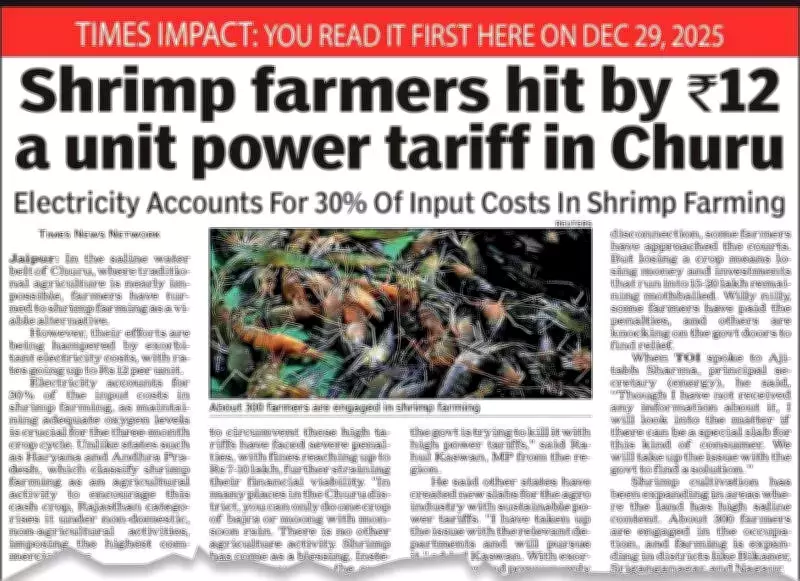
The issue gained prominence after a Times of India report titled "Shrimp farmers hit by ₹12 a unit power tariff in Churu" highlighted the severe financial challenges faced by these farmers in its December 29 Jaipur edition. The report brought widespread attention to a critical problem affecting rural livelihoods.

The Challenge of Saline Water Regions
In the saline water belt of Churu district, where traditional agriculture is nearly impossible due to high salt content in the soil and water, farmers have turned to shrimp farming as a viable economic alternative. However, their efforts are being severely hampered by electricity costs that can reach as high as Rs 13 per unit.
"We are looking to create a new slab for this farming activity," confirmed a senior energy department official. "The decision on tariff levels will be taken after studying models in other states and factoring in local conditions."
Electricity: A Critical Cost Component
Electricity accounts for approximately 30% of the total input costs in shrimp farming. Maintaining adequate oxygen levels in the ponds throughout the three-month crop cycle is absolutely crucial for shrimp survival, making reliable and affordable power essential for success.
Unlike states such as Haryana and Andhra Pradesh, which classify shrimp farming as an agricultural activity to encourage this cash crop, Rajasthan currently categorizes it under non-domestic, non-agricultural activities. This classification subjects shrimp farmers to the highest commercial electricity rates available.
Financial Strain and Penalties
The high tariffs have created significant financial strain for farmers attempting to establish sustainable operations. Some farmers who tried to circumvent these expensive rates faced severe penalties, with fines reaching between Rs 7-10 lakh, further threatening their financial viability.
Ravi Kant, a shrimp farmer from Ratangarh, explained the broader context: "In many areas of Churu district, you can only do one crop of bajra or moong with monsoon rain. There is no other agriculture activity. Shrimp came as a blessing. The government should encourage the crop, and low power tariffs are critical for it."
Expanding Aquaculture Sector
Shrimp cultivation has been expanding steadily in regions with high saline content in the soil and water. Currently, approximately 300 farmers are engaged in this occupation across Rajasthan. In recent years, the practice has been expanding beyond Churu to other districts including Bikaner, Sriganganagar, and Nagaur, indicating growing interest in this alternative agricultural model.
The proposed tariff reduction represents a potential turning point for rural communities in saline-affected regions, offering hope for more sustainable livelihoods through aquaculture development supported by reasonable energy costs.