President Droupadi Murmu has given her assent to a landmark new law that overhauls India's rural employment guarantee framework. The Viksit Bharat-Guarantee for Rozgar and Ajeevika Mission (Gramin) Bill (VB-G RAM G), 2025, repeals the two-decade-old Mahatma Gandhi National Rural Employment Guarantee Act (MGNREGA) and introduces a new scheme with significant changes.
From MGNREGA to VB-G RAM G: What Stays and What Changes
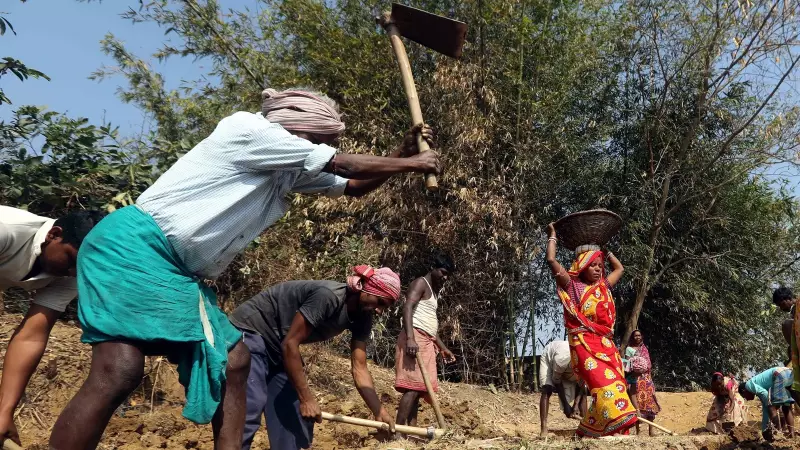
The new legislation retains the core rights-based approach of its predecessor, a move widely welcomed by analysts. Crucially, it enhances the guaranteed days of wage employment from 100 to 125 days per financial year for rural households. Since its inception in 2005, MGNREGA generated a staggering 4,872.16 crore person-days with a total expenditure exceeding Rs 11.74 lakh crore, acting as a critical safety net for crores of families, especially during the COVID-19 pandemic.
The MGNREGA era is credited with transforming rural labour dynamics. It provided job cards that gave workers an identity, helped eliminate unpaid labour (begaari), ensured equal pay for men and women, and set a wage floor. Most importantly, it empowered labourers with dignity and bargaining power against landlords and contractors.

Key Concerns: Fiscal Burden on States and Farm Season Pause
However, the VB-G RAM G Act introduces two contentious provisions. First, it significantly alters the funding model. While the Rural Development Ministry projects the first full year's cost at Rs 1.51 lakh crore, the financial burden will now be shared with states. The Centre will fund the entire scheme only in four Union Territories.
For 11 northeastern and hill states, the Centre will bear 90% of the cost. But for 19 major states, the new law mandates a 40% share of the expenditure. Based on the 2024-25 MGNREGA spending of Rs 1.04 lakh crore, this could impose an additional annual fiscal burden of approximately Rs 30,000 crore on these states, many of which are already facing financial constraints.
Second, to address farm labour shortages, the Act proposes a 60-day pause in guaranteed employment during peak agricultural seasons. Critics argue this may be a misdiagnosis of the problem. Historical MGNREGA data shows demand for work typically peaks in June and remains low from September to November, which covers kharif harvest and rabi sowing. The real deterrent for farm labour, experts point out, is often delayed or incomplete wage payments in the agricultural sector, not competition from MGNREGA.
Reversal in Planning and the Road Ahead
Another shift is in the planning process. The new Act moves away from MGNREGA's 'bottom-up' Labour Budget, which was based on actual demand from the ground. Instead, it reintroduces a 'top-down' approach through 'normative allocation' of resources, which some fear could undermine local needs assessment.
The transition from MGNREGA to VB-G RAM G impacts the welfare of an estimated 8.61 crore families (12.16 crore workers). While the increase in guaranteed work days is a positive step, the success of the new framework will hinge on resolving the funding challenges for states and ensuring that the seasonal pause does not deprive vulnerable households of essential income when they need it most.