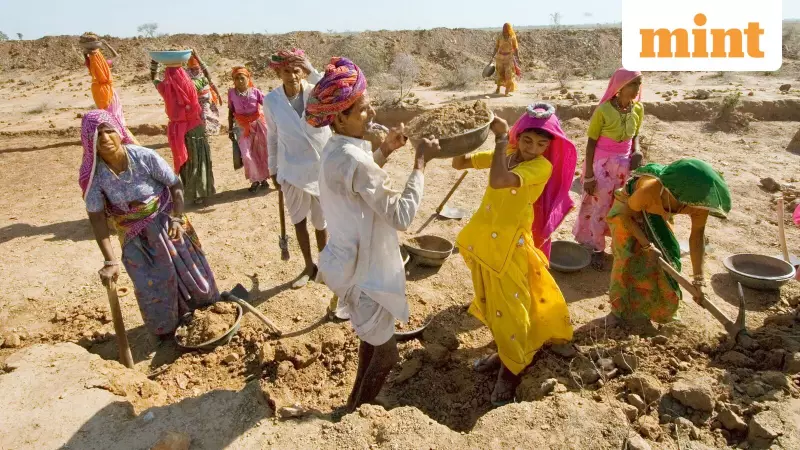
In a significant move, the Union government has initiated a sweeping overhaul of India's flagship rural job guarantee programme. On Thursday, the Lok Sabha passed the Viksit Bharat – Guarantee for Rozgar and Ajeevika Mission (Gramin) Bill 2025, which seeks to replace the nearly two-decade-old Mahatma Gandhi National Rural Employment Guarantee Act (MGNREGA), 2005, and its accompanying scheme.
Why is the Government Revamping MGNREGA?
The government argues that rural India has transformed since MGNREGA's inception. It cites a sharp decline in poverty, from 25.7% in FY12 to 4.86% in FY24, driven by rising incomes and better infrastructure. Officials state that with stronger social protection and more diverse livelihoods, the old framework no longer fits today's reality. A key issue identified is that MGNREGA wages sometimes compete with regular farm jobs, disrupting the local labour market.
Key Changes in the Proposed New Scheme
The most contentious change involves funding. Currently, the Centre bears 100% of the wage costs. Under the new bill, the funding pattern will shift: the Centre will fund only 60% of the total cost in most states, and 90% in north-eastern and Himalayan states, with state governments covering the rest. Union Territories will continue to receive full central funding.

The bill also introduces a state-wise "normative allocation" determined annually by the Centre, moving away from the current demand-driven model. Any expenditure beyond this cap must be borne by states.
Other major proposals include increasing the guaranteed employment from 100 to 125 days per rural household annually. The scheme will focus on creating durable assets in four areas: water security, core rural infrastructure, livelihood infrastructure, and climate-resilient works.
To address past leakages, the bill mandates robust monitoring, biometric attendance, and Aadhaar-based verification. It also includes a provision to halt work during 60 notified peak agricultural days to avoid competition with farming.
Criticisms and Financial Implications
Opposition parties and civil society groups have strongly criticised the bill. The primary concern is the increased financial burden on states. According to rural development ministry estimates, the total annual fund requirement would be ₹1,51,282 crore. Under a 60:40 split, states would have to shoulder a bill of ₹55,589.70 crore, a significant new liability.
Critics like economist Jean Dreze argue the bill concentrates power with the central government without corresponding obligations. Others fear the pre-set allocations will effectively cap employment days, disproportionately affecting poorer states and potentially leading to distress migration.
In protest, the NREGA Sangharsh Morcha has called for a nationwide 'day of action' on 19 December, with planned demonstrations by rural workers across India.
The bill, having cleared the Lok Sabha, now awaits discussion in the Rajya Sabha. Its passage would mark the most substantial change to India's rural employment safety net since the original act was passed in 2005.