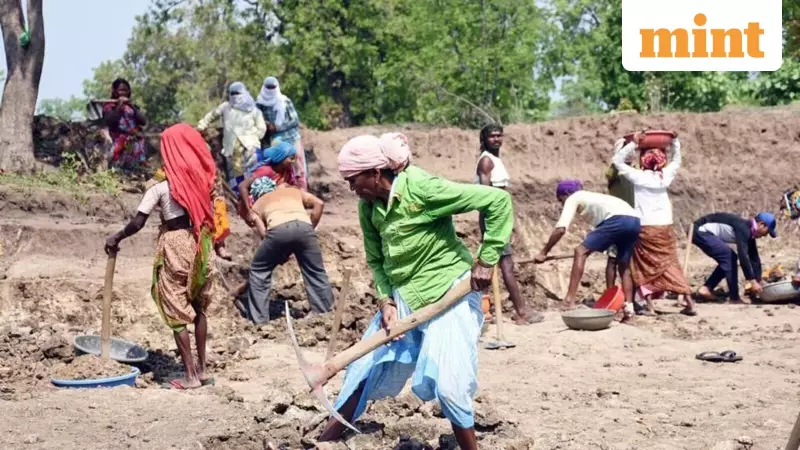
The Indian government has introduced a legislative proposal that could fundamentally reshape the country's flagship rural jobs program, significantly increasing the financial responsibility of state governments. The Viksit Bharat-Guarantee for Rozgar and Ajeevika Mission (Gramin) (VB-G RAM G) Bill, 2025, tabled in the Lok Sabha earlier this week, seeks to replace the existing Mahatma Gandhi National Rural Employment Guarantee Scheme (MGNREGS).
A Major Shift in Funding and Framework
The proposed bill marks a dramatic departure from the current MGNREGS framework on three core aspects: funding patterns, the availability of work, and the central government's control over fund disbursals. The most consequential change is the overhaul of the financial sharing model between the Centre and the states.
Under the existing MGNREGS norms, the central government bears the entire cost of unskilled wages and 75% of the material costs. Given that wages constitute roughly 66% of total scheme expenditure and materials about 31%, this arrangement means the Centre currently funds approximately 90% of the overall scheme cost, with states covering the remaining 10%.

The new rules propose a 60:40 cost-sharing ratio between the Centre and states for all scheme expenses in a given year. This simple arithmetic translates into a threefold increase in the financial burden for state governments. Furthermore, the bill introduces clauses with additional cost implications for states, including liability for unemployment benefits if work is not provided within 15 days and a cap on central funding based on normative allocations decided by the Centre.
The Staggering Fiscal Impact on State Budgets
The financial ramifications for state coffers are substantial. An analysis based on the 2024-25 financial year reveals that if the new 60:40 formula had been in effect, states collectively would have faced an additional burden of approximately ₹31,000 crore. This sum represents an increase of about 0.54% in total state expenditure.
The strain would have been even more acute during periods of economic distress. For instance, during the COVID-19 pandemic year of 2020-21, the revised funding formula would have saddled states with an extra liability of around ₹40,000 crore, boosting their total expenditure by just over 1%. This potential spike in spending comes at a time when states have been lauded for fiscal prudence, having contained their aggregate fiscal deficit within 3% of GDP for three consecutive years from 2021-22 to 2023-24.
The burden is not distributed evenly across the country. A state-wise breakdown for 2024-25, applying the proposed formula, shows Uttar Pradesh would have seen the highest additional liability at ₹4,239 crore, followed by Andhra Pradesh (₹3,269 crore) and Tamil Nadu (₹3,211 crore). Notably, special category states in the Himalayan and North-Eastern regions are exempted from this change, retaining the older 90:10 Centre-state cost-sharing ratio.
Between Promise and Practical Reality
On paper, the new scheme enhances the employment guarantee from 100 days to 125 days per household annually. However, ground reality paints a different picture. Even under the current 100-day guarantee, no major state outside the North-East has managed to provide the full quota of employment to a significant portion of households. In 2024-25, apart from Kerala, no larger state provided 100 days of work to more than 10-15% of participating households.
This gap between promise and delivery is unlikely to narrow. Over the last six years, the average days of employment provided per household has fluctuated between 40 and 51 days, even during the peak pandemic distress. So far in the current fiscal year, the average stands at 35 days. Critics argue that states, already wary of the massive new fiscal burden, will have a strong disincentive to scale up work provision to anywhere near the promised 125 days. The central government's enhanced discretion in deciding fund allocations for each state further reduces their flexibility.

The proposed changes have reignited the debate on fiscal federalism and the design of social safety nets. While the government aims to integrate employment guarantees under the umbrella of centrally sponsored schemes, the Reserve Bank of India has previously cautioned that a proliferation of such schemes reduces state spending flexibility and can dilute cooperative federalism. As the bill moves through the legislative process, its potential impact on rural wages, state finances, and the economic security of millions of workers remains a critical point of national discussion.