

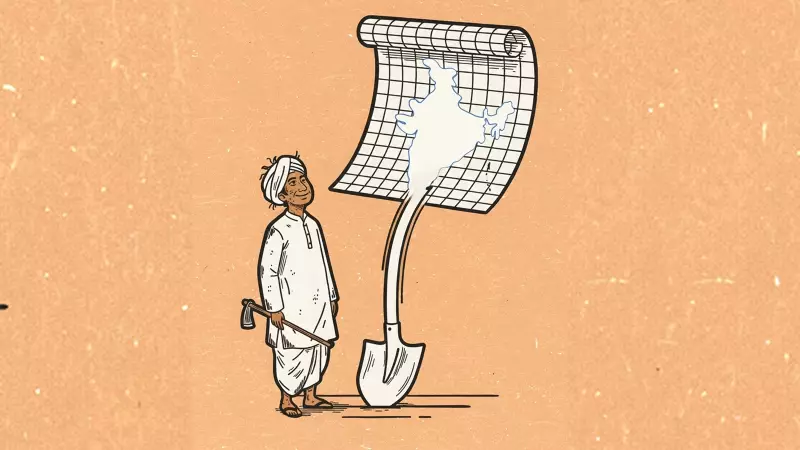
The Indian government's sweeping overhaul of the Mahatma Gandhi National Rural Employment Guarantee Act (MGNREGA), aligning it with the Viksit Bharat 2047 vision through the VB-G RAM G framework, has sparked significant debate. Moving beyond emotional rhetoric, a factual analysis of the new provisions reveals a multi-pronged attempt to modernize the nearly two-decade-old social security scheme.
Core Changes: From 100 to 125 Days and a New Funding Model
The most prominent change in the new law is the enhanced employment guarantee target of 125 days per rural household annually, a significant increase from the previous 100-day framework. This shift addresses a persistent performance gap. Historical data shows that despite the scheme's existence, only about 7.5-8% of households completed the full 100 days of work. The average days of employment provided per household also remained stagnant at around 50.4 days during FY21-25.
Another major reform is the change in the scheme's financial architecture. MGNREGA has been converted from a Central Sector Scheme (with a 90:10 fund-sharing ratio between centre and states) to a Centrally Sponsored Scheme (CSS) with a generic 60:40 cost-sharing ratio. Critics have raised concerns about increased fiscal burdens on states. However, data indicates the Union government has been the primary funder, spending Rs 9.95 lakh crore over 19 years (FY07-FY25), with Rs 86,000 crore allocated for 2025-26 alone—the highest ever. The central share is estimated to potentially reach Rs 95,692 crore by FY27.

Improving Wages, Asset Creation, and Local Governance
The revamp also tackles long-standing issues of wage adequacy and asset quality. While the average wage per person per day has risen from Rs 88 (FY07-FY12) to around Rs 267 currently, real-term increases have been modest. The CSS structure is expected to facilitate better compensation. Furthermore, the law explicitly removes disentitlement provisions, placing the onus on states to inform workers in advance.
A critical shift is moving from short-term income generation to sustainable productive asset creation. The new framework focuses works on four key areas: water security, rural infrastructure, livelihood infrastructure, and climate resilience. Created assets will be geo-tagged and integrated into the Viksit Bharat National Rural Infrastructure Stack and systems like PM Gati Shakti for optimal planning. Since its inception, 9.6 crore rural assets have been created, with a staggering 84% built in the last decade (FY15-25).
The funding approach changes from demand-driven to normative, state-specific allocations, aiming to reduce annual fluctuations and prioritize local needs. This model draws inspiration from Finance Commission tax devolution, using parameters like the number of gram panchayats and women's participation share. The reform also empowers Gram Panchayats as active partners in the Viksit Bharat mission, encouraging them to identify and pitch sustainable projects.
Context and Conclusion: A Scheme for a Changing Rural India
The overhaul comes at a time when rural economic dynamics are evolving. With rural poverty declining significantly, the share of MGNREGA expenditure at the overall poverty line across states is now minimal, averaging around 10%. This suggests rural incomes have diversified, reducing the scheme's direct poverty alleviation role.
In essence, VB-G RAM G represents a substantial recalibration of MGNREGA. It aims to inject accountability, transparency, and technological integration while pooling resources more effectively. By increasing the workday guarantee, refining the funding model, prioritizing durable assets, and empowering local governance, the reform seeks to ensure this well-intentioned scheme remains a relevant lynchpin for socio-economic development in a rapidly transforming India.






