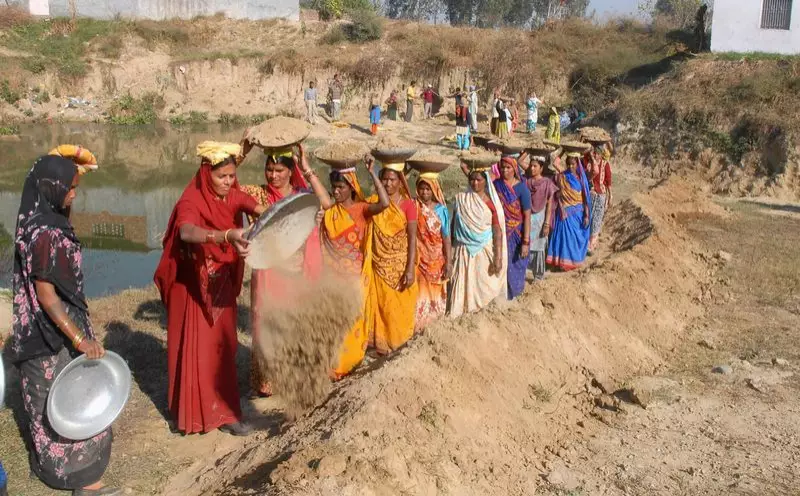
New data has revealed a significant gap between the promise and the reality of India's flagship rural job guarantee scheme. While the Mahatma Gandhi National Rural Employment Guarantee Act (MGNREGA) legally assures 100 days of work per household annually, and the Congress party's 2024 election manifesto promised to raise this to 125 days, the actual average work provided over the past five years stands at a mere 48 days.
The Stark Reality of Work Days Under MGNREGA
An analysis of official data from the past five financial years, from 2019-20 to 2023-24, paints a sobering picture. The average number of days of work provided per household under the scheme has consistently fallen short of the 100-day mark. The figures show a low of 48.4 days in 2021-22 and a high of 51.5 days in 2023-24, resulting in a five-year average of approximately 48 days.
This performance is critically examined against the backdrop of political promises. During the recent Lok Sabha election campaign, the Congress party pledged to enact a law guaranteeing 125 days of work per year under MGNREGA. However, the existing framework itself has struggled to meet its foundational guarantee of 100 days for over a decade.

Financial Allocations and State-Wide Disparities
The implementation shortfall occurs despite substantial financial commitments from the central government. For the current financial year 2024-25, the Union Budget allocated Rs 86,000 crore for MGNREGA. Furthermore, a recent supplementary demand for grants sought parliamentary approval for an additional Rs 28,000 crore for the scheme, indicating persistent demand and budgetary adjustments.
The distribution of work days also reveals stark disparities across states. In the financial year 2023-24, states like Tamil Nadu (78.7 days), Kerala (63.1 days), and West Bengal (60.9 days) performed relatively better. In contrast, several larger states provided significantly fewer days of employment. Uttar Pradesh averaged only 38.1 days, Bihar 35.9 days, and Madhya Pradesh 41.5 days per household.
Historical Context and Persistent Challenges
The last time the national average of person-days generated per household even approached the 100-day guarantee was in the financial year 2010-11, when it reached 54 days. Since then, the figure has predominantly hovered in the 40s. This long-term trend underscores systemic challenges in the scheme's implementation, including delays in wage payments, insufficient allocation of work, and procedural bottlenecks at the grassroots level.
The data underscores a critical disconnect. While political narratives often highlight the expansion and importance of the rural job safety net, the ground reality for millions of households is access to less than half the employment legally guaranteed to them. This gap has profound implications for rural income, poverty alleviation, and economic security, especially in the post-pandemic years where demand for work under the scheme surged.
Implications for Rural Livelihoods and Policy
The consistent underperformance in delivering the promised work days raises serious questions about the efficacy of the scheme as a full-fledged employment guarantee. For rural households dependent on casual labour, MGNREGA is designed to be a critical source of income during agricultural lean seasons and times of distress. The shortfall means these families are forced to seek alternative, often less secure, sources of income or face financial hardship.
Experts point to several factors: administrative delays in approving and opening work, fluctuations in central funding releases, and a lack of proactive planning for durable assets that can generate sustained work. The debate now intensifies around whether the focus should be on first fulfilling the existing 100-day mandate before making new promises, or if a systemic overhaul is needed to make a higher guarantee feasible and meaningful for India's rural workforce.
The newly released data serves as a crucial benchmark. It highlights the formidable challenge ahead for any government aiming to not just promise but actually deliver a higher number of guaranteed work days, making the journey from 48 to 125 a steep climb that requires more than just legislative change.