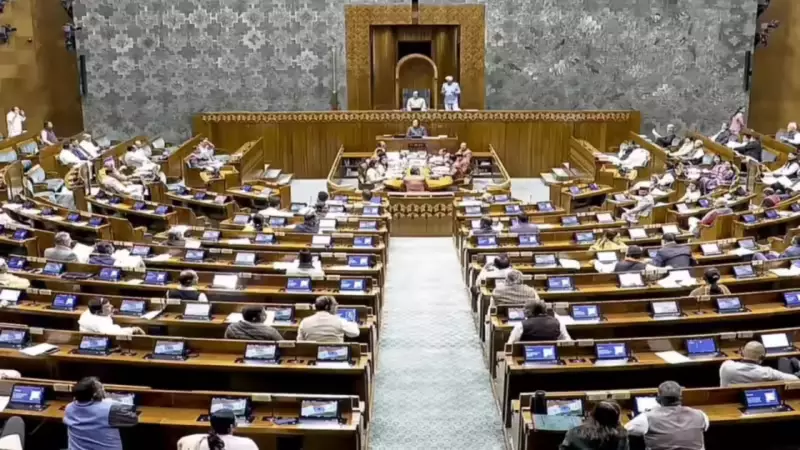
The Lok Sabha witnessed heated exchanges and repeated adjournments on Thursday as it passed the contentious Viksit Bharat Guarantee for Rozgar and Ajeevika Mission (Gramin) Bill. The legislation, which seeks to replace the two-decade-old Mahatma Gandhi National Rural Employment Guarantee Act (MGNREGA), was approved amid sustained protests from opposition members.
A New Rural Employment Guarantee
Moving the Bill for consideration and passage, Union Minister for Rural Development Shivraj Singh Chouhan stated that the new law would provide a statutory guarantee of 125 days of wage employment in a financial year to every rural household whose adult members volunteer for unskilled manual work. Chouhan emphasized that the Bill, often referred to as the VB-G RAM G Bill, aligns with Mahatma Gandhi's vision of self-reliant villages and aims to fuel comprehensive rural development and poverty eradication.
Opposition's Fierce Criticism and Protests
The opposition launched a sharp attack on the government for both repealing and renaming the landmark MGNREGA. Trinamool Congress MP Mahua Moitra accused the government of undermining Gandhi's legacy and "dishonouring" both Mahatma Gandhi and Rabindranath Tagore by removing Gandhi's name from the scheme. She argued that the Bill destroys the concept of 'Ram Rajya' in letter and spirit.

Congress MP Jai Prakash called the removal of the Father of the Nation's name "the biggest crime." He criticized the Bill as "anti-poor" and "anti-Dalit," claiming it would impose fresh financial burdens on states and strip grassroots institutions like gram sabhas of their decision-making powers regarding work selection.
Government's Defence and the Road Ahead
Defending the legislation, BJP MP Brijmohan Agarwal claimed the previous Congress-led government had reduced MGNREGA to a futile "dig the pit and cover the pit" scheme rife with corruption, failing to strengthen the rural economy. He asserted that the inclusion of "Ram" in the new law's framework would act as a deterrent to corrupt practices.
According to the provisions of the passed Bill, state governments will be required to frame their own schemes consistent with the new law within six months of it coming into force. The debate on the Bill was held on Wednesday, with Minister Chouhan replying on Thursday before the passage, as directed by Speaker Om Birla.
The passage marks a significant shift in India's rural employment policy, setting the stage for a new implementation model aimed at the stated goal of a 'Viksit Bharat' or Developed India, even as it continues to face strong political opposition.