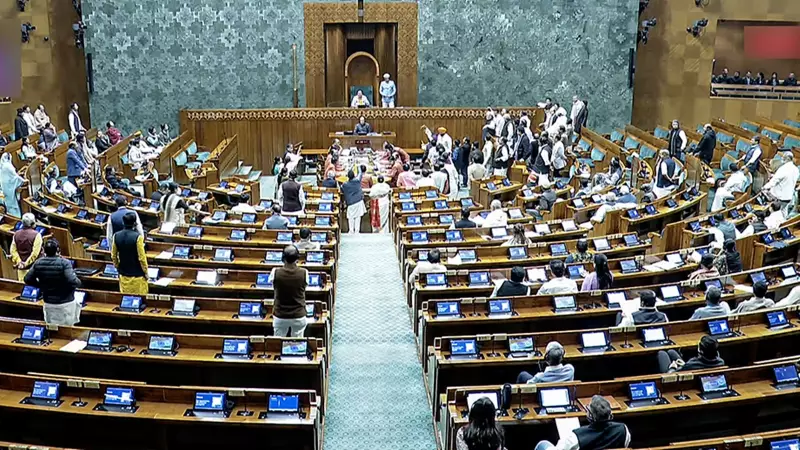
The Lok Sabha on Thursday passed a landmark bill to replace the Mahatma Gandhi National Rural Employment Guarantee Act (MGNREGA), a move that sparked intense protests and a heated debate over the future of India's rural job guarantee framework. The Viksit Bharat-Guarantee for Rozgar and Ajeevika Mission (Gramin) Bill, 2025 (VB-G RAM G) was approved by a voice vote, leading to the adjournment of the House for the day.
A Contentious Passage Amidst Protests
The bill's passage was anything but smooth. Opposition members vociferously protested, with some tearing papers in the well of the House. The introduction of the bill on Tuesday had already faced strong resistance, with demands for its withdrawal. The debate stretched for over eight hours on Wednesday, continuing past midnight until 1:30 am. On Thursday, Union Minister for Rural Development Shivraj Singh Chouhan delivered his reply amid constant sloganeering by opposition members chanting "MGNREGA."
Chouhan framed the debate in ideological terms, accusing the opposition of going against the teachings of Mahatma Gandhi. "I am bowing before the feet of Mahatma Gandhi," Chouhan declared, asserting that Gandhi was the government's inspiration. He pointed out that the original scheme was not named after Gandhi initially. "NREGA was first not named after Mahatma Gandhi. It was when the 2009 elections came that they remembered Bapu and added his name. But if someone implemented it properly, it was Prime Minister Narendra Modi," he stated, contrasting what he called opposition "drama" with the Modi government's work.

Key Changes: More Days, New Funding Formula
The new legislation brings significant structural changes to the rural employment scheme. The most prominent benefit is an increase in the number of days of guaranteed employment from 100 days to 125 days per household per year.
However, the funding pattern undergoes a major overhaul:
- Under MGNREGA: The Centre provided 100% of the wage costs and 75% of the material costs. States bore 25% of material costs, administrative expenses, unemployment allowance, and compensation.
- Under VB-G RAM G: The Centre will provide 60% of all costs, with states contributing the remaining 40%.
Furthermore, the Centre will decide a state-wise normative allocation each financial year. States will be required to bear any expenditure that exceeds this allocated amount. Chouhan defended this change, alleging corruption in the old system. "Some states spent 19-20 per cent on material... Did they not pocket the money?" he asked, arguing the new model would ensure greater transparency.
Political Fault Lines and Opposition's Critique
The opposition attacked the bill on multiple fronts. A primary point of contention was the removal of Mahatma Gandhi's name from the scheme. TMC's Mohua Moitra stated that renaming the scheme dishonored both Gandhi and Rabindranath Tagore, who first called him 'Mahatma'.
Congress MP Priyanka Gandhi argued that the bill "weakens the legal right of employment" and would strain state finances by reducing the Centre's share from 90% (under MGNREGA's funding model for wages and material) to 60%. "This will hit the finances of the state governments, especially those waiting for GST compensation," she warned. Congress leader Shashi Tharoor also opposed the financial restructuring, noting the shifted burden onto states.
DMK's Kanimozhi Karunanidhi said the bill failed to protect the legal right to work. In his reply, Chouhan countered by highlighting increased expenditure, claiming the Modi government spent about Rs 8.53 lakh crore on MGNREGA compared to about Rs 2.13 lakh crore under the UPA.
Chouhan outlined the broader vision for VB-G RAM G, stating its aim is a "developed India through developed villages." He said the scheme would focus on creating durable assets like reviving water tables, digging new ponds and wells, and building roads, schools, and playgrounds. The bill now awaits passage in the Rajya Sabha to become law, setting the stage for the next phase of India's rural employment policy.