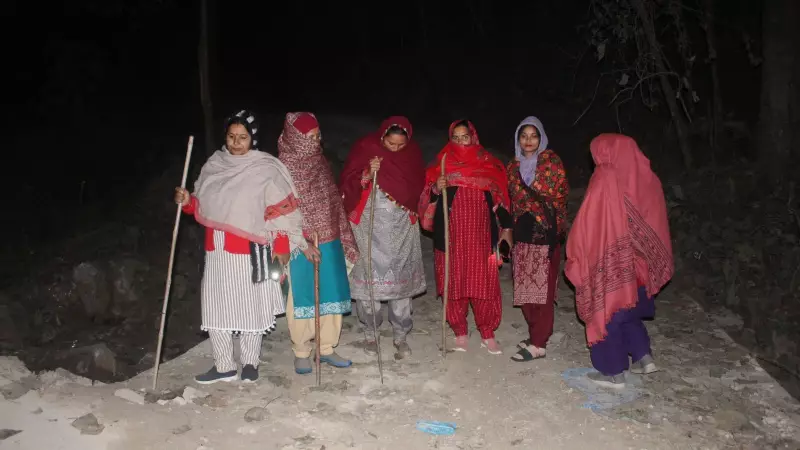
In Himachal Pradesh, the Mahatma Gandhi National Rural Employment Guarantee Act (MGNREGA) continues to be a crucial source of livelihood for women, especially those from the Scheduled Caste (SC) and Scheduled Tribe (ST) communities. Official data reveals that over 60% of the person-days generated under the scheme have consistently gone to these women beneficiaries over the past five years.
Steady Women Participation Amid Declining Budgets
Despite a significant reduction in central funds and labour budgets, the share of women in total MGNREGA workdays in Himachal has remained robust. The women's participation rate ranged from 61.05% in the financial year 2020-21 to 63.22% in 2025-26. This resilience is notable against a backdrop of shrinking resources.
The approved labour budget from the Government of India fell from Rs 330 lakh in 2020-21 to Rs 250 lakh in 2025-26. Correspondingly, the total central release plummeted from Rs 963.69 crore to Rs 756.13 crore over the same period. This financial contraction led to a sharp drop in total person-days generated, from 336.19 lakh to 170.05 lakh.

Currently, the state has 13.62 lakh active workers out of 28.31 lakh registered under MGNREGA. Of this active workforce, 26.53% belong to the SC category and 6.24% to the ST category.
Officials Raise Alarm Over New VB-G RAM G Scheme
A senior officer from the state's Rural Development and Panchayati Raj Department, which implements MGNREGA, expressed serious concerns about the newly introduced Viksit Bharat-Guarantee for Rozgar and Ajeevika Mission (Gramin) or VB-G RAM G. The officer warned that the shift to a normative allocation system could further reduce funds and adversely affect the scheme's implementation.
"Normative allocations may decline and adversely affect the implementation," the official stated. This system replaces the previous labour budget with fixed, principled limits set by a central authority, moving away from a demand-driven model.
Statutory Pause During Peak Seasons: A Major Hurdle
The officer highlighted a specific clause in the new framework as the biggest concern: a proposed statutory pause on MGNREGA works during peak agricultural seasons, including sowing and harvesting periods.
Explaining the state's unique constraints, the officer said, "In Himachal Pradesh, most developmental works, such as constructing small link roads and water tanks in rural areas, are only feasible between September-December and April-July. These windows overlap with agricultural seasons." The remaining months are challenging due to heavy monsoon rains, harsh winters, and snowfall.
The officer apprehended that the state's near 100% performance record under MGNREGA, with annual expenditure around Rs 1,000 crore, could see a reduction of up to 50% under the new VB-G RAM G framework.
Scheme Reach and Rising Costs
MGNREGA is implemented across Himachal's 12 districts, 91 development blocks, and 3,616 Gram Panchayats. A total of 15.39 lakh job cards have been issued, covering 28.37 lakh workers. Currently, 9.27 lakh job cards and 13.65 lakh workers are active.
Data also shows that the average cost per person per day under the scheme has increased from Rs 271.54 to Rs 329.11 over the past five years.
On Monday, Rural Development and Panchayati Raj Department Secretary C Paul Rasu participated in a virtual meeting with the Ministry of Home Affairs (MHA) to discuss the implementation of the new VB-G RAM G scheme in the state. Secretaries from other states also attended the meeting.
Despite its relatively small population, Himachal Pradesh has been recognized as one of the better-performing states under MGNREGA. However, the transition to the new scheme and its associated clauses now pose significant challenges to maintaining this record and supporting its primary beneficiaries—women from marginalized communities.