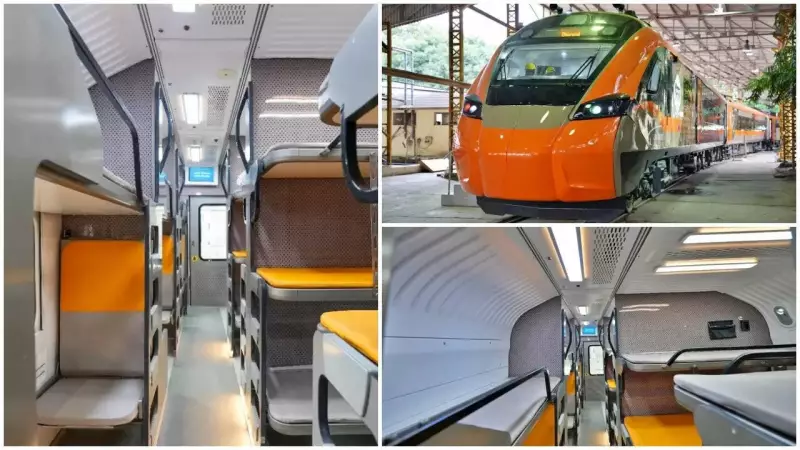
In a significant boost to rail infrastructure in Eastern India, Prime Minister Narendra Modi is set to flag off the country's inaugural Vande Bharat Sleeper train service. The high-speed overnight train will connect Guwahati in Assam with Howrah in West Bengal, with the launch expected in the third week of this month.
A Major Leap in Overnight Travel
The introduction of the Vande Bharat Sleeper variant marks a substantial upgrade for passengers undertaking long overnight journeys. The train is designed to operate at speeds of 120-130 kmph, which will slash the travel time between the two eastern capitals by more than three hours. Railway Minister Ashwini Vaishnaw revealed that the indigenously built train boasts a design speed of 180 kmph, promising a faster and more comfortable travel experience.
This launch comes just months before assembly elections are scheduled in both Assam and West Bengal. When questioned about the choice of route linking two poll-bound states, Minister Vaishnaw stated the decision aligns with the Prime Minister's focus on accelerating development in eastern and northeastern India, a vision encapsulated in the "purvodaya" scheme.

Features, Fares, and Future Plans
The railway ministry has shared comprehensive details about the new service and its passenger-centric features:
- Fixed Fare Structure: In a major reform, the train will introduce a fixed rate per kilometer, eliminating dynamic pricing. Fares are set at Rs 2.4, Rs 3.1, and Rs 3.8 per km for 3AC, 2AC, and 1AC classes, respectively.
- One-Way Ticket Cost: For the Guwahati-Howrah journey, this translates to approximately Rs 2,300 for 3AC, Rs 3,000 for 2AC, and Rs 3,600 for 1AC.
- Regional Cuisine: Enhancing the passenger experience, the train will offer Assamese cuisine for journeys originating from Guwahati and Bengali food for those starting from Kolkata.
- Advanced Comfort: Vaishnaw emphasized that the riding comfort rivals the best global trains, and the advanced AC system maintains adequate oxygen levels to prevent passenger discomfort.
The service will run six days a week. Looking ahead, the minister announced an ambitious rollout plan: eight more such sleeper trains for routes spanning 1,200-1,500 km will be introduced in the next six months, with the total reaching 12 by December. Production is expected to ramp up rapidly from next year once the entire supply chain is firmly in place.
Broader Railway Reforms and Infrastructure Push
Minister Vaishnaw positioned this launch as part of a series of transformative reforms planned for Indian Railways, with more significant changes anticipated by 2026. He also provided updates on critical infrastructure projects aimed at boosting speed and safety:
- Progress on track fencing.
- Upgradation of approximately 79% of the network.
- Enhancements to the Over Head Equipment (OHE), which is crucial for supplying power to electric trains at higher speeds.
With this infrastructure expansion, railways are hopeful of increasing train frequency and, ambitiously, eliminating waitlisted tickets in certain sectors within the next 2-3 years. The launch of the Vande Bharat Sleeper train is thus not just a new service, but a symbol of a broader modernization drive aimed at revolutionizing long-distance rail travel in India.