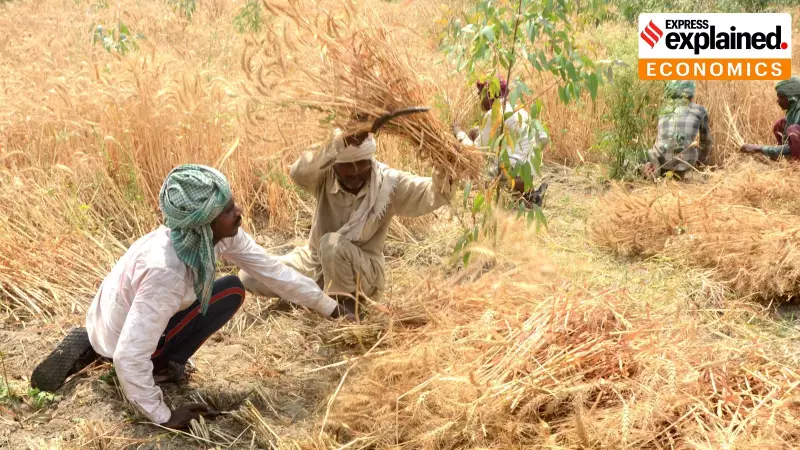
The newly introduced Viksit Bharat-Guarantee for Rozgar and Ajeevika Mission Gramin (VB-G RAM G) Bill has ignited a fresh debate on the relationship between rural employment schemes and agricultural labour availability. Central to the proposed legislation is a provision allowing state governments to halt rural work projects for up to 60 days during the peak sowing and harvesting seasons. This move, aimed at ensuring adequate farm labour, revives a long-standing criticism levelled against the Mahatma Gandhi National Rural Employment Guarantee Act (MGNREGA) – that it drains workers from farms.
The Core Debate: Policy Response to Perceived Shortage
The VB-G RAM G Bill, tabled in Parliament on Tuesday, seeks to replace the 2005 MGNREGA law. Its proposed seasonal pause directly addresses concerns that schemes like MGNREGA create labour scarcity in agriculture, a view famously held by former Union Agriculture Minister Sharad Pawar. During the UPA era, Pawar had even written to the then Prime Minister Manmohan Singh advocating for a three-month halt to MGNREGA during busy farming periods. The new bill settles for a two-month break.
This policy intervention is predicated on the assumption that guaranteed government work pulls labour away from farms, driving up wages and disrupting agricultural cycles. However, a decade's worth of wage data and employment trends suggests the reality is more nuanced.

What the Numbers Say: A Story of Tepid Wage Growth
If MGNREGA had significantly tightened the rural labour market, one would expect a substantial and sustained rise in rural wages. Data from the Labour Bureau, tracking daily wage rates across 25 occupations in 600 villages, tells a different story.
Over the ten years ending 2024-25, the year-on-year growth in all-India average rural wages for male workers fluctuated between a modest 3.6% and 6.4%. Crucially, in four out of those ten years – 2015-16, 2019-20, 2021-22, and 2022-23 – nominal wage growth failed to keep pace with consumer price inflation, meaning real wages actually fell. In the years where real wages did grow, the increase exceeded 1% only once, in 2017-18.
Interestingly, wages for specifically agricultural work (covering 12 defined occupations like ploughing, sowing, and harvesting) grew faster than overall rural wages for eight of the ten years. Yet, even this growth largely matched inflation, failing to indicate a dramatic wage surge driven by labour shortage.
The Silent Game-Changer: Rising Female Workforce Participation
One powerful factor potentially offsetting any labour drain from farms is the historic rise in women joining the rural labour force. The Labour Force Participation Rate (LFPR) for rural women – the percentage of those aged 15+ working or seeking work – has climbed sharply from 24.6% in 2017-18 to 47.6% in 2023-24, as per Periodic Labour Force Survey data.
This transformation has been attributed to flagship government schemes like Ujjwala (LPG connections), Har Ghar Jal (piped water), and Saubhagya (electricity). By reducing the time women spend on gruelling household chores like collecting firewood and fetching water, these initiatives have freed them up to seek employment outside the home, often in farm-related activities near their villages.
Economists describe this as a "rightward shift of the labour supply curve" – essentially, more people entering the workforce willing to work. This increased supply has likely exerted a downward pressure on rural wages, counteracting any upward pressure from MGNREGA.
Conclusion: A Complex Picture Beyond Simple Causation
The evidence for MGNREGA causing an acute, widespread farm labour shortage appears weak when viewed through wage trends and LFPR data. The influx of rural women into the workforce may have effectively replenished the agricultural labour pool. While farmers' complaints about timely labour availability for specific tasks like paddy transplanting or cotton picking are valid, pinning the blame solely on MGNREGA may be an oversimplification.

The proposed 60-day pause in the VB-G RAM G Bill is a significant policy shift aimed at addressing perceived market friction. However, its necessity based on MGNREGA's impact requires more robust, ground-level evidence, considering the complex interplay of wage dynamics, social welfare, and a rapidly changing rural labour force dominated by women's entry.