Delhi Joins Central E-Bus Payment Security Scheme, Receives ₹500 Crore Boost
In a significant development for India's clean mobility ambitions, the national capital Delhi has been officially included in the PM e-Bus Sewa-Payment Security Mechanism (PSM) Scheme. This initiative, which has already onboarded 15 Indian states, aims to accelerate the deployment of 38,000 electric buses across the country.
The Centre has released the first tranche of ₹500 crore for the ₹3,435.33-crore scheme, according to government officials familiar with the matter. This financial injection is designed to provide payment security in case public transport authorities default on payments to e-bus bidders, operators, or original equipment manufacturers.
Resolving Delhi's E-Bus Implementation Hurdles
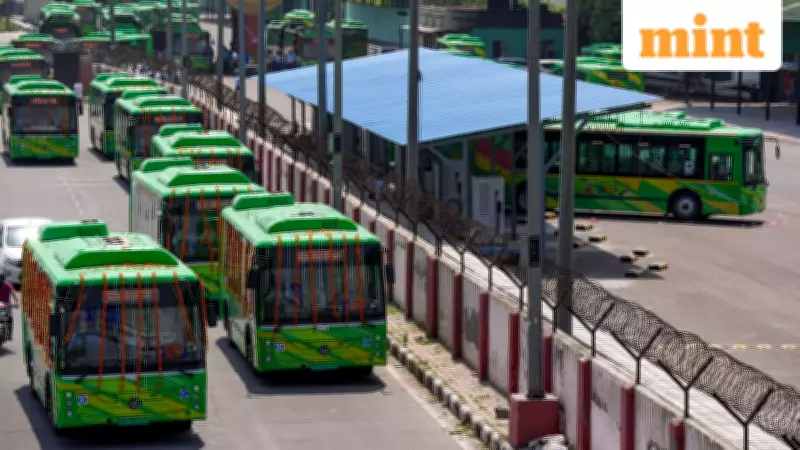
The inclusion of Delhi comes after previous delays in implementing the city's allocation of 2,800 e-buses under the ₹10,900 crore PM Electric Drive Revolution in Innovative Vehicle Enhancement (PM E-Drive) Scheme. These buses were in limbo as the Delhi government had not completed the process of obtaining a direct debit mandate (DDM) with the Reserve Bank of India.

The DDM serves as a crucial payment security mechanism, allowing the central bank to automatically deduct funds from a state's account to ensure timely payments to bus manufacturers. "They (Delhi government) have completed the procedure now," said one government official, noting that a separate fund was created under the 1993 Delhi Act specifically for the PSM fund.
The Delhi government completed the onboarding procedure by registering a DDM with the RBI in January 2026, according to a second official. In essence, if a public transport authority is unable to pay bus makers or operators, the PSM would be used instead to ensure routine payments, with the state government later replenishing the PSM fund.
Addressing Cost Barriers in Electric Bus Adoption
The PSM Scheme plays a vital role in the Centre's ambition to electrify public transportation by lowering procurement costs. Electric buses are more than twice as expensive as their diesel counterparts, with each e-bus costing approximately ₹1-1.25 crore. This high price depends significantly on global electric vehicle battery prices, which constitute at least one-third of the total cost. In comparison, a standard diesel bus costs about ₹25-50 lakh.
"One of the major issues with private sector participation in public transport operations is the surety of payment," explained Amit Bhatt, India managing director at global think tank International Council on Clean Transportation (ICCT). "This becomes even more important with electric buses, as their capital costs are higher. A payment security mechanism is one such measure that provides comfort to the private party by reducing financial risk."
Bhatt added that this step would help deploy more e-buses in the national capital, which has emerged as a preferred destination for e-bus deployment. Data from the Vahan portal reveals that between 2023 and 2025, Delhi recorded the highest sales of e-buses in the country at 3,539 units, followed by Maharashtra with 2,777 units, and Karnataka with 1,562 units.
India's Electric Bus Landscape and Global Comparisons
India's electric bus fleet has been steadily growing, rising from roughly 1,170 units sold in 2021 to more than 4,400 in 2025. Despite this progress, the country's public transport electrification continues to lag behind that of China and the European Union.
In August 2025, Niti Aayog highlighted the slow pace of electric vehicle adoption across various segments, including buses. The government's leading policy think tank noted in its report that the country's e-bus penetration stood at just 7% in 2023, significantly lower than the European Union's 14% and China's 50%.
The reality remains that e-bus sales in 2025 represented only a small share of overall bus sales in India, where diesel models continued to dominate. Approximately 4,400 e-buses were sold in 2025, compared to more than 66,000 diesel buses during the same period, resulting in an e-bus penetration rate of about 6.5%.

India's efforts to increase electric vehicle adoption are crucial to meeting the country's net-zero emissions target of 2070, as vehicular emissions remain one of the largest contributors to greenhouse gas and air pollutant emissions. The inclusion of Delhi in the payment security scheme represents a significant step forward in addressing the financial barriers that have slowed the transition to cleaner public transportation.