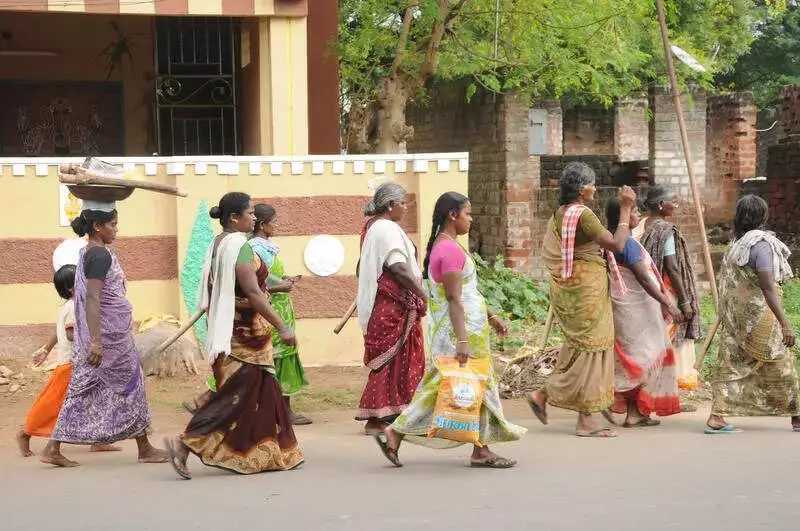
Long before the Mahatma Gandhi National Rural Employment Guarantee Act (MGNREGA) became synonymous with rural job security in India, its foundational model was being meticulously crafted in the erstwhile united state of Andhra Pradesh. As the central government proposes the new Viksit Bharat Guarantee for Rozgar and Ajeevika Mission (Gramin) Bill, 2025, to replace the landmark law, it's crucial to remember the state-level experiment that created a national template.
The Andhra Pradesh Genesis of a National Scheme
Few beyond policy corridors are aware that the comprehensive operational manual used by the Government of India to implement MGNREGA nationwide was directly adapted from Andhra Pradesh's execution framework. The state's systematic and detailed approach provided the blueprint that the Union government later adopted across the country.
The story begins in the mid-2000s. Following the formal notification of the NREGS Act and its rules on October 2, 2005, the united Andhra Pradesh cabinet, under the leadership of the late Chief Minister YS Rajasekhara Reddy, moved swiftly. The state resolved to be the first in India to roll out the ambitious scheme. True to its word, Andhra Pradesh officially launched the programme on February 2, 2006, setting a benchmark for others to follow.

Building the Implementation Framework
To ensure the law translated effectively into action on the ground, the state government formed a dedicated cabinet subcommittee. This group included then Agriculture Minister N Raghuveera Reddy and Rural Development Minister JC Diwakar Reddy. They were supported by a team of seasoned IAS officers, many of whom are now retired and hail from both present-day Telangana and Andhra Pradesh.
This team worked intensively to bridge the gap between legislation and practical application. Their collective efforts resulted in the creation of a comprehensive manual. This critical document merged the cabinet's directives with the central Act's guidelines, mapping every step—from organising fieldwork and generating employment to monitoring progress and evaluating outcomes.
Akunuri Murali, current Chairperson of the Telangana Education Commission and a former bureaucrat involved in the process, recalled, "We created the first model that the Centre subsequently adopted, leading to the release of a national manual." Another key architect was former IAS officer K Raju, who now oversees pradesh affairs for the Jharkhand Congress.
The National Launch and a Symbolic First
The national rollout followed swiftly. In February 2006, then Prime Minister Dr. Manmohan Singh formally inaugurated MGNREGS from Bandlapalli, a remote village in the Narpala mandal of Anantapur district in united Andhra Pradesh. This historic event was marked by a powerful symbol: Cheemala Pedakka, a Dalit widow supporting two children, became the nation's first job card holder.
Her enrollment embodied the promise of a scheme designed to transform rural livelihoods. From this Andhra Pradesh village, MGNREGA expanded to become the backbone of rural employment and a critical social safety net across India, touching millions of lives. The state's pioneering work in systematising its implementation remains a testament to how regional innovation can successfully shape national policy.