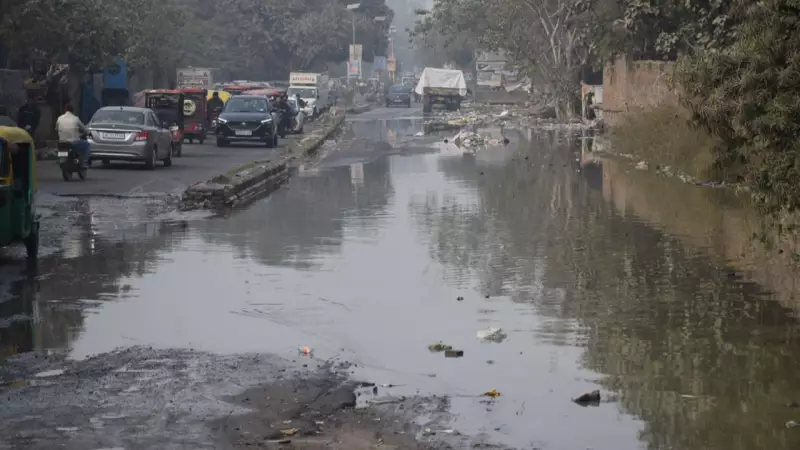
NEW DELHI: Winter has arrived, the monsoon is a distant memory, and the Yamuna has receded to its seasonal flow. Yet, in the heart of Shaheen Bagh, a vital connecting road remains treacherously submerged under a blanket of dark, stagnant water, turning daily life into an obstacle course for thousands.
A Daily Battle for Basic Mobility
In the neighbourhood that rose to national prominence during the Anti-CAA protests, a stretch over 100 metres long near Okhla's N Block now functions as a dangerous, open manhole. The water, carrying plastic waste, food debris, and an oily film, has invisibly merged with overflowing drains. "Several vehicles have broken down here in the past few weeks," reported Shahzad Ali Idrisi, a local resident. He highlighted the peril for smaller vehicles and pedestrians, noting, "E-rickshaws have fallen into open drains. People have been injured. Accidents are waiting to happen."
Auto-rickshaw and e-rickshaw drivers often refuse to ply the stretch or demand extra fare. Pedestrians, like student Rida from Abul Fazal, tread with fear. "I fear slipping every day. The water is filthy. If someone falls, who will take responsibility?" she questions. The road is now passable only for SUVs and trucks, forcing others to take long detours or risk damage to their vehicles.

Health Hazards and a Threat to the Dead
The consequences extend far beyond inconvenience. For local families, the perpetual waterlogging has triggered persistent health issues. Children suffer from itching, rashes, fever, and recurring stomach infections. Shazia Khan, a mother from N Block, lamented the ordeal her children face. "Their clothes get soaked. Their shoes are ruined. And there is the constant fear of infection," she said, emphasizing that this is "saal bhar ka paani" (year-round water), not just monsoon residue.
The crisis also looms over the adjacent Gore Ghabiran Muslim graveyard. Caretaker Mufti Abdul Raziq warned that water is accumulating against the boundary wall, risking collapse. "If the wall collapses again, graves could be damaged. This is not just a road problem," he stated. He added that funeral processions are frequently disrupted as mourners cannot wade through the impure water without breaking their ritual ablution (wudhu). A section of the wall had collapsed two years ago, requiring lakhs in community-funded repairs.
Political Blame Game and Civic Apathy
Despite complaints to the Municipal Corporation of Delhi (MCD) and the local police station, a lasting solution remains elusive. The civic body points to jurisdictional tangles. Ram Raj Meena, Executive Engineer (Maintenance) of MCD's Central Zone, explained that the drain connects to the Jasola drain, which falls under Uttar Pradesh's irrigation department. He added that since Shaheen Bagh is an "unauthorised area," the matter was referred to the Delhi Government's Irrigation and Flood Control Department.
Meanwhile, a political blame game ensues. Former Congress MLA Asif Muhammad Khan and local councillor Ariba Khan have accused sitting AAP MLA Amanatullah Khan of flawed sewer planning, alleging excess water from the Okhla tank was diverted into a drain not designed for such load. In response, AAP MLA Amanatullah Khan said a long-term solution involving a new pipeline is pending and work will restart after Delhi's severe pollution-related restrictions (GRAP IV) are lifted.
Frustrated by the inaction, residents took matters into their own hands this past August, pooling ₹50,000 to hire private workers to clean the choked sewer. Mohammad Anis, part of the effort, summed up the community's plight: "Residents pay twice. Once by wading through flooded neighbourhoods. Then from our own pockets."
The stark irony is palpable for residents like Manzoor Ahmed. "The same area that once hosted lakhs in a disciplined, self-organised protest now struggles to secure something as basic as a passable road," he reflected. As authorities exchange letters and blame, the people of Shaheen Bagh continue to pay a daily price in risk, indignity, and broken promises.