

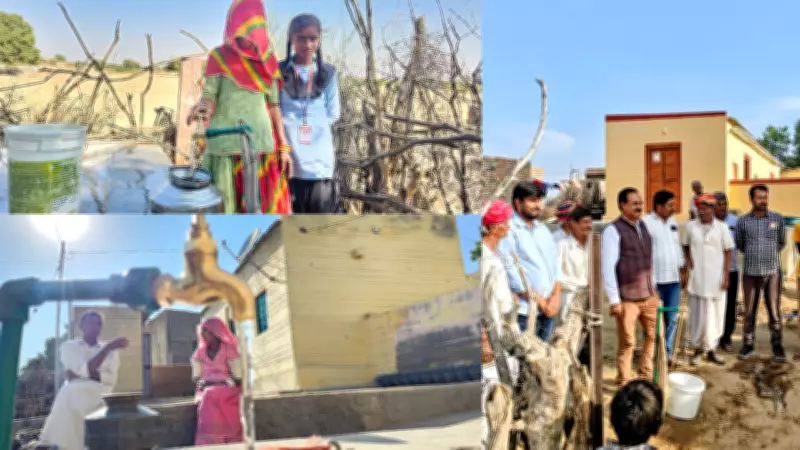
Historic Water Milestone Achieved in Rajasthan's Remote Border Village
In a landmark development for Rajasthan's arid regions, water from the Narmada canal has finally reached Sundra—the last border village in Barmer district—after an epic 728-kilometer journey from its source in the Amarkantak hills of Madhya Pradesh. This achievement has brought immense joy and relief to residents who have endured water scarcity for generations.
Transformation of a Desert Community
Sundra, located along the India-Pakistan international border in Rajasthan's Barmer district, has witnessed what locals describe as a historic transformation. For the first time since Independence, clean and potable drinking water now flows through taps in every household of this remote desert village.
This development represents not merely the arrival of water, but a decisive victory over decades of hardship and the dawn of new hope for the community. The reliable water supply is expected to dramatically improve the quality of life for villagers who have struggled with water scarcity throughout their lives.

Centuries of Struggle Against Desert Conditions
Local resident Ugam Sodha explained that Sundra, established in 1734, was once considered one of the largest gram panchayats in India by area, covering approximately 1,345 square kilometers. Life in this village has always been shaped by the harsh desert environment.
Located about 170 kilometers from Barmer district headquarters, residents faced tremendous challenges accessing drinking water for years. The groundwater proved so saline that even animals avoided it. Government-installed tubewells repeatedly failed, forcing people to travel 15-20 kilometers to neighboring villages to fetch water.
Another villager, Derawar Singh, recalled additional hardships during the 1965 and 1971 India-Pakistan wars when the entire village had to be evacuated, compounding their existing struggles.
Health Impacts and Daily Burdens
The daily struggle for water created significant health issues and prompted migration from the area. Saline water consumption led to yellowing of teeth, weakened bones, and premature aging among residents. Women bore particular burdens, spending hours each day traveling long distances to collect water for their families.
Local resident Lalu Singh described the Narmada water arrival as a historic achievement after years of struggle and waiting. Previously, people had no alternative but to rely on fluoride-rich, saline water from wells after tubewells and other official arrangements proved inadequate.
Engineering Marvel Overcomes Multiple Challenges
Sonaram Beniwal, Superintending Engineer of the Public Health Engineering Department (PHED) Project Circle in Chohtan (Barmer), explained that the Narmada canal-based drinking water project has resolved the region's most significant challenge—access to safe drinking water. Starting from the Sardar Sarovar Dam, the water has traveled 728 kilometers to reach Sundra.
The ambitious project aims to supply water to more than 200 villages across the region. To accomplish this, engineers constructed 16 large water storage reservoirs, several pumping stations, and over 80 elevated service reservoirs. Despite formidable challenges including laying pipelines across shifting sand dunes, electricity shortages, and security restrictions in the sensitive border area, the project was successfully completed.
A New Era for Sundra Residents
For the people of Sundra, this transformation carries profound significance. Many elderly residents are seeing tap water in their homes for the very first time in their lives. Women, in particular, have been liberated from the daily burden of traveling long distances to fetch water, freeing up time for other activities and improving family wellbeing.
The arrival of tap water in Sundra symbolizes development, dignity, and dramatically improved quality of life. This achievement demonstrates that meaningful transformation is possible even in the most challenging geographical regions when determined efforts are made to address fundamental human needs.






