Nagpur: The ambitious Nagpur Smart City 2.0 project has been thrown into uncertainty after the state government dissolved the Special Purpose Vehicle (SPV) responsible for its execution. This decision has left the next phase without a clear framework, even as the existing smart infrastructure grapples with widespread failures.
SPV Dissolution Derails Key Planning
The winding up of the Nagpur Smart and Sustainable City Development Corporation Ltd (NSSCDCL) has effectively halted critical components of Smart City 2.0. The proposed Detailed Project Report (DPR) and the appointment of a Project Management Unit (PMU) have been shelved, creating a policy and execution vacuum at a crucial time.
Existing Infrastructure in Disrepair
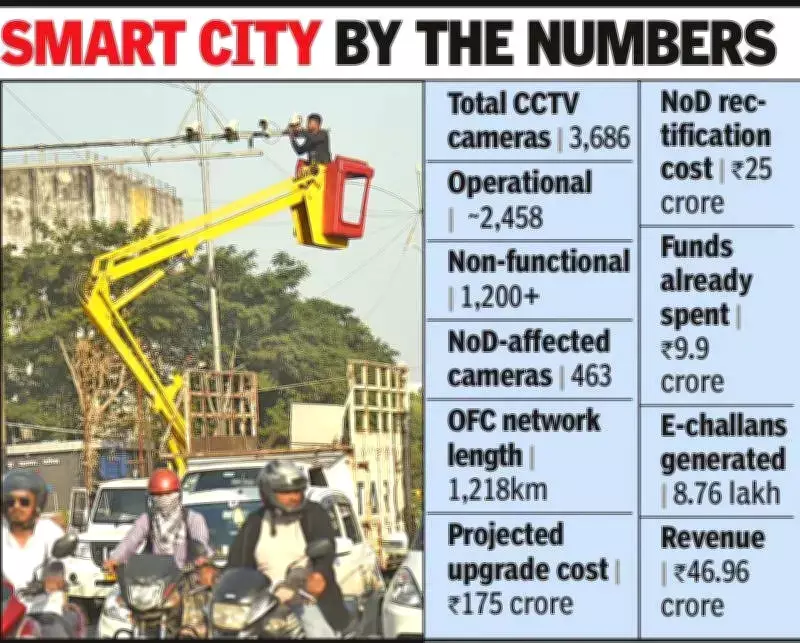
Meanwhile, the city's current smart infrastructure is faltering. Nagpur's surveillance network, once hailed as a cornerstone of urban policing, is experiencing widespread breakdowns. Out of 3,686 installed cameras, only about 2,458 are operational. Over 1,200 cameras are non-functional, including 463 affected by 'Notification of Disturbance' (NoD), largely due to frequent optic fibre cuts and hardware failures caused by poor coordination during road excavation.

Optic Fibre Network Weakness
The 1,218-kilometre optic fibre cable (OFC) network, designed as the digital backbone, has become a major weak point. Frequent damage and delays in restoration have disrupted real-time monitoring, directly impacting traffic rule enforcement and crime detection.
Costly Remediation Efforts
To address the crisis, Rs 175 crore has been sought for expanding the Smart City CCTV network, including Rs 25 crore for NoD rectification. An additional Rs 9.9 crore has already been spent. Despite escalating costs, system reliability remains inconsistent.
Expertise Gap and Project Delays
Officials acknowledge that operations of the Integrated Command and Control Centre (ICCC), data centre infrastructure, and OFC network require specialised expertise. This critical knowledge currently rests with the existing technical team, which has repeatedly stepped in to restore services during breakdowns.
Delays in key projects highlight execution gaps. The Rs 197 crore Integrated Intelligent Traffic Management System (IITMS), implemented by NMC, missed its February 14, 2026 deadline. Work has been completed at only 39 of 171 junctions, with just 10 signals fully functional. Implementing agency KELTRON has sought an extension, pending approval.
Past Utility vs. Present Strain
Despite setbacks, past data reflects the system's utility. Between 2019 and 2023, over 6,014 cases were reviewed at the City Operation Centre, with 2,133 CCTV footage used in legal proceedings. The system generated 8.76 lakh e-challans worth Rs 47 crore. However, with nearly one-third of cameras down and core infrastructure unstable, its reliability is under serious strain.
Expansion Without Stabilisation
Even as fresh tenders are floated to expand surveillance in Mahal and Reshimbagh, the contrast is stark: expansion without stabilisation, and ambition without a roadmap. With no SPV, no DPR, and no PMU in place, Nagpur's Smart City 2.0 faces its biggest challenge: rebuilding both broken systems and missing governance framework.

Smart City by the Numbers
- Total CCTV cameras: 3,686
- Operational: ~2,458
- Non-functional: 1,200+
- NoD-affected cameras: 463
- OFC network length: 1,218 km
- Projected upgrade cost: Rs 175 crore
- NoD rectification cost: Rs 25 crore
- Funds already spent: Rs 9.9 crore
- E-challans generated: 8.76 lakh
- Revenue: Rs 46.96 crore