As Mumbai prepares for the crucial Brihanmumbai Municipal Corporation (BMC) elections in January, the city's chronic pedestrian woes have taken center stage. A ground report reveals a stark contrast between crowded, unusable footpaths and civic promises for better walking infrastructure, with citizens demanding concrete plans to make their daily commute safer.
The Daily Struggle: Encroachments Force Walkers Onto Roads
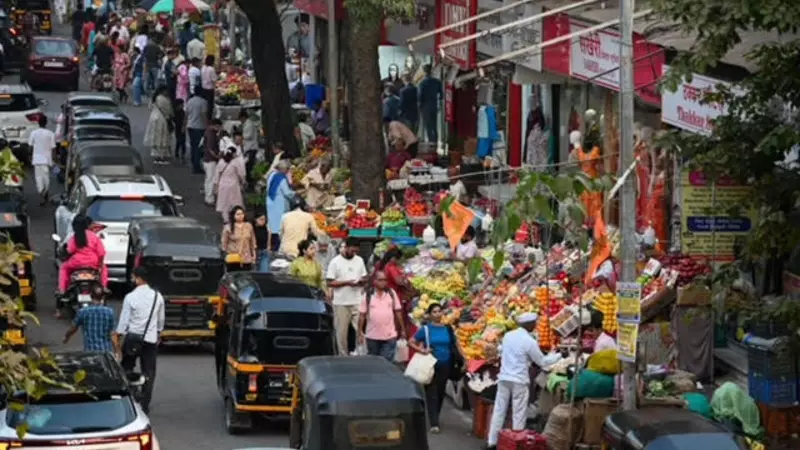
The scene outside Dadar's bustling railway station is emblematic of the city-wide crisis. On Chhabildas Road, footpaths are monopolized by vendors selling goods from bags to fruits, while garbage piles up from adjacent shops. This leaves no space for the thousands who disembark from trains, forcing them to navigate a heavy flow of vehicles directly on the road.
This chaotic experience is far from unique. According to the BMC's own Comprehensive Mobility Plan (CMP) for Greater Mumbai, a staggering 51 per cent of all trips in the city are made on foot. Despite this overwhelming reliance on walking, the lack of adequate and accessible pedestrian infrastructure remains the most significant grievance among Mumbaikars. The problem has been exacerbated in recent years as large-scale infrastructure projects consume existing public spaces.

The Bombay High Court earlier this year took serious note of this issue, pulling up civic authorities and traffic police for unlawful parking and encroachments that make pedestrians' lives miserable.
From Colonial Planning to Modern Neglect
Mumbai's relationship with footpaths has a long history. The city boasts about 4,000 kilometres of footpaths, with origins tracing back to the 1880s. The first dedicated walking spaces were laid in the Fort area, following European models. Urban expert Pankaj Joshi of Urban Centre Mumbai notes that in colonial times, 80-85% of trips were on foot, leading the British administration to dedicate significant space for pedestrians.
Planned neighbourhoods extended northwards through schemes like Dadar Matunga Sion between the 1910s and 1930s, and later in suburbs like Bandra, Khar, and Andheri. These areas initially featured wide footpaths. However, Joshi points out that the emphasis on pedestrian infrastructure began to weaken post-1960s. "After the 1960s, the footpaths started becoming narrower. This worsened further in the 1980s and 1990s," he states, adding that suburbs now bear the brunt of this decades-long shift.
What Ails Mumbai's Footpaths?
A global study by Compare the Market this year ranked Mumbai among the world's 10 least walkable cities, alongside Johannesburg and Manila. For residents, encroachments are the primary obstacle. The BMC's 2016 CMP identified permanent structures, haphazard parking, and lack of designated hawking zones as key factors discouraging footpath use.
Vedant Mhatre of the Walking Project, an organization mapping the city's footpaths, echoes this. "Hawkers and parked vehicles occupy walking space significantly," he says, lamenting the failure to implement policies like the Street Vendors Act. He also flags poor quality control, where newly developed footpaths deteriorate within a year, calling for dedicated expenditure on proper street design.
Architects highlight a lack of uniformity, with surfaces changing every 50-100 metres. Despite Indian Road Congress standards, on-ground implementation faces challenges from housing societies and legacy structures. Alarmingly, walkability remains a low budget priority. Less than 1% of the projected budget in the city's Traffic and Transport Infrastructure Plan up to 2034 is earmarked for foot overbridges, subways, and cycle tracks.
Promises and Pilot Projects: Will This Time Be Different?
Responding to growing demands, the BMC, in its 2025-26 budget, earmarked Rs 100 crore for its "Pedestrian First" plan. In November, it floated tenders to remodel 16.5 km of footpaths across 14 high-footfall locations as a pilot project, aligning with a Universal Footpath Policy. The upgrades promise paving around trees, benches, and encroachment removal.

Localized projects are also underway, like beautifying five internal streets in Kala Ghoda with an aim to make them pedestrian-only. However, this is not the first such initiative. A 2016 Pedestrian First policy and a 2017 circular to ward officers had similar goals, with limited lasting impact.
Citizens' Demand: Make Walkability an Election Issue
Ahead of the civic polls, citizens are insisting that pedestrian infrastructure be treated as a priority. Mandeep Singh Makkar of the Chandivali Citizens Welfare Association states the policy exists only on paper. "Day by day, the quality of walkability is only deteriorating," he says, calling it their number one demand as it requires law enforcement, not massive funding.
In South Mumbai's A ward, which handles a massive floating population through Churchgate and CSMT stations, Atul Kumar of the Nariman Point Churchgate Citizens Association stresses the need for special attention. He emphasizes implementing policies like the Town Vending Committee to balance walkability with hawkers' commercial needs.
Architect Pankaj Joshi argues that "designing and implementing engineered footpaths should be incorporated into the manifestos of all political parties," noting it can be done for a fraction of the cost of mega-projects. Vedant Mhatre agrees, calling footpath development a low-hanging fruit that caters to the masses without huge investment.
As Mumbai stands at a civic crossroads, the question remains whether the election season will finally translate into safe, walkable paths for the millions who navigate the city on foot every day.