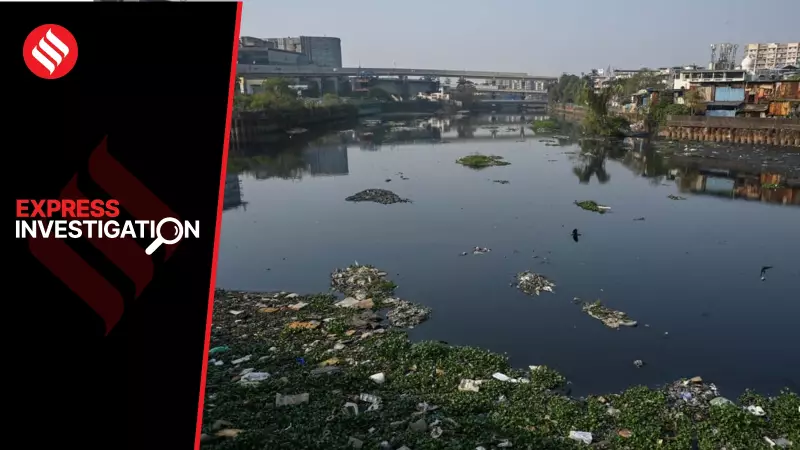
Mumbai's Mithi River: A Toxic Legacy Ahead of BMC Polls
Mumbai votes tomorrow in the long-delayed Brihanmumbai Municipal Corporation elections. Today, the Mithi River presents a stark picture of toxic flow, stalled projects, and crores sitting idle. The 2005 deluge killed over 1,000 people. Since then, official delay and inaction continue to choke Mumbai's largest river.
Water Quality Deteriorates Sharply
The Mithi River's water quality has worsened significantly. Persistent sewage contamination and rampant pollution plague the waterway. Records obtained under the Right to Information Act reveal troubling details.
Water Quality Index data from the past twelve months shows cold comfort. The river fell under "Bad to Very Bad" categories for 65 months. It registered as "Bad" for at least 16 months. The WQI dropped from 41.03 units in May 2008 to 27.60 in May 2024. Any reading below 38 indicates heavy pollution.

This index analyzes parameters like pH levels, dissolved oxygen, faecal coliform, and biochemical oxygen demand. BOD measures dissolved oxygen consumed by microorganisms decomposing organic matter. A river is polluted if it fails the BOD criteria of 3 mg per litre. Mithi's average levels between 2009 and May 2025 remained high, reaching 108 mg per litre.
Faecal coliform levels rose 2.5 times between 2009 and 2024. They increased from 1262.5 units per ml to 3199.17. In 2023, the river recorded 5,40,000 units per 100 ml. This figure is 216 times the permissible limit set by the Central Pollution Control Board.
Projects Stalled, Funds Unspent
The administration struggles with the daunting task of cleaning the Mithi River after the 2005 floods. The BMC spent Rs 881.14 crore from 2007 to 2020 on flood mitigation measures. These included widening, building retaining walls and drainage lines, and installing sewage interceptors. An additional Rs 415.68 crore went toward desilting between 2007 and 2025.
Yet the target remains challenging. Untreated sewage of 309 million litres per day continues entering the river. Two major initiatives face significant delays.
The Mithi River Quality Improvement and Pollution Control Project has completed only one of four packages. The most crucial package, pegged at Rs 1,700 crore, involves measures like floodgates at 18 spots. It was awarded only in November 2025, eight years after project initiation in 2017.
The Mithi River Rejuvenation Project shows zero expenditure because there has been zero execution. A Rs 35.87 crore consultancy study was commissioned in 2022. Records show Rs 3,941 crore allocated for the river quality project remains unspent. Another Rs 2,437 crore under the "Rejuvenation of Rivers" head also sits idle.
Package Delays Highlight Execution Gaps
Nothing illustrates the gap between intent and execution better than the four packages under the flagship project. Consider their status:
- Package 1, completed: 8 MLD sewage treatment plant, service road, sewer line. Sewage tapped: 8 MLD. Started in 2018, completed December 2022.
- Package 2, delayed: Pending work 2007-2017, retaining walls, 10-km sewage network. Sewage tapped: 96 MLD. Work started 2021 with initial deadline December 2023, now pushed to March 2027.
- Package 3, stalled: Gate pumps at 18 outfalls, tap sewage network across 5.9 km. Sewage to be tapped: 37 MLD. Letter of Approval issued only in December 2025 to a Special Purpose Vehicle.
- Package 4, delayed: 6.8-km-long tunnel to intercept and divert sewer. Sewage tapped: 168 MLD. Work started January 2021 with deadline September 2025; revised to December 2026.
For the rejuvenation project, consultants prepared plans and submitted initial concepts in October 2022. They submitted revised plans in May 2024. Yet the final conceptual plan remains under administrative review.
River's Path and Pollution Sources
The Mithi River originates from the overflow of Vihar and Powai lakes. It snakes through Andheri and BKC before draining into the Arabian Sea through Mahim creek. The river is among only three in India listed by the CPCB as contaminated sites.

Of its total length, 6 km lies under the Mumbai Metropolitan Region Development Authority. The remaining 11 km falls under BMC jurisdiction. A senior BMC official, speaking anonymously, acknowledged the river receives 309 MLD of untreated sewage through multiple outfalls. Industrial effluents from unauthorized units in pockets like Dharavi add to the pollution.
Past efforts focused mainly on flood control. The ongoing pollution-control project aims to intercept and treat the entire 308 MLD through phased work. The first phase, treating 8 MLD, has been completed. Subsequent phases will treat 96 MLD over a 10-km stretch, 37 MLD along 5.9 km between CST Bridge and Mahim Causeway, and the remaining 168 MLD.
Some Improvements, But More Needed
Experts acknowledge certain improvements. Dr Rakesh Kumar, former director of the National Environmental Engineering Research Institute, notes desilting work has increased the river's holding capacity. It can now hold greater water volume, reducing flooding chances during high tide.
"Earlier, there were no channels for water to flow out, but with widening and drain-related work, conditions have certainly improved," Kumar said. Tuhin Banerji, a former NEERI scientist, agrees measures like desilting and retaining walls have helped. But he stresses they are insufficient alone.
"The administration needs to focus on treating wastewater entering the river through the drains lining it. This treatment should be carried out in a decentralised manner, at the point of origin of these drains," Banerji emphasized.
The BMC has increased annual desilting allocations based on committee recommendations. Costs averaged Rs 20-30 crore from 2006 to 2020 but spiked to Rs 62.20 crore in 2023-24. The sharp increase is now under Enforcement Directorate probe. The amount allocated for 2025-26 is Rs 90 crore.
Human Cost and Health Risks
The human cost remains concerning. For people living along the river's banks in Kurla, Dharavi, and Saki Naka, high faecal contamination raises health risks. Fever, diarrhoea, and skin infections threaten children and the elderly particularly.
With untreated sewage flowing year-round, the river has effectively become an open drain. It runs through dense neighbourhoods populated mainly by marginalised communities. Former NEERI chief Rakesh Kumar explains clean water normally has zero BOD and faecal coliform levels.
"High carbon contamination increases bacterial activity, which depletes dissolved oxygen essential for aquatic life, thereby threatening marine ecosystems," Kumar said. He added faecal coliform indicates sewage contamination. Even brief exposure to such polluted water can cause illnesses ranging from diarrhoea to high fever.
As Mumbai prepares to vote, the Mithi River stands as a powerful reminder of governance challenges. Successive governments of all political hues have failed this key test of accountability. The river's condition highlights how delays and inaction continue to affect India's financial capital, two decades after tragic floods first sounded the alarm.