

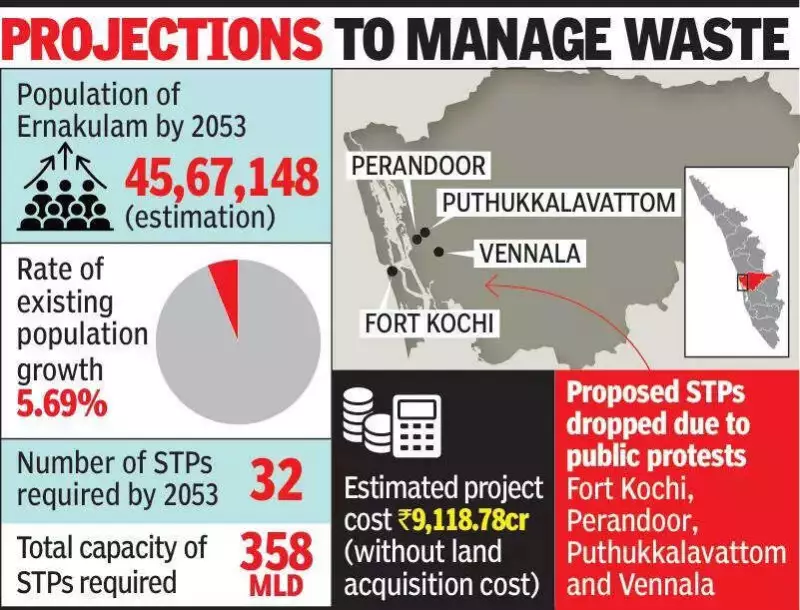
A critical project to address Kochi's mounting sewage crisis has encountered a significant regulatory hurdle. The proposed 55 million litres per day (MLD) sewage treatment plant (STP), essential for treating wastewater from homes and businesses, is now in jeopardy after the state Pollution Control Board (PCB) denied permission for its planned location in Elamkulam.
Regulatory Red Flag Over Residential Safety
The PCB's denial stems from a fundamental safety rule. The board mandates a minimum distance of 74 metres between an STP and any residential or public property. During a preliminary inspection, officials found the proposed plant site was merely 30 metres away from a residential area, falling drastically short of the requirement.
A PCB official explained the rationale behind the strict norm. "It is essential to maintain this distance to ensure that there is no smell, overflow or leakage from STPs, causing inconvenience to residents in the vicinity. Also, it is important to ensure no contamination of potable water if there is any leakage," the official stated. The board has consequently suggested that the Kerala Water Authority (KWA) relocate the plant, leaving the water utility in a difficult position.

KWA's Land Dilemma and Urban Transformation
The KWA's choice of the Elamkulam site was born out of necessity. The authority has struggled to find suitable land within the city for the much-needed STP. The plan was to construct the new 55 MLD facility alongside an existing 5 MLD plant, built three years ago, on a 13-acre plot the KWA has owned since the 1950s. Together, these plants were designed to manage sewage from the congested central Kochi area, spanning between Marine Drive and the Ernakulam railway line.
However, the urban landscape of Elamkulam has transformed unrecognisably over the decades. From having hardly any residential units in the 1950s, the area now has over 1,000 houses within a 1-kilometre radius of the KWA plot. This massive growth is the core reason the proposed plant now violates distance norms, creating a classic conflict between urban development and essential infrastructure.
Seeking Exemptions and Exploring Alternatives
With finding an alternative plot in Kochi city proving nearly impossible, the KWA is now pursuing a dual strategy. The authority has decided to seek an exemption from the state government and insist on a joint inspection with the PCB at the proposed site. A KWA official emphasised the larger public health imperative, stating, "We promise to ensure no pollution due to STPs here. We can no longer ignore the reality that untreated sewage discharge is polluting our water bodies — groundwater and aquatic systems."
Simultaneously, KWA is revisiting a previously shelved plan. The authority will review an earlier proposal to establish a new plant at Fort Kochi, which was scrapped following public protests. A KWA officer involved in planning said, "We are in the process of making a project for the islands. First, we have to identify the area to establish the plant and then lay the network covering the 30 divisions. We will have to conduct social and topographical surveys and clearly zone the area."
The stalemate highlights the acute challenge of implementing vital civic infrastructure in densely populated urban areas. The proposed plant's goal was to convert contaminated sewage into safe water for reuse in irrigation or flushing, a sustainable solution now delayed indefinitely. The outcome of KWA's appeal to the state government will be crucial for Kochi's wastewater management and environmental health.






