Jammu & Kashmir's Hydropower Potential Largely Untapped, Survey Reveals
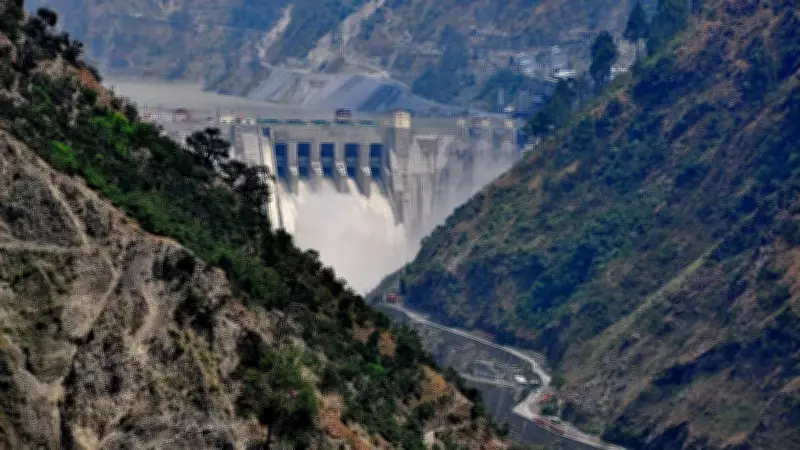
The Jammu and Kashmir Economic Survey, tabled in the UT's Assembly, has highlighted a significant underutilization of the region's hydropower resources. According to the report, only 23.81 percent of Jammu & Kashmir's estimated hydropower potential has been harnessed to date.
Current Hydropower Generation and Sectoral Breakdown
The survey estimates Jammu & Kashmir's total hydropower potential at a substantial 18,000 megawatts (MW), with over 14,000 MW already identified for development. However, the current operational capacity stands at just 3,540.15 MW across 31 projects.
This installed capacity is distributed across three key sectors:

- State Sector: 1,197 MW managed by the J&K Power Development Corporation across 13 projects.
- Central Sector: 2,250 MW overseen by the National Hydroelectric Power Corporation Limited (NHPC) through six projects.
- Independent Power Producer (IPP) Mode: 92.75 MW generated by 12 projects operated by JKSPDC and JAKEDA.
Ambitious Plans to Double Hydropower Capacity
In a major push to boost energy production, Jammu & Kashmir is actively working to double its hydropower generation capacity. This initiative centers on the development of four major hydropower projects with a combined capacity of 3,014 MW.
The key projects slated for completion by 2028 include:
- Pakal Dul (1,000 MW)
- Rattle-II HEP (850 MW)
- Kiru (624 MW)
- Kwar (540 MW)
The successful commissioning of these projects is expected to significantly enhance the UT's power generation capabilities and contribute to meeting rising local demand.
Infrastructure Development and Revenue Growth
The report notes substantial improvements in power infrastructure and revenue. Revenue from electric power tariffs reached Rs 4,908 crore in 2024-25, making it the second-highest revenue resource for the UT. This growth is attributed to the implementation of central government schemes.
Key infrastructure achievements include:
- Transmission and distribution capacity of 34,839 MVA established by November 2025, marking a 44 percent increase since 2020.
- Electric line length expanded to 1,76,601 circuit kilometres.
- Approximately 24.59 lakh electricity consumers across various categories being supplied with power.
Smart Metering and Distribution Reforms
Under the Prime Minister’s Development Package (PMDP) and the Revamped Distribution Sector Scheme (RDSS), significant progress has been made in modernizing the power distribution network. Smart metering and aerial bunched cabling are advancing rapidly.
As of January 14, 2026:
- 6.46 lakh smart meters have been installed against a revised PMDP target of 6.86 lakh.
- Under RDSS, 5.25 lakh smart meters have been installed against a larger target of 14.07 lakh.
The survey reports that the quality and continuity of power supply have shown noticeable improvement in 2025-26, aligning with the government's goal to provide reliable, safe, and affordable 24x7 electricity.
Rising Demand and Renewable Energy Initiatives
Electricity consumption in Jammu & Kashmir has been on a steady upward trajectory. Per capita electricity consumption recorded a Compound Annual Growth Rate (CAGR) of 2.15 percent over the last nine years, increasing from 1,171 KWh to 1,488 KWh. Total purchased/consumption units surged from 15,225 million units to 20,830 million units during the same period.
The renewable energy sector is also making significant strides, with a growing emphasis on solar energy and small hydropower projects.
Notable renewable energy developments include:

- JAKEDA has allotted 56 Mini Hydel Projects (MHPs) with a total capacity of 147.00 MW under the IPP mode. Seven projects with a cumulative capacity of 35.25 MW have already been commissioned.
- Under the PM Surya Ghar Bijli scheme, 7,125 government buildings have been solarized against a target of 22,494, and 16,799 households have been solarized against a target of 83,550.
- These solar initiatives have added 131 MW to the region's renewable energy capacity, particularly crucial during winter months when hydropower generation is limited.
The government's comprehensive strategy focuses on optimizing power generation, strengthening transmission and distribution infrastructure, and expanding renewable energy sources. This approach aims not only to meet local demand but also to create potential for exporting surplus power, thereby generating additional revenue for the Union Territory.