Jaipur's Comprehensive Mobility Plan Charts Path to All-Electric Future by 2055
The Urban Development and Housing (UDH) department, in collaboration with RITES, has unveiled a forward-thinking Comprehensive Mobility Plan (CMP) for Jaipur that extends far beyond conventional urban mobility strategies. This ambitious blueprint prioritizes the creation of a completely pollution-free transport network, setting a transformative vision for the Pink City's future.
Electric Vehicle Revolution and Infrastructure Development
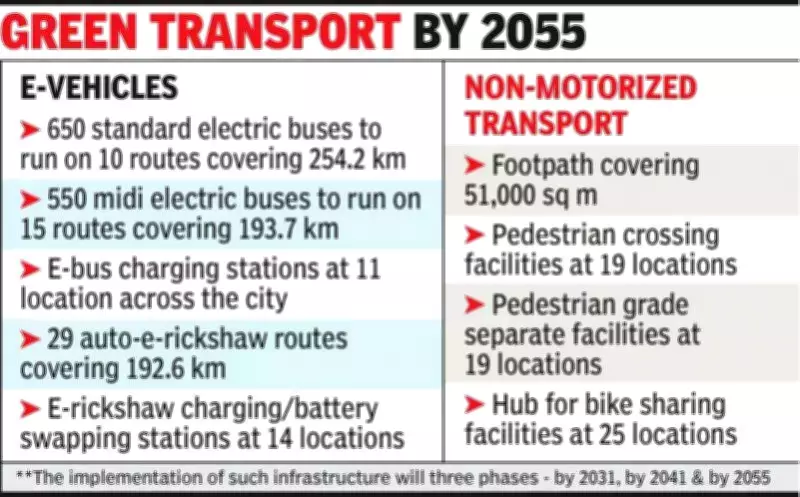
Projecting that Jaipur's population will surpass 1 crore (10 million) by 2055, the plan meticulously outlines the required number and types of vehicles for city roads, with a groundbreaking mandate: all vehicle categories are proposed to be electric. To support this massive transition, the CMP identifies 25 strategic locations across Jaipur to be developed as dedicated electric vehicle charging areas.
A senior official involved in the planning process explained that the CMP's core objective is to develop a Sustainable Urban Transport (SUT) network specifically designed to mitigate carbon dioxide emissions from vehicles. "The CMP proposes a fundamental shift to alternative fuels and highly efficient technology. In simple terms, by 2055, all vehicles operating on Jaipur's city roads will be electric vehicles," the official stated.

Charging Infrastructure for Public and Shared Transport
The official elaborated on the supporting infrastructure, noting, "To facilitate the movement of these e-vehicles, the CMP proposes establishing 11 dedicated charging stations for electric buses and another 11 charging or battery swapping stations specifically for e-rickshaws." This dual approach ensures that both mass public transport and last-mile connectivity solutions are adequately powered.
Emphasis on Non-Motorized Transport and Pedestrian Safety
Beyond the introduction of vehicles powered by alternative fuels, the CMP places significant emphasis on non-motorized transport (NMT) corridors and enhanced facilities for pedestrians. The government will focus on a multi-pronged approach to build this infrastructure, which includes:
- Development and upgrading of footpaths across the city.
- Construction of foot overbridges and other safe pedestrian crossing facilities.
- Development of dedicated cycle lanes to promote cycling.
- Introduction of e-bike sharing facilities to complement the transport ecosystem.
The plan proposes a substantial total network of 25.5 kilometers for the development of footpaths throughout Jaipur. Additionally, there are plans to construct Non-Motorized Vehicle (NMV) lanes covering 16 kilometers, with particular focus along the industrial areas of Mansarovar and Sitapura to ensure safe commutes for workers.
Public Bicycle Sharing as Last-Mile Connectivity
Another official highlighted the importance of integrating modern shared mobility solutions. "Public Bicycle Sharing (PBS) is emerging as one of the most sustainable and popular transport modes across the globe. The CMP strongly emphasizes the introduction of a PBS system to serve as last-mile connectivity, seamlessly linking homes to the nearest metro stations," the official added. This integration is crucial for creating a cohesive, multi-modal transport network.
Enhanced Pedestrian Crossings at Key Intersections
To further improve pedestrian safety and urban walkability, the CMP proposes the construction of different structures for pedestrian crossings—such as footbridges or subways—at 17 major intersections across Jaipur. This targeted approach aims to reduce congestion and accident risks at the city's busiest junctions.
Jaipur's Comprehensive Mobility Plan represents a holistic and ambitious roadmap, combining an all-electric vehicle mandate with robust charging infrastructure, extensive non-motorized transport corridors, and pedestrian-friendly urban design. It sets a clear trajectory for transforming Jaipur into a model of sustainable urban mobility by the mid-21st century.