

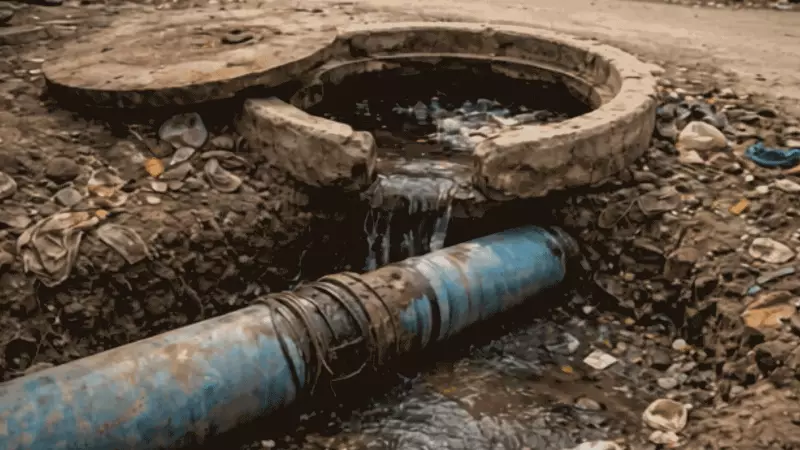
The recent water crisis that brought India's cleanest city, Indore, to its knees was not a sudden, unforeseen calamity. It was a slow-motion disaster, meticulously engineered by years of systemic neglect, flawed planning, and a glaring lack of foresight by the authorities. While a major pipeline burst on the fateful day of July 10, 2024, served as the immediate trigger, the roots of the collapse ran deep into the city's overstretched and poorly managed water infrastructure.
The Trigger Point: A Pipeline Burst Exposes Deep Fault Lines
On July 10, a critical 1,200-mm diameter pipeline, part of the Narmada Phase-IV project, ruptured near the Bhamori pumping station. This pipeline was a vital artery, responsible for supplying a staggering 110 million liters per day (MLD) of water to large sections of Indore. The breach was severe, halting all pumping operations and instantly cutting off water to approximately 40% of the city's population. The Indore Municipal Corporation (IMC) scrambled, estimating repairs would take 48 to 72 hours. For hundreds of thousands of residents, this meant days of desperate water scarcity, with long queues at tankers becoming a common sight across affected zones.
However, framing this as a simple pipeline accident would be a grave mistake. The incident acted merely as a stress test, revealing the brittle and fragile state of Indore's entire water supply network. The city's dependence on a single, massive pipeline for such a huge volume of supply was itself a monumental risk. There was no effective redundancy, no parallel system that could take over in case of such a failure. The crisis laid bare a dangerous "all eggs in one basket" approach to urban water management.

Systemic Failures: How Planning and Governance Dried Up
The origins of this disaster can be traced back to fundamental flaws in urban planning and project execution. A key figure in the initial planning stages, former IMC commissioner Asheesh Singh, had reportedly advocated for a more resilient approach during the Narmada Phase-IV project's conception. His suggestion involved constructing two parallel pipelines of 700-mm diameter each instead of one massive 1,200-mm line. This design would have offered built-in redundancy; if one line failed, the other could continue to operate at a reduced capacity, preventing a complete collapse.
This prudent recommendation was ultimately overruled. The decision to opt for the single, larger pipeline was driven by short-term considerations of cost and perceived efficiency, sacrificing long-term security and resilience. This critical choice, made years ago, directly set the stage for the July 2024 crisis. It highlighted a pervasive issue in civic infrastructure projects: the prioritization of immediate cost savings over sustainable, fail-safe design.
Furthermore, the city's water woes are compounded by its explosive and unplanned growth. Indore's population has surged, but its water infrastructure has failed to keep pace. The existing systems are operating far beyond their intended capacity. The crisis underscored the absence of a comprehensive Water Security Master Plan that accounts for population growth, climate variability, and infrastructure lifecycle management.
Beyond the Crisis: The Path to a Water-Secure Future
The immediate aftermath saw the IMC and the state government in firefighting mode, deploying water tankers and working to repair the breached pipeline. While restoring supply was urgent, the real lesson lies in preventing a recurrence. The disaster forces a hard look at several non-negotiable steps for Indore's future.
First, creating redundancy in the supply network is paramount. The city must invest in building alternative feeder lines and interconnections within its distribution grid. Second, there is an urgent need to revive and rigorously maintain local water bodies and traditional sources to reduce over-dependence on the distant Narmada river. Third, implementing a robust 24x7 monitoring system using sensors and IoT technology for the pipeline network can help in early leak detection and preventive maintenance.

Most importantly, the crisis calls for greater accountability and a shift in governance philosophy. Infrastructure planning must be driven by engineers and urban planners with a mandate for resilience, rather than being sidelined by administrative or financial shortcuts. Public transparency about the state of water infrastructure and crisis preparedness plans is also essential.
The Indore water disaster serves as a stark warning for cities across India undergoing rapid urbanization. It proves that accolades for cleanliness or smart city status are hollow without resilient, foundational infrastructure. The pipeline burst on July 10 was merely the symptom; the disease was a chronic case of poor planning and myopic governance. For Indore to truly live up to its reputation, it must now build a water system that is not just efficient, but also unbreakable.





