Indore: Not a single meat shop in the city holds a licence from the Indore Municipal Corporation (IMC). Approximately 500 shops dealing in fish, chicken, goat, or buffalo meat are operating without a No-Objection Certificate (NOC), according to Ashwini Shukla, in-charge of the IMC sanitation and solid waste management department.
"Meat falls under four categories, but no shop in Indore has the compulsory IMC permission," Shukla told TOI. The absence of licences is compounded by a deeper infrastructure gap. Goat and buffalo meat must legally be processed in a slaughterhouse. "There is no govt-approved or legal slaughterhouse in Indore," Shukla said.
A slaughterhouse tender awarded in 2016 was halted mid-way by protests and has since been cancelled. "The decision to cancel the tender was recently taken in IMC MIC's meeting," he added.

The IMC has in some instances provided physical space to vendors, including near its headquarters for a fish market, while collecting rent. However, Shukla, who also serves as a Mayor-in-Council (MIC) member, clarified: "We had made available the space and charge the rent, but have not provided any licence or permission for this business." Some owners carry a 'Gumasta' licence, but officials clarified this is only a shop registration, not authorisation to operate a meat business.
Despite the non-compliance, the IMC has not acted to shut the shops. "We can't stop anybody's food, and thus, on humanitarian grounds, these shops are operating despite not having IMC's permission," Shukla said. He also pointed to the livelihoods of thousands dependent on the trade.
Daily waste collection from meat shops continues, and owners are periodically directed to maintain hygiene. On steps underway, the IMC has floated tenders for 27 tin-shed kiosks for fish vendors, priced at Rs 5 lakh each, funded under the fishermen welfare scheme. "These kiosks will be allotted to fishermen and will be provided with all required permissions and licences, marking the first step towards a fully legalized sector," Shukla said.
The regulatory position is clear. The Food Safety and Standards (Licensing and Registration of Food Businesses) Regulations, 2011, require meat shops to obtain an NOC from the police or concerned Panchayat/Municipality/Corporation before a licence is granted, said Indore Food Safety Officer Manish Swami. He added that non-compliance can attract legal action and licence cancellation. Outside IMC's jurisdiction, some rural Panchayats have granted NOCs to meat shops. "Based on instructions from the concerned authority, an inspection can be carried out at the meat shop to check their permissions and following of guideline set for the business," Swami said.
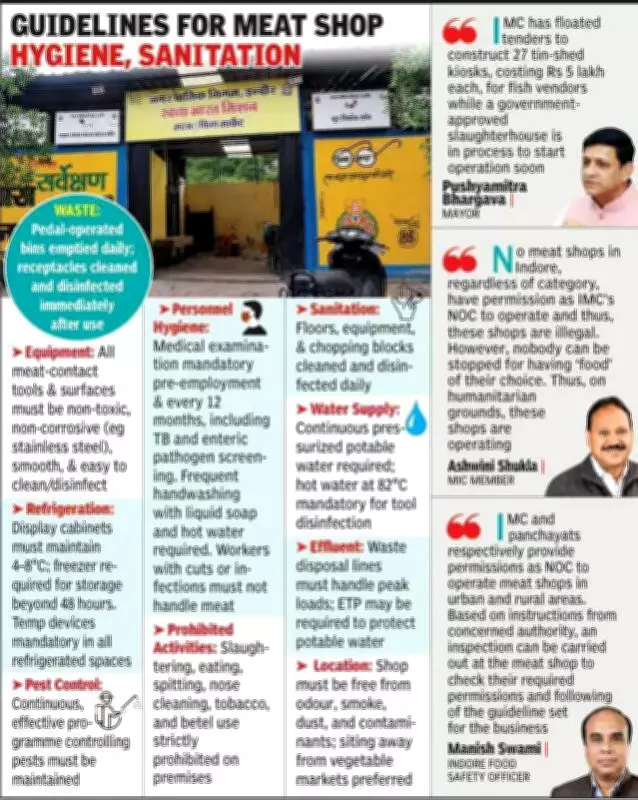
Guidelines for Meat Shop Hygiene and Sanitation
- Equipment: All meat-contact tools and surfaces must be non-toxic, non-corrosive (e.g., stainless steel), smooth, and easy to clean and disinfect.
- Refrigeration: Display cabinets must maintain 4–8°C; freezer required for storage beyond 48 hours. Temperature monitoring devices mandatory in all refrigerated spaces.
- Pest Control: Continuous, effective programme controlling pests must be maintained.
- Personnel Hygiene: Medical examination mandatory pre-employment and every 12 months, including TB and enteric pathogen screening. Frequent handwashing with liquid soap and hot water required. Workers with cuts or infections must not handle meat.
- Prohibited Activities: Slaughtering, eating, spitting, nose cleaning, tobacco, and betel use strictly prohibited on premises.
- Sanitation: Floors, equipment, and chopping blocks cleaned and disinfected daily.
- Waste: Pedal-operated bins emptied daily; receptacles cleaned and disinfected immediately after use.
- Water Supply: Continuous pressurized potable water required; hot water at 82°C mandatory for tool disinfection.
- Effluent: Waste disposal lines must handle peak loads; ETP may be required to protect potable water.
- Location: Shop must be free from odour, smoke, dust, and contaminants; siting away from vegetable markets preferred.
Photo Quotes:

Ashwini Shukla, MIC member: "No meat shops in Indore, regardless of category, have permission as IMC's NOC to operate and thus, these shops are illegal. However, nobody can be stopped for having 'food' of their choice. Thus, on humanitarian grounds, these shops are operating."
Pushyamitra Bhargava, Mayor: "IMC has floated tenders to construct 27 tin-shed kiosks, costing Rs 5 lakh each, for fish vendors while a government-approved slaughterhouse is in process to start operation soon."
Manish Swami, Indore food safety officer: "IMC and panchayats respectively provide permissions as NOC to operate meat shops in urban and rural areas. Based on instructions from concerned authority, an inspection can be carried out at the meat shop to check their required permissions and following of the guideline set for the business."