Power Couples Reshape Bureaucratic Landscape in North India
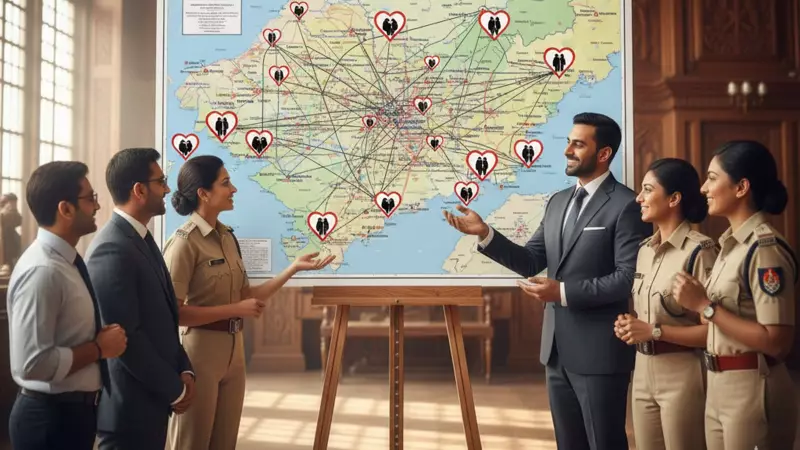
Love is quietly rewriting the cadre map across Haryana and Punjab. A remarkable pattern has emerged within the administrative machinery of these two states. At least 66 Indian Administrative Service (IAS) and Indian Police Service (IPS) officers are married to each other. This forms one of the largest known clusters of civil service couples in the entire country.
Inter-Cadre Transfers Fuel the Phenomenon
What makes this situation particularly notable is the active pursuit of togetherness. Numerous officers have sought and secured inter-cadre transfers. They move from their original parent cadres specifically to serve alongside their spouses. While the rules permit such moves under specific conditions, the sheer scale in this region has sparked significant conversation.
Bureaucratic and political circles are now discussing cadre management, institutional balance, and the growing influence of these so-called 'power couples' in governance.

A senior officer explained the legal framework to The Indian Express. "The number is likely higher than 66," the officer noted. "This clustering is not accidental, nor is it illegal."
Inter-cadre transfers for IAS and IPS officers fall under the All India Services (Cadre) Rules. Marriage to another officer from the IAS, IPS, or Indian Foreign Service (IFS) is a recognized ground for transfer. However, it comes with conditions.
- The officer must be confirmed in service.
- Both state governments involved must provide their consent.
- The central government must grant final approval.
"Typically, such a transfer is allowed once in an officer's career," the officer added. "It balances family unity with administrative needs. Furthermore, the Centre increasingly encourages 'spouse posting' within the same state, even without a formal cadre change, especially for younger officers."
Haryana: A Hub for Converging Careers
The trend in Haryana spans three decades of civil service. Among the most senior couples are 1994-batch IPS officers. Navdeep Singh, a Haryana native, serves as Additional Director General of Police (ADGP). His wife, Kala Ramachandran, also a 1994-batch IPS officer, originally hailed from the Tamil Nadu cadre. She now leads the Haryana Police Academy in Madhuban.
Another notable pairing from the 1995 batch includes Sandeep Khirwar, currently on central deputation, and Charu Bali, who serves as ADGP at the Recruitment Training Centre in Bhondsi.
The trend intensifies with younger batches, showcasing a clear pattern of cadre migration after marriage.
Recent Examples in Haryana Include:- Astha Modi (2013 batch IPS) is married to Parth Gupta (AGMUT cadre IAS), who shifted to Haryana post-marriage.
- Anupama Anjali (2018 batch IAS) moved from Andhra Pradesh to Haryana after marrying Harshit Kumar (2020 batch IAS).
- Shantanu Sharma (2020 batch IAS) relocated from the Assam-Meghalaya cadre to Haryana for his marriage to C Jayashradha (2020 batch IAS).
- Most recently, Utsav Anand (2022 batch IAS) moved from Uttar Pradesh to Haryana after marrying his batchmate, Anjali Shrotriya.
Punjab's Bureaucracy Mirrors the Trend
Punjab's administrative scene reflects and sometimes amplifies this phenomenon. Several officer couples simultaneously hold senior secretariat, district, and police leadership positions.
At the top are officers like Tejveer Singh (1994 batch IAS), Additional Chief Secretary of Technical Education, and his wife Jaspreet Kaur (1995 batch IAS), Additional Chief Secretary of Mining and Planning.
District governance in Punjab now features married officers leading major districts at the same time.

- Himanshu Aggarwal (2014 batch IAS) serves as Jalandhar Deputy Commissioner (DC). His wife, Komal Mittal (2014 batch IAS), is the Mohali DC.
- Aashika Jain (2015 batch IAS) holds the position of Hoshiarpur DC, while her husband Himanshu Jain (2016 batch IAS) leads as Ludhiana DC.
IAS-IPS marriages are equally prominent in Punjab. Girish Dayalan (2011 batch IAS), Registrar of Cooperative Societies, is married to Avneet Kondal (2012 batch IPS), the Senior Superintendent of Police (SSP) in Bathinda.
This growing network of power couples is fundamentally reshaping the bureaucratic fabric of both Haryana and Punjab. It highlights a personal dimension within the rigid structures of India's civil services, creating new dynamics in regional administration.