Hyderabad Water Board Confronts Mounting Summer Crisis as Supply-Demand Gap Widens
The Hyderabad Metropolitan Water Supply and Sewerage Board (HMWSSB) is bracing for an exceptionally challenging summer season, with the disparity between the city's escalating water requirements and its static supply capacity continuing to expand alarmingly. Despite adding approximately 50,000 new consumer connections over the past twelve months, the total volume of water available to Hyderabad has not seen any increase, placing unprecedented strain on an already overburdened distribution infrastructure.
Decade of Growth Without Corresponding Supply Enhancement
Official data from HMWSSB reveals a dramatic surge in domestic water connections, which have skyrocketed by more than six hundred thousand over the last ten years. From eight lakh connections recorded in 2016, the number has ballooned to 14.2 lakh by the conclusion of 2025, propelled by relentless urban sprawl and a booming real estate sector. In stark contrast, the city's water supply has remained frozen at approximately 600 million gallons per day (MGD) since 2012. Board officials have candidly admitted their current inability to augment supply even by a single MGD, creating intense pressure across the entire water network.
Peripheral Neighborhoods Bear the Brunt of Shortages
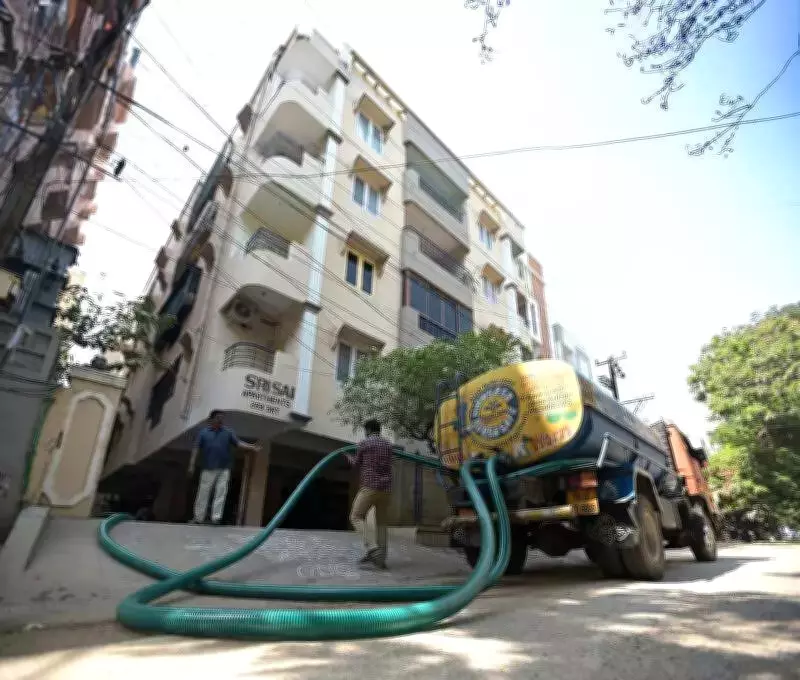
Rapidly developing localities on the metropolitan outskirts, including Tellapur, Kollur, and Osmannagar, are experiencing the most severe impacts. As high-rise residential towers and commercial complexes proliferate across these areas, a significant portion of residents are forced to depend on groundwater extraction and private water tanker services, particularly during the scorching summer months. Ramana Eshwaragir, president of the Tellapur Neighbourhood Association, highlighted the dire situation: "Our locality has a population nearing 50,000, yet barely 30% of households possess formal water connections. The majority rely entirely on groundwater and tankers. Numerous apartment complexes submitted connection applications over a year ago, but consistent municipal supply remains elusive."

Projected Deficits and Future Mitigation Efforts
HMWSSB authorities acknowledge the growing shortfall, estimating that Hyderabad currently requires about 700 MGD to meet existing needs. Projections indicate that by 2027, demand could escalate to 835 MGD, potentially creating a deficit approaching 235 MGD. A senior official noted that the anticipated completion of the Godavari Phase II and III water supply projects next year should provide some relief from these shortages.
Urban Planning and Conservation Initiatives
Urban planning experts attribute the crisis partly to unregulated construction practices. KM Lakshmana Rao, a retired professor from JNTUH, cautioned: "Building approvals should not be issued in areas lacking pipeline infrastructure. Relying on groundwater for large populations is fundamentally unsustainable and poses serious health risks when water is treated informally for drinking purposes." In response, HMWSSB has implemented mandatory rainwater harvesting pit installations for all new connections and announced an ambitious plan to construct 18,000 such pits within Outer Ring Road limits within the next ninety days to promote water conservation.