

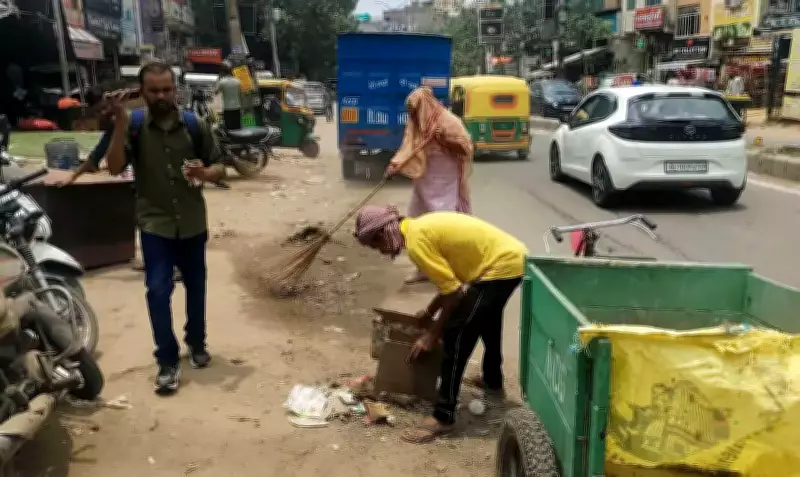
Haryana Government Proposes Mixed Sweeping Model for Urban Sanitation Overhaul
In a significant policy shift aimed at enhancing urban sanitation, the Haryana government is considering the implementation of a mixed sweeping model across the state. This initiative follows key observations by Chief Minister Nayab Singh Saini, who highlighted a direct correlation between the efficiency of door-to-door waste collection systems and the necessity for daily road sweeping.
New Directions from the Urban Local Bodies Department
The Department of Urban Local Bodies (ULB) has communicated this directive to all municipal corporations in Haryana. According to an official note quoting the Chief Minister, once door-to-door garbage collection is fully streamlined and operates effectively, the need for daily road sweeping could be significantly reduced or even eliminated entirely.
However, acknowledging practical challenges, the CM noted that stabilizing and fully implementing door-to-door collection across urban areas may take time. As an interim measure, the Haryana government has suggested a balanced approach: manual sweeping for six days a week combined with mechanical sweeping on alternate days, to be carried out simultaneously.

This arrangement is set to be reviewed after one year, with findings to be submitted for the Chief Minister's further directions. A revised Request for Proposal (RFP) has been circulated, emphasizing that daily sweeping may not be required once door-to-door collection is perfected.
Municipal Corporation of Gurgaon's Response and Adjustments
The Municipal Corporation of Gurgaon (MCG) had previously submitted an estimate for manual and mechanized road sweeping over a five-year period. In light of the new directives, MCG Commissioner Pradeep Dahiya announced that the proposal will be revised to a one-year term as per ULB department instructions.
"We already sent the proposal for five years but we will now revise it to one year as per the ULB department directions," Dahiya stated.
Expert Warnings on Air Pollution and Infrastructure Gaps
In cities like Gurgaon, where road dust is a major contributor to air pollution, experts caution that reducing sweeping frequency without robust dust-control measures could exacerbate environmental problems. Gauri Sarin, Convener of Gurgaon Residents Against Pollution and Making Model Gurgaon, expressed concerns.
"Given many challenges, road sweeping cannot be reduced or done away with at this stage," Sarin said. "Garbage-vulnerable points tend to emerge on roads when doorstep waste collection is not fully streamlined, which likely is the basis of the CM's observations. However, significant gaps remain."
Sarin emphasized the need to strengthen roadside infrastructure, including:
- Developing proper pavements
- Installing adequate bins
- Deploying more efficient road-cleaning machinery
- Implementing dedicated horticulture bins for green waste management
She added that current sanitation systems and resources are insufficient to meet the city's growing needs.
Contractual and Operational Challenges in Sweeping Services
A former consultant, who has closely worked with Haryana municipal corporations and is a waste management expert, requested anonymity to discuss contractual issues. He pointed out that RFPs should be long-term and cannot be open-ended to avoid financial inefficiencies.
"While making the RFPs, such conditions cannot be put up that sweeping will be done for a year or the arrangement will be reviewed first because in such cases, the contractors quote higher prices," the expert explained. "In such cases where uncertainty over the contract's duration is higher, the loss is ultimately borne by the government since contractors quote higher charges."
He acknowledged studies showing that sweeping frequency can be reduced with perfect doorstep waste collection but stressed it cannot be eliminated entirely. "In cities like Gurgaon and Faridabad, there is so much dust, stray cattle roaming, unchecked construction dust, etc., due to which sweeping is necessary," he added.

Background on Sweeping Machine Operations and Contracts
The ULB department purchased sweeping machines in 2019, with operations and maintenance of 44 such machines across various state corporations outsourced to a private company for five years, although the machines remain ULB property. In Gurgaon, a private firm was awarded the work in September 2019 for five years until March 31, 2025, followed by a one-year extension.
After the contract of the private agency responsible for operating and maintaining the city's road sweeping machines ended on March 31 this year, MCG has awarded the work to another Dwarka-based private agency. This new contract covers operation and maintenance of the machines across the city for the next six months, with an estimated project cost of Rs 5 crore.
This policy shift represents a proactive step by the Haryana government to optimize urban sanitation efforts, balancing efficiency with environmental and practical considerations in rapidly growing urban centers.





