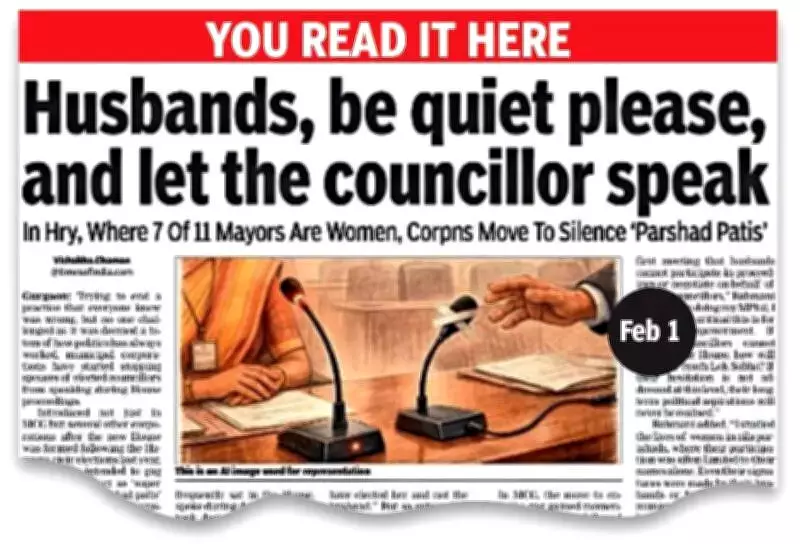
Haryana Government Takes Formal Action to End Proxy Participation in Municipal Meetings
The Haryana government has officially intervened to reinforce a significant shift in municipal governance, directing all municipal corporations to prohibit representatives of elected women councillors from attending House meetings. This decisive action follows growing concerns that despite reservation policies guaranteeing seats for women in urban local bodies (ULBs), many elected councillors are being marginalized in decision-making processes.
Addressing Decades-Old Practice of "Proxy Participation"
The state's urban local bodies department issued formal directions acknowledging that the practice of husbands or relatives attending meetings and speaking on behalf of elected women councillors has persisted in some municipalities despite previous government instructions. This phenomenon, often referred to as "proxy participation," has seen male family members acting as "super councillors" or "parshad patis"—participating in discussions and even replacing elected women in House meetings without any legal standing.
The department's communication stated clearly: "It has also come to the notice that a lesser number of women representatives are participating in the meetings of the House of Municipalities and, in some instances, their representatives are participating in such meetings." The directive emphasized that House meetings are meant to be attended only by elected women members themselves.

Strengthening Women's Political Representation
This development represents a crucial step toward strengthening the true spirit of women's reservation in ULBs. With seven of Haryana's eleven mayors being women, ensuring that these elected representatives exercise their mandate directly rather than through family members has become increasingly important for genuine political participation.
The move effectively formalizes changes that several municipal corporations had already begun implementing independently. Following Haryana's civic elections last year, municipal corporations including the Municipal Corporation of Gurgaon (MCG) had started challenging the decades-old practice of proxy participation.
Implementation and Enforcement Challenges
While the government's intervention signals growing recognition that political representation must translate into actual participation in governance, enforcement will ultimately depend on how strictly municipal corporations implement the directive. Officials have expressed confidence that the formal directive will make enforcement easier across all ULBs.
Pradeep Dahiya, MCG commissioner, commented on the development: "We ensured it right from the beginning that the women councillors' representatives won't be allowed to speak in the meetings on their behalf. Now that the directions from the ULB have come, we will maintain it."
The department's letter specifically noted that earlier government instructions on this matter were not being "followed meticulously," highlighting the need for this reinforced directive. The order explicitly states: "The representative of the elected women member may not be allowed to attend the meetings of the House of Municipalities."
Broader Implications for Governance
This policy shift addresses fundamental questions about political representation and participation in local governance. By ensuring that elected women councillors participate directly in decision-making processes, the government aims to create more authentic and effective municipal governance structures.
The move comes at a time when women's political participation at the local level has been increasing numerically but sometimes lacking in substantive engagement. By eliminating proxy participation, the government hopes to empower women councillors to develop their political skills, voice their constituents' concerns directly, and contribute more meaningfully to municipal decision-making.
As municipal corporations across Haryana begin implementing these directives, the effectiveness of this policy will be closely watched by governance experts and women's rights advocates alike. The success of this initiative could potentially serve as a model for other states grappling with similar challenges in ensuring genuine political participation by elected women representatives.