The Greater Visakhapatnam Municipal Corporation (GVMC) finds itself managing a project of stark contrasts. Its flagship ₹940-crore hybrid sewerage initiative, launched in 2019 to serve the Gajuwaka, Pendurthi, and Malkapuram areas, is delivering dramatically different outcomes in its two major segments nearly six years later.
A Tale of Two Packages: Success and Stalemate
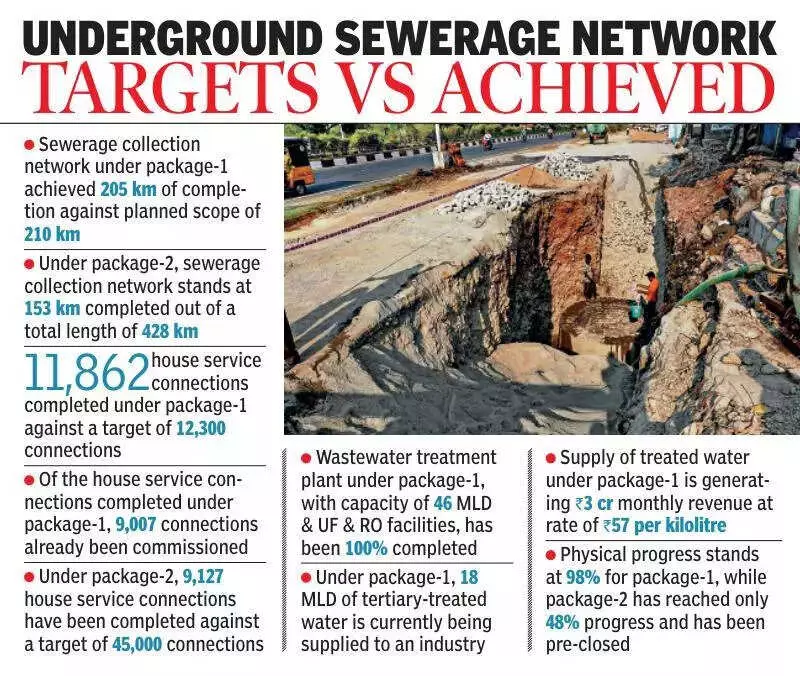
Package-1, covering Pendurthi, stands as a notable success story. With 98% of the work completed, this segment is not only functional but has also become a revenue source for the civic body. The sewerage collection network is largely finished, with 205 kilometres of lines laid against a target of 210 km. Out of 12,300 planned house service connections, 11,862 have been completed, and 9,007 are already in active use.
The crown jewel of this package is the fully operational wastewater treatment plant. It has an ultrafiltration and reverse osmosis capacity of 46 million litres per day (MLD). Currently, 18 MLD of tertiary-treated water is being supplied to a public sector undertaking, generating a steady monthly income of nearly ₹3 crore for GVMC.

The Stalled Second Package and Revival Plans
In sharp contrast, Package-2, covering Gajuwaka and Malkapuram, has ground to a halt at just 48% physical progress. The contract was mutually pre-closed due to unresolved issues between the contractor and GVMC. Here, only 153 km of the planned 428 km sewer network is complete. Just 9,127 house service connections have been built out of a massive target of 45,000. GVMC must now float fresh tenders to complete the remaining 52% of the work.
To resuscitate the stalled package, GVMC has proposed two alternative models. The first model suggests leveraging the existing revenue-generating success of Package-1. By connecting more households and supplying tertiary-treated water, the income could fund the balance of work in Gajuwaka, where about 148 km of network is already laid. Work in Malkapuram, which has not yet begun, would follow, easing the financial load.
The second option, proposed on instructions from higher authorities, is to complete the remaining works under a Concessionaire Hybrid Annuity Model (CHAM). This would involve a public-private partnership to finance and execute the project.
The Bigger Picture for Visakhapatnam
This ambitious project was conceived to address a critical infrastructure gap. At the time of its launch, the existing underground drainage (UGD) network covered only about 40% of the city's geographical area and served roughly 55% of its population. The goal was to extend scientific sewerage coverage to all parts of Visakhapatnam, including newly merged areas.
Overall, the project's master plan envisages laying 640 km of sewer lines and providing 57,000 UGD connections across the three target areas. The current split outcome underscores the complexities of executing large-scale urban infrastructure projects, where financial models, contractor performance, and phased implementation can lead to divergent results on the ground.