Gurgaon: DHBVN Introduces Dual-Source Power Supply for Critical Public Services
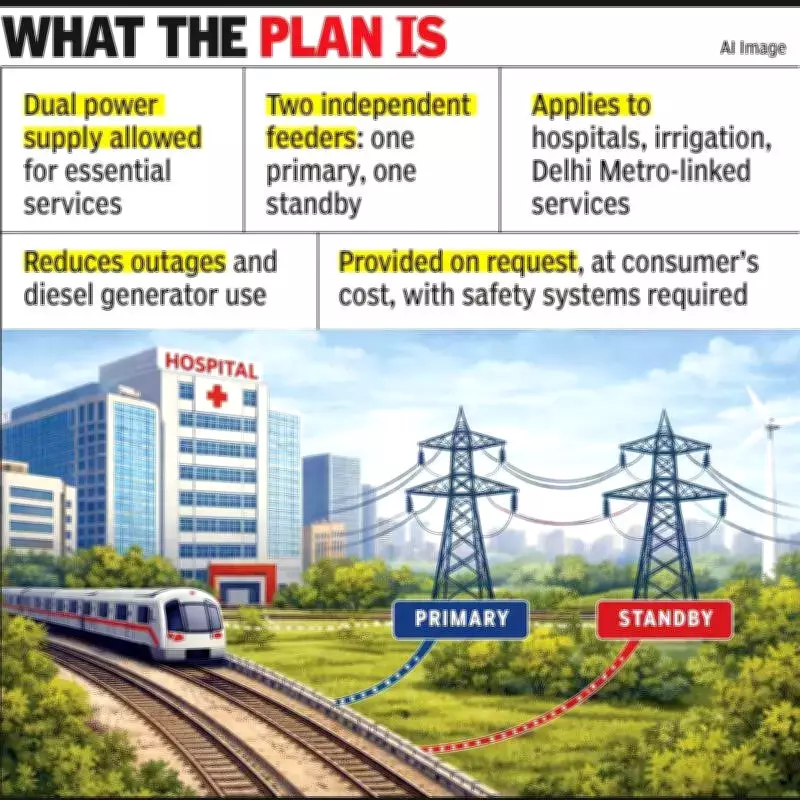
In a significant move to enhance power reliability for essential services, the Dakshin Haryana Bijli Vitran Nigam (DHBVN) has issued a new circular permitting dual-source electricity supply for institutions providing public services. This initiative, aligned with the Haryana Electricity Regulatory Commission's (HERC) 2025 order, aims to address the vulnerabilities faced by hundreds of hospitals, irrigation facilities, and Delhi Metro-linked services that currently depend on a single feeder.
Addressing Power Outage Challenges
Under the existing system, outages caused by feeder faults or maintenance often lead to severe disruptions. Medical equipment in hospitals can malfunction, canal operations face delays, and reliance on diesel generators becomes frequent. The lack of an alternative supply source has forced these institutions to depend heavily on diesel generator sets, raising concerns over pollution, high operating costs, and reliability issues.
Relying on a single power source leaves crucial services vulnerable. Hospitals often face equipment disruptions from voltage swings, irrigation systems stall, and metro operations too rely on risky, costly backups during even brief outages—increasing both operational risk and expense.

New Framework for Enhanced Reliability
The new circular allows these institutions to receive supply from two independent feeders at 11 kV or above, with one designated as primary and the other as standby. Under the revised framework, institutions such as government and private hospitals, irrigation canal services, and the Delhi Metro Rail Corporation can now receive electricity from two independent sources—subject to technical feasibility and availability of an 11 kV or higher voltage level feeder.
DHBVN managing director Vikram Singh emphasized that the facility will be provided on consumer request and at their cost. "The system will designate one feeder as the primary source and the other as standby, preventing simultaneous use. Consumers must install an interlocking mechanism or an automatic transfer switch (ATS) to ensure both supplies remain isolated and cannot mix—an essential requirement for grid safety," he said.
Billing and Infrastructure Requirements
For billing purposes, a common meter will be installed on the consumer's premises, and total consumption from both supply points will be combined. The key difference lies in fixed charges:
- If the supply comes from separate transformers or substations, each requires its own load reservation and will incur a separate fixed charge.
- However, if supply is drawn from different points within the same substation under a single reservation, it is treated as a single source with standard fixed charges.
The circular also mandates that all infrastructure related to dual-source connectivity must be built at the consumer's expense and inspected by the chief electrical inspector before commissioning. Once energized, the system will become DHBVN's property, for which a written undertaking will be taken. In cases involving Haryana Vishwakarma Power Nigam substations, a no-objection certificate will be required.
Expected Benefits and Implementation
This initiative is expected to significantly reduce the use of diesel gensets, thereby lowering operational costs and environmental impact. Permission for dual-source supply will be granted after verification by whole-time directors, based on designs vetted by the chief engineer (PD&C), DHBVN.
The move represents a proactive step towards improving power reliability for essential services in Gurgaon and surrounding areas, ensuring that critical operations remain uninterrupted during power disruptions.