Ghaziabad's Groundwater Recharge Efforts Stalled by Funding and Coordination Issues
A recent review of the central government's Jal Shakti Abhiyan in Ghaziabad has uncovered significant challenges. Funding gaps and poor coordination between departments are severely affecting groundwater recharge efforts in the district. Officials warn that the situation could deteriorate further if immediate corrective steps are not implemented.
Review Highlights Critical Gaps in Implementation
The assessment focused on the Jal Shanchay Jan Bhagidari scheme version 2.0. Richa Gautam, a scientist at the Central Ground Water Board's north region in Lucknow, conducted the review as the technical officer for Ghaziabad. She called for strict measures to address the problems.
Key recommendations include stopping illegal groundwater extraction and constructing various recharge structures. These structures include rainwater harvesting systems, ponds, soak pits, percolation pits, and check dams. The goal is to enhance groundwater levels across the district.

Ghaziabad is one of twelve groundwater-stressed districts undergoing this focused review. The JSJB initiative, under the Ministry of Jal Shakti, aims to promote mass water conservation. It focuses on creating low-cost artificial recharge structures like rooftop rainwater harvesting systems and recharge pits. The scheme also seeks to revive defunct borewells.
Groundwater Stress Persists Across Most Blocks
Officials presented findings based on the National Aquifer Mapping and Management Programme. NAQUIM assessments classify blocks as over-exploited, critical, semi-critical, or safe based on extraction versus recharge trends. The data reveals continued stress on groundwater resources in most blocks of Ghaziabad.
Srishti Jaiswal, an assistant geophysicist with the ground water department, shared the latest groundwater level data for 2025. She noted some signs of limited improvement in certain blocks after the monsoon. However, the overall picture remains concerning.
Block-wise analysis shows varying degrees of stress:
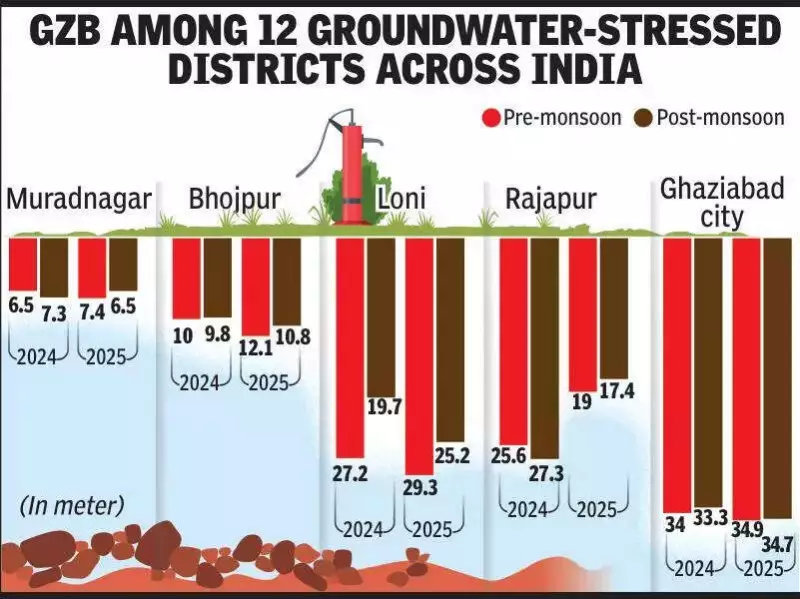
- Muradnagar: This is the only semi-critical block. Its pre-monsoon groundwater level dropped to 7.4 meters below ground level in 2025 from 6.5 meters in 2024, indicating rising stress. Post-monsoon levels improved slightly to 6.5 meters in 2025 from 7.3 meters a year earlier.
- Bhojpur: Groundwater levels deepened sharply here. Pre-monsoon levels fell from 10 meters in 2024 to 12.1 meters in 2025. Post-monsoon recovery was modest, reaching 10.8 meters in 2025 compared to 9.8 meters in 2024.
- Loni: This block continues to show severe stress with very deep groundwater levels. Pre-monsoon levels worsened from 27.2 meters in 2024 to 29.3 meters in 2025. Post-monsoon levels improved from 19.7 meters to 25.2 meters, but still reflect heavy extraction pressure.
- Rajapur: This block remains over-exploited with fluctuating trends. Pre-monsoon groundwater levels showed some improvement, but post-monsoon levels remained stressed at 17.4 meters, indicating inadequate recharge.
- Ghaziabad City: Recorded the deepest groundwater levels in the district, exceeding 34 meters both before and after the monsoon in 2025. This shows negligible improvement despite rainfall.
Funding Shortfalls and Coordination Problems Hamper Progress
One major concern raised during the review is the non-availability of MGNREGA funds in Ghaziabad. This has stalled the construction of new artificial recharge structures. Officials stated that this limitation narrows options for large-scale groundwater infrastructure, forcing reliance on corporate social responsibility funds.
Jaiswal explained, "Several groundwater-related works were taken up using CSR funds, but these are limited in scale and coverage. They cannot substitute for sustained public funding. We focused on rainwater harvesting systems, ponds, soak pits, percolation pits, and check dams to recharge groundwater despite the lack of MGNREGA funds."

Weak inter-departmental convergence emerged as another critical issue. Works by the municipal corporation and the Ghaziabad Development Authority under JSJB 2.0 are being reported separately. The centre-appointed officer also flagged delays in uploading data to the JSJB 2.0 portal. Inadequate repair and maintenance of existing recharge structures further compound the problems.
The review underscores the urgent need for integrated efforts and reliable funding to address Ghaziabad's groundwater crisis. Without prompt action, the district's water security remains at risk.