The Election Commission has outlined several 'logical discrepancies' that may trigger notices to voters during the special intensive revision (SIR) of electoral rolls, set to begin on June 15. These discrepancies include improbable family age gaps, changes in parent names, and entries supported solely by Aadhaar.
Details of Logical Discrepancies
Officials have stated that if a voter's details do not match earlier records or raise red flags, they may be required to prove their age and address through prescribed documents before their entry is confirmed. It has been clarified that Aadhaar will only be accepted as proof of identity, not as evidence of date of birth or residence during scrutiny. Badshapur SDM Sanjiv Singla emphasized, 'Aadhaar is only for identification, not for address and age. Electors will have to submit additional documents for address and age.'
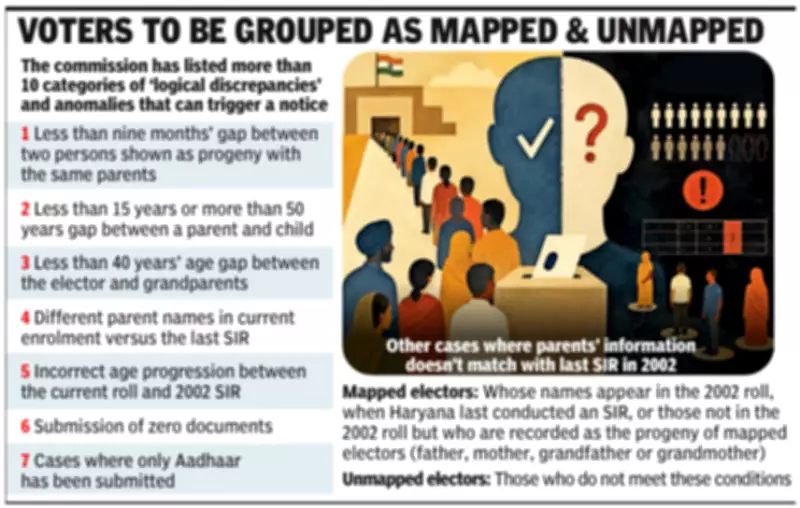
The commission has listed over 10 categories of logical discrepancies that can trigger a notice. These include less than nine months' gap between two persons shown as progeny with the same parents, less than 15 years or more than 50 years gap between a parent and child, different parent names in current enrolment versus the last SIR, incorrect age progression between the current roll and the 2002 SIR, and cases where only Aadhaar has been submitted. These flags have drawn attention because similar discrepancies were at the heart of controversial deletions from electoral rolls in Bengal ahead of the assembly elections earlier this year.

Mapping of Voters
During the exercise in Haryana, voters will be broadly grouped as 'mapped' and 'unmapped'. Mapped electors are those whose names appear in the 2002 roll, when Haryana last conducted an SIR, or those not in the 2002 roll but recorded as progeny of mapped electors (father, mother, grandfather, or grandmother). Unmapped electors are those who do not meet these conditions.
Officials explained that if an elector's details match exactly with the previous SIR record, no notice will be issued. If the match is partial or there is a discrepancy, a notice will be served, and the elector may have to produce additional documents.
Reasons for SIR
The commission has cited four broad reasons for conducting the SIR: frequent migration, multiple entries of the same voter at different places, non-removal of absentee/shifted/dead entries, and illegal enrolment of foreign nationals. Singla insisted that the objective is not indiscriminate deletion. 'The purpose of SIR is to purify the electoral list and not to remove anyone. Names of only those who have moved, are dead, or fall in the discrepancy category and cannot submit required documents will be removed. During the process, new voters will also be added,' he said.
Document Requirements
Documents required will depend on the voter's date of birth. Those born before July 1, 1987, must submit one valid personal document. Those born between July 1, 1987, and December 2, 2004, must provide one personal document plus one document of either parent. Applicants born after December 2, 2004, must submit one personal document and one document each of both parents.
July 1 has been fixed as the qualifying date, meaning anyone who turns 18 by then can seek inclusion. Form 6 for new voters will be available during the exercise, and applications can be made online at voters.eci.gov.in. Enumeration forms can be downloaded from June 15.
Polling Station Rationalization
Polling stations will be rationalized from June 14 to 26. Singla said the aim is to cap any polling station at 1,200 voters and keep travel distance within 2 km, while attaching—as far as possible—members of the same family and residents of the same area to the same polling station.
The draft electoral roll will be published on July 21. Between then and September 18, residents can file claims and objections for missing names, incorrect details, or to challenge ineligible entries. Officials said decisions on such claims will be based on prescribed documents, with notices issued where entries are not included.