

Open Construction Pits Pose Deadly Threat in Urban Areas, Experts Warn
A series of fatal accidents in the national capital has starkly exposed the lethal dangers posed by open, poorly barricaded construction pits and drains on city roads across urban India. The recent tragedies have ignited public outrage and prompted urgent calls for stricter safety enforcement.
Recent Tragedies Highlight Systemic Negligence
In the latest horrific incident on Friday, a 25-year-old motorcyclist tragically died after falling into a 20-foot-deep pit dug for Delhi Jal Board work in Janakpuri. Shockingly, the pit was allegedly left completely unprotected without proper barricades or adequate warning signs. The victim's body and motorcycle were recovered hours later following an overnight search by his distraught family.
This Janakpuri death followed closely on the heels of another widely reported tragedy in the National Capital Region earlier this year. In that devastating incident, a 27-year-old software engineer drowned after his car plunged into a water-filled construction pit in Noida. Both cases have raised serious, fundamental questions about contractor negligence, complete lack of proper barricading, and catastrophic failure of monitoring by civic agencies.

Bhubaneswar Faces Similar Lethal Conditions
Urban experts and safety activists warn emphatically that such accidents are not isolated incidents but represent a dire warning for administrations in cities like Bhubaneswar and Cuttack. In these urban centers, construction works on public roads are frequently undertaken without implementing basic safety protocols, particularly during nighttime hours.
Civic activists point out that identical lethal conditions exist throughout Bhubaneswar, where extensive stretches of roads are currently excavated for multiple infrastructure projects. These include sewerage system expansion, stormwater drain work, telecom and power cable laying operations, and ongoing flyover construction.
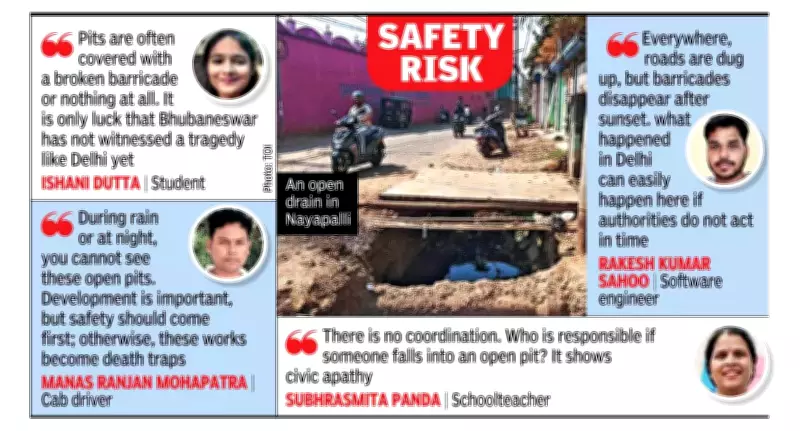
In numerous areas across the city, deep trenches remain dangerously open for days or even weeks with only minimal, inadequate protection. Often, mere loose tape or a single, insufficient barricade serves as the only safeguard, with no proper warning signage whatsoever.
High-Risk Areas and Vulnerable Populations
Localities such as Nayapalli, Saheed Nagar, Rasulgarh, Patrapada, Chandrasekharpur, and Old Town areas frequently feature open pits along busy arterial roads and even inside dense residential clusters. These excavations primarily serve ongoing drain and sewerage construction work.
The risk multiplies dangerously due to multiple compounding factors: poor street lighting, uneven road surfaces, and the complete absence of reflective signage. These conditions significantly increase hazards for two-wheeler riders, pedestrians, elderly citizens, and young children, particularly during late evening and early morning hours when visibility is poorest.
During monsoon season, the danger escalates exponentially as open pits rapidly fill with rainwater, completely obscuring their true depth and making them virtually invisible traps. Residents recall numerous near-miss incidents where vehicles have narrowly escaped plunging into these excavated stretches.
Resident Testimonies and Expert Warnings
"It is only sheer luck that has prevented a fatal accident in our area so far," said Ritesh Jena, a concerned resident of Chandrasekharpur. "A major drain construction project here has been ongoing for months. The pits are so enormous that anyone could easily fall in and sustain grievous, life-threatening injuries."
Road safety expert Syed Maqbool Ali stated bluntly, "This situation is genuinely dangerous and completely unacceptable. City authorities must take immediate lessons from these tragic incidents in Delhi and implement rigorous safety measures without delay."
Urban planners caution that Bhubaneswar's fast-paced infrastructure development push, if not matched with strict on-ground enforcement and monitoring, could easily replicate the Delhi-like tragedies. The city has witnessed several similar incidents involving fatalities in past years.

Official Response and Promised Actions
In response to growing concerns, city mayor Sulochana Das announced, "We have directed the fencing and barricading of all open drains immediately. We have also issued a strict advisory to all contractors involved in sewerage, drainage, and other construction work to implement adequate safety measures at their worksites. Our teams will conduct reinspections of all vulnerable sites to ensure compliance."
The recurring pattern of these preventable tragedies underscores an urgent need for systemic overhaul in how urban infrastructure projects manage public safety. As cities expand and modernize, ensuring that development does not come at the cost of citizen lives must become the paramount priority for civic authorities nationwide.





