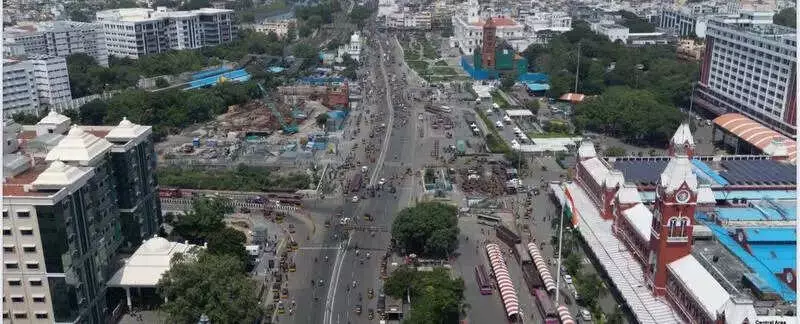
In a significant move aimed at transforming the city's chaotic and often hazardous streets, the Chennai Unified Metropolitan Transport Authority (Cumta) has drafted a comprehensive, uniform street and road design code for the entire Chennai metropolitan area. This initiative seeks to finally address long-standing civic woes including broken footpaths, inconsistent pedestrian facilities, and the perennial problem of frequent road digging by various utilities.
A Single Standard for Multiple Agencies
The newly drafted code will serve as a mandatory guideline for a multitude of local bodies and agencies, bringing them under one unified framework. This includes four corporations, 12 municipalities, 13 town panchayats, 1 special grade town panchayat, and 22 panchayat unions. Crucially, it will apply to roads maintained by over 15 stakeholders, such as the Greater Chennai Corporation (GCC), Chennai Metro Rail Limited (CMRL), the Chennai Metropolitan Water Supply and Sewerage Board (CMWSSB), and the state highways department.
Explaining the code's importance, Aswathy Dilip, Managing Director of ITDP India, stated that currently, each agency follows different standards—some refer to Indian Roads Congress (IRC) norms, others to Ministry of Road Transport and Highways (MoRTH) manuals, while some have their own. "A single guideline can standardise road infrastructure across the city," she emphasized, highlighting the potential for cohesive urban development.

Key Features and Phased Implementation
The ambitious 350-page document classifies roads into four distinct categories and mandates several citizen-friendly features:
- Mandatory footpaths of at least 2 metres width on one side of all roads.
- Dedicated space for essential road elements like bus stops, parking, and dustbins, with a minimum width of 2.5 metres where needed.
- Provision for tree corridors of at least 1 metre, kept free from utility conflicts.
- The potential for 2–3 metre-wide cycle tracks along selected corridors.
Cumta member-secretary I Jeyakumar revealed that this code is part of the authority's 25-year Comprehensive Mobility Plan. The implementation will be phased. "In the short term, within a couple of years, we want to implement immediately actionable fixes so that there is at least some level of standardisation in pedestrian infrastructure," Jeyakumar said. The first draft is currently with stakeholders for feedback, with a final version expected by February 2024. The authority is pushing to notify it as a government order, making it enforceable by the second half of 2025.
On-Ground Strategy and Traffic Police Concerns
Detailing the implementation strategy, GCC deputy commissioner (works) V Sivakrishnamurthy indicated a practical, bottom-up approach. Instead of starting with major arterial roads, the corporation will begin on collector streets with medium footfall. "Roads like Venkatanarayana Road can be used to test standardised solutions for footpaths, parking, and bus stops, which can later be replicated elsewhere," he explained.
Meanwhile, the traffic police have urged Cumta to prioritize pothole repairs and road restoration. Joint commissioner of police (traffic–south) P Vijaya Kumar linked poor road conditions directly to increased congestion and accidents. He suggested that daily coordination meetings between agencies like CMRL, highways, traffic police, and stormwater departments could ensure quicker fixes, especially given the city's frequent traffic diversions.
This unified road design code represents a landmark step for Chennai, promising to bring order, safety, and uniformity to its sprawling street network, ultimately aiming to enhance the daily commute and urban experience for millions of residents.