Chennai's Koyambedu Flyover Becomes Traffic Nightmare Instead of Solution
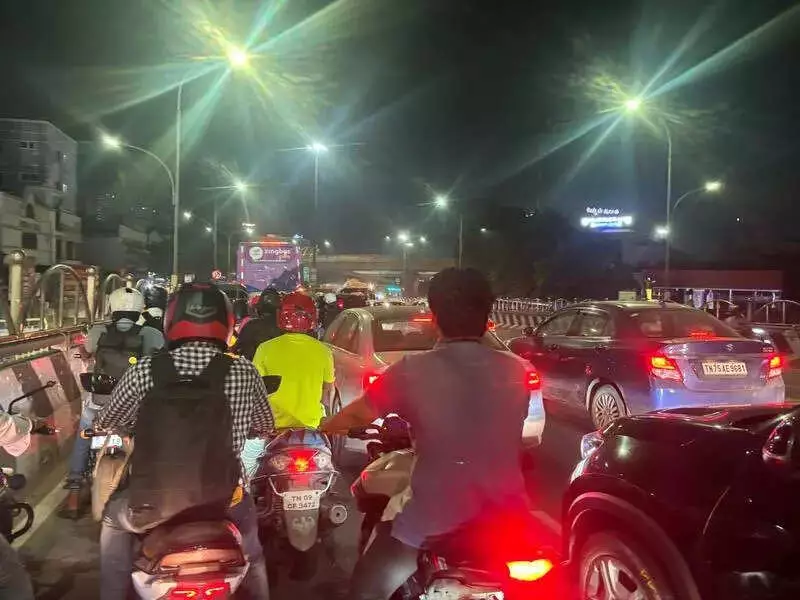
What should take just five minutes to cross now stretches to at least twenty minutes during peak hours. The Koyambedu flyover in Chennai, designed as a decongestion measure for the city's busiest transit hub, has turned into a major inconvenience four years after its inauguration.
A Costly Structure That Fails to Deliver
Built at a cost of 93.5 crore rupees, this 1.15-kilometer flyover stands as the second longest in Chennai. Yet it has become completely redundant during most evenings. Vehicles pile up from SAF Games Village all the way to the Koyambedu grade separator, moving no faster than they did on the road below before the structure existed.
Multiple Factors Create Perfect Storm of Congestion
Several issues converge to create this traffic chaos. Private buses illegally pick up passengers at the exit ramp toward the Koyambedu-Poonamallee High Road junction. This creates a significant bottleneck that worsens when government buses exit the Chennai Mofussil Bus Terminus simultaneously.

The exit ramp becomes a critical choke point where vehicles from both above and below the flyover meet. Adding to the problem, city traffic police permit pedestrian crossings near the ramp by the Vijayakanth memorial, further slowing vehicle movement.
Authorities Acknowledge Problems and Propose Solutions
A senior police officer revealed that traffic enforcement has requested the state highways department to construct a foot-over-bridge with lift facilities from the memorial area. "Right now, we allow a one-minute pedestrian crossing," the official explained. "We have given approval for the construction, but the highways department says it has to acquire nearby land first."
The police deploy eight personnel in the morning and sixteen in the evening to manage the situation. "Some private operators who have depots in Koyambedu possess court orders permitting them to operate from there," the officer noted. "But we drive them away, urging them to pick up passengers elsewhere."
Expert Analysis Points to Planning Flaws
Sampath Kumar, a professor in the highways and transportation department at Sathyabama University, identified the core problem. He stated that authorities must acquire at least 400 square meters of land at the exit ramp's left side to create a seven-meter-wide lane.
"Build a triangular green island to create a proper junction," Kumar suggested. "Vehicles taking the left turn to Poonamallee High Road can go under the flyover using the left lane of the triangle, while those heading straight can go above. This would prevent the convergence that causes current bottlenecks."
A highways engineer who participated in the flyover planning team admitted that planners underestimated vehicle density during the project's design phase. This miscalculation now contributes significantly to the ongoing traffic problems.
The situation highlights how infrastructure projects, even when well-intentioned, can fail to address real-world traffic patterns without proper planning and enforcement. Chennai residents continue to face daily delays on what was supposed to be a solution to their commuting woes.