Chennai Among Four Metros to Get 50 New Automatic Weather Stations This Year
Chennai will become one of four major metros to receive fifty new automatic weather stations this year. This initiative aims to significantly improve hyper-local weather forecasting in urban areas across the country.
Union Minister Announces Major Upgrade
Union Minister of State Jitendra Singh made this important announcement during the 151st Foundation Day celebration of the India Meteorological Department in Delhi on Thursday. He confirmed that fifty automatic weather stations will be installed in Delhi, Mumbai, Chennai, and Pune.
The minister emphasized that this move will strengthen real-time weather monitoring capabilities and enhance disaster preparedness across these metropolitan regions.

How Dense AWS Networks Improve Forecasting
Singh explained that a dense network of automatic weather stations provides granular, high-resolution spatial data. This enables more accurate prediction of sudden weather events including downpours, thunderstorms, extreme heat events, and rapid pressure changes.
Such data-driven forecasting proves critical not only for disaster risk reduction but also for informed decision-making across multiple sectors. Agriculture, aviation, urban planning, and public safety all benefit from improved weather predictions.
What Automatic Weather Stations Measure
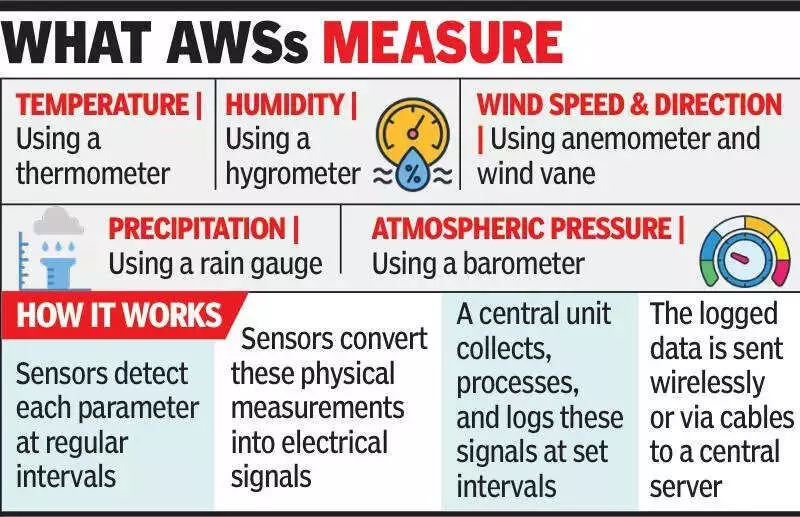
Automatic weather stations typically measure several key weather parameters at fixed intervals. These include rainfall, temperature, humidity, wind speed and direction, and atmospheric pressure. Sensors collect this data and transmit it in real time to a central monitoring system.
IMD officials revealed that Tamil Nadu, Puducherry, and Karaikal currently operate sixty-six automatic weather stations and eighty-one automatic rain gauges. Chennai already maintains observatories at Nungambakkam, Meenambakkam, Ennore, and VIT, along with more than ten automatic rain gauges.
The IMD also receives additional rainfall data from automatic weather stations and rain gauges established by various state government departments and institutions like the Tamil Nadu Agricultural University.
Expert Insights on Localized Forecasting
Y E A Raj, former deputy director general of the IMD, highlighted the importance of denser weather station networks. He stated that a denser AWS grid helps capture localized downpours that often go undetected with sparse observations. This improved data collection also enhances forecast verification processes.
Raj explained that even if numerical models don't ingest all AWS data directly, forecasters can still use this information for local forecasts covering the next twenty-four hours. He emphasized that past weather data remains crucial for predicting future weather patterns accurately.
The installation of these fifty new automatic weather stations represents a significant step forward in India's weather monitoring infrastructure. Urban residents in Chennai and other metros can expect more precise weather forecasts that better reflect local conditions.