The Chandigarh administration is struggling with a skewed bureaucratic structure that is hampering public service delivery. The system is characterized by severe overcrowding at senior levels, while lower ranks face acute staff shortages.
Overcrowding at Senior Levels
According to a Government of India notification dated January 3, 2025, there are 11 sanctioned posts of IAS officers in Chandigarh. Of these, five are at the secretary level, excluding the chief secretary. However, the union territory currently has 12 secretaries — double the sanctioned number. This includes 11 IAS officers and one officer from the Central Civil Services (CSS), who serves as secretary for social welfare and women and child development.
The IAS officers holding secretary posts include the deputy commissioner, a Haryana cadre IAS officer who additionally holds the charge of secretary for industry, and the municipal corporation commissioner, a Punjab cadre IAS officer who is also secretary for rural development and panchayats.

All IAS officers posted in Chandigarh are deployed at the secretary level, leaving the middle rung without dedicated IAS oversight and dependent on makeshift arrangements. A retired IAS officer who served in the city remarked, "The city of around 12 lakh people, spread over 114 sq km, has no reason to have such a top-heavy governance system. At one time, most departments were handled by three senior-most IAS officers — adviser (now chief secretary), home secretary, and finance secretary. As the number of IAS officers increased, sometimes exceeding sanctioned posts, nearly all started getting secretary-level posts."
Many experts believe that junior-level IAS officers should be assigned director-level posts. This would improve implementation of policies, while senior IAS officers overseeing more departments could enhance inter-departmental coordination.
Middle and Lower Level Issues
In contrast, the middle layer suffers from ad-hoc arrangements and lacks proper structural alignment. Currently, 16 officers from the PCS, HCS, and DANICS services serve on deputation, primarily filling joint secretary, additional secretary, and director-level posts. Many hold multiple charges, handling both secretariat and field-level public-facing responsibilities. The Centre's cadre notification provides for only one sanctioned post each of joint secretary and additional secretary — both meant for IAS officers.
This distorted hierarchy represents a classic top-heavy bureaucratic setup. At the same time, lower levels of the administration are plagued by severe manpower shortages. More than 1,000 posts remain vacant across senior, middle, and lower levels. This includes over 400 vacancies in the common cadre of the general administration, such as clerks and stenographers.
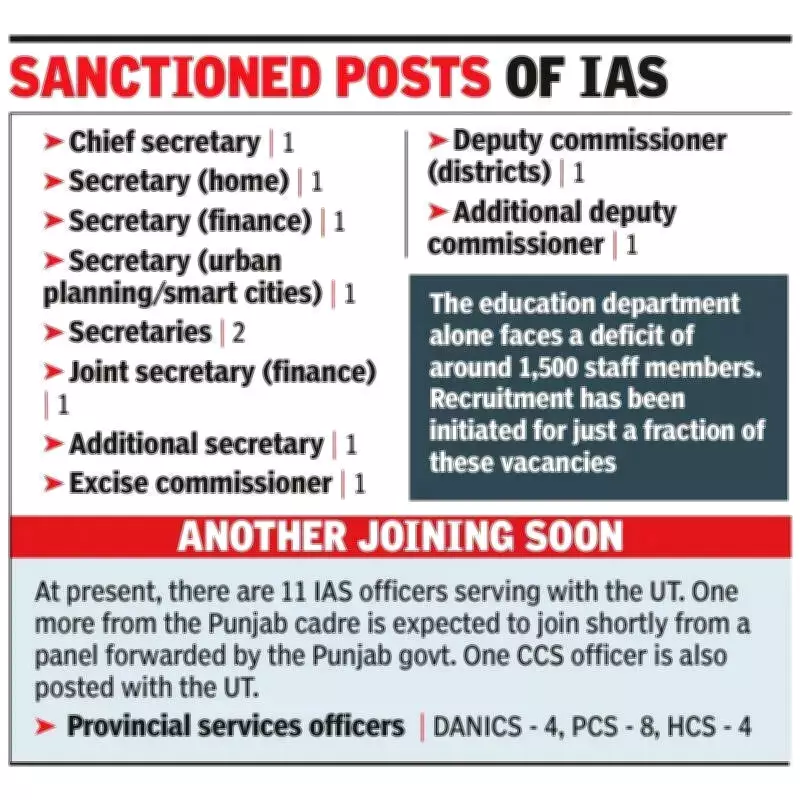
The situation is particularly grim in some departments. The municipal corporation is functioning with only about one-third of its sanctioned regular workforce, severely affecting essential civic services like sanitation, maintenance, and public infrastructure upkeep. The education department alone faces a deficit of around 1,500 staff members. Recruitment has been initiated for just a fraction of these vacancies, resulting in strained teaching and administrative support in schools.
A UT official stated, "This has led to greater reliance on contractual staff, slowed decision-making, piled-up files, reduced field-level implementation, and a noticeable decline in the quality of public services at the grassroots level."
Sanctioned Posts of IAS in Chandigarh
- Chief secretary: 1
- Secretary (home): 1
- Secretary (finance): 1
- Secretary (urban planning/smart cities): 1
- Secretaries: 2
- Joint secretary (finance): 1
- Additional secretary: 1
- Excise commissioner: 1
- Deputy commissioner (districts): 1
- Additional deputy commissioner: 1
Current Staffing and Future Additions
At present, 11 IAS officers serve with the UT. One more from the Punjab cadre is expected to join shortly from a panel forwarded by the Punjab government. One CCS officer is also posted with the UT. Provincial services officers include DANICS (4), PCS (8), and HCS (4).