Chandigarh's Urban Crisis: A City at a Crossroads
Chandigarh, the iconic 'City Beautiful' masterfully designed by architect Le Corbusier, stands at a critical inflection point. The city is wrestling with a complex historical legacy while confronting an increasingly precarious future, besieged by mounting urban pressures and the stalled implementation of vital protective measures.
The Unfulfilled Promise of Master Plan 2031
Notified in 2015, the Chandigarh Master Plan-2031 (CMP-2031) presented a visionary blueprint to safeguard the city's unique planned character, foster sustainable expansion, and tackle regional challenges head-on. Regrettably, a significant portion of its core recommendations have either been ignored or only partially executed by the bureaucrat-led administration. This failure has left the Union Territory exposed to an existential threat fueled by uncontrolled regional sprawl and inadequate governance.
The Tricity Conundrum and Coordination Failures
Sandwiched between Punjab and Haryana, Chandigarh occupies a mere 114 square kilometers, with its broader planned area extending to about 144 square kilometers. Its landlocked geography makes coordinated development with the neighbouring cities of Mohali and Panchkula—collectively known as the Tricity—absolutely imperative. However, both planned and unplanned urban clusters in these satellite areas have dramatically intensified pressure on Chandigarh, worsening severe traffic gridlock, chronic parking shortages, and immense strain from inter-city commuters.

A cornerstone proposal of CMP-2031 was the creation of a Chandigarh Regional Planning Board, modelled on the successful National Capital Region Planning Board (NCRPB). This body was intended to oversee holistic Tricity planning under a dedicated Town and Country Planning Act specifically for the Union Territory. The plan echoed earlier calls from central ministries for such legislation to enable synchronized master plan formulation and revisions. Astonishingly, despite this need being identified as far back as the 1970s with a proposed "Tricity Planning Development Authority," no unified statutory body exists today.
The central government recently confirmed in Parliament that no single, cohesive master plan governs the coordinated development of Chandigarh, Mohali, and Panchkula. Each urban centre operates under its own disparate frameworks. This fragmented approach has led to significant delays in critical infrastructure projects, including metro connectivity, shorter routes to Mohali's international airport, and an outer ring road, primarily due to insurmountable inter-state coordination hurdles.
Expert Insight on Interlinked Challenges
Architect Shilpa Das Vermani, founder and convener of ‘Act! Chandigarh’, emphasized the deeply interconnected nature of the Tricity's problems. "Several key problems are common and inter-linked. For instance, Chandigarh's transport and traffic issues stem largely from high volumes of inter-city traffic from Mohali and Panchkula. Projects have suffered inordinate delays because of these persistent coordination issues," she explained.
Historical attempts at regional planning, such as the 1984 creation of the Chandigarh Interstate Capital Region (CISCR) covering 2,431 square kilometers and the unapproved 1999 Chandigarh Interstate Metropolitan Regional Plan (CISMeR), failed to materialize into statutory mechanisms or approved regional plans. CMP-2031 strongly advocates for prioritizing such regional plans with proper legal backing through a dedicated planning board.
Key Pending Proposals from the Master Plan
The inaction on CMP-2031 has left numerous critical proposals in limbo, threatening the city's fabric and functionality.

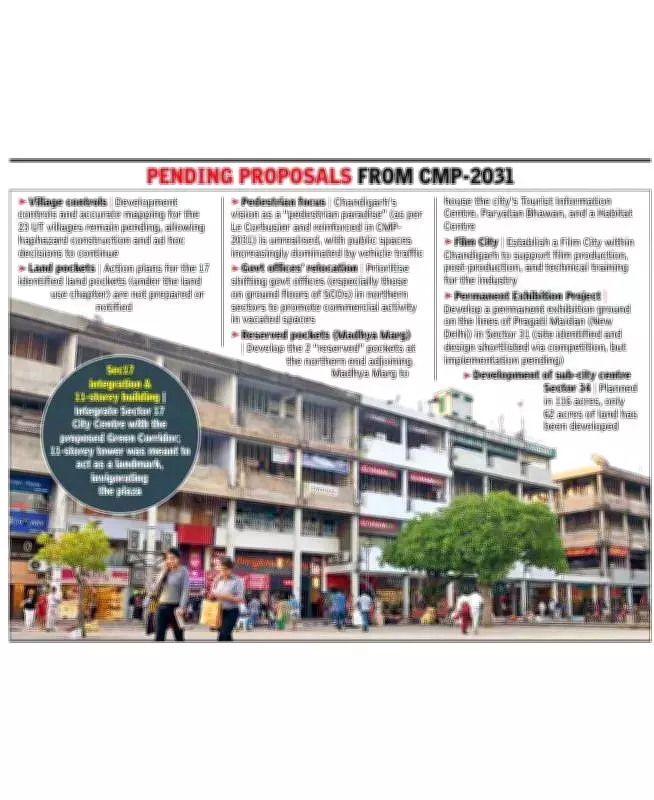
- Village Controls: Development controls and accurate mapping for the 23 villages within the UT remain pending, permitting haphazard construction and ad-hoc decision-making to continue unchecked.
- Land Pockets: Action plans for the 17 identified land pockets under the land use chapter have not been prepared or officially notified.
- Pedestrian Paradise Vision: Le Corbusier's vision, reinforced in CMP-2031, of Chandigarh as a "pedestrian paradise" remains unrealized, with public spaces increasingly dominated by vehicle traffic.
- Government Office Relocation: The plan to prioritize shifting government offices from ground floors in northern sectors to promote commercial activity in vacated spaces has not been implemented.
- Sector 17 Integration: The proposed integration of Sector 17 City Centre with a Green Corridor has not progressed.
- Reserved Pockets Development: The two "reserved" pockets at the northern end adjoining Madhya Marg, intended for a Tourist Information Centre, Paryatan Bhawan, and a Habitat Centre, remain undeveloped.
- Film City Establishment: Plans to establish a Film City within Chandigarh to support production, post-production, and technical training are stalled.
- Permanent Exhibition Project: Development of a permanent exhibition ground akin to Delhi's Pragati Maidan in Sector 31 is pending, despite a site being identified and designs shortlisted via competition.
- High-Rise Development: The construction of an 11-storey landmark building in Sector 17 to invigorate the plaza has not materialized.
- Sub-City Centre: Development of the sub-city centre in Sector 34, planned for 116 acres, has only seen 62 acres developed.
The collective failure to act on these and other recommendations places Chandigarh's legacy and livability in serious jeopardy, demanding urgent administrative and political intervention to secure the city's future.