Chandigarh's Traffic Gridlock Reaches Critical Levels
Chandigarh's renowned quality of life is being severely compromised by an escalating traffic and parking crisis, even as recent national policy recommendations have revived discussions about implementing congestion pricing—a measure long included in local plans but consistently blocked by political and public resistance.
National Survey Urges Action on Urban Congestion
The Economic Survey 2025-26, presented in Parliament in late January 2026, has explicitly called for Indian cities to adopt targeted congestion pricing in dense business districts, coupled with demand-based parking management systems. The document emphasizes that such strategies can significantly reduce traffic volumes, increase average speeds, and lower emissions, drawing evidence from successful international implementations.
The survey specifically highlighted Chennai's Metropolitan Area Parking Policy 2025 as a model approach that discourages excessive private vehicle use by treating parking as scarce urban real estate, enforcing stricter regulations, and prioritizing walking, cycling, and public transportation. These demand-management tools are presented as practical complements to larger transit infrastructure investments.

Chandigarh's Unimplemented Policy Framework
In stark contrast to these national recommendations, Chandigarh's own comprehensive parking policy has remained largely unimplemented. The policy recommends that the municipal corporation introduce peak and non-peak hour congestion pricing across high-demand zones, including:
- Commercial areas
- Institutional zones
- Residential sectors
- Public and semi-public spaces
The framework calls for a technology-enabled parking management system to administer differential rates and congestion-based fees. Additionally, it advocates for innovative concepts like car-free days and vehicle-free zones—none of which have materialized despite being formally proposed.
Other unimplemented parking solutions from Chandigarh's policy include:
- Mandatory staff buses operated by all government, PSU, industrial, and IT companies
- Differential timings for schools and offices across Punjab, Haryana, and UT administrations
- On-street paid parking systems
- Community night parking facilities in each subsector
- Dedicated bus corridors
Failed Initiatives and Stalled Infrastructure
The failure to implement these short-term measures is particularly concerning given the paralysis affecting longer-term solutions. A proposed metro rail project remains indefinitely stalled due to opposition within both the UT administration and central government, with implementation—if eventually revived—likely requiring years or even decades.
A 2023 attempt by the Chandigarh Municipal Corporation under then-Mayor Anup Gupta to double parking fees for vehicles registered outside the Tricity area (Chandigarh, Panchkula, and Mohali) aimed to deter external traffic inflows but sparked immediate backlash from Punjab and Haryana governments—both of which use Chandigarh as their capital. The UT Administrator ordered a complete rollback in August 2023, declaring the policy "biased" against neighboring states.
International Success Stories
Global examples demonstrate the potential effectiveness of congestion management strategies:
Singapore's 1975 Area Licensing Scheme reduced central business district car entries by approximately 45%, with the subsequent Electronic Road Pricing system delivering further reductions on key routes.
London's cordon-based Congestion Charge decreased zone traffic by 16% (including a 30% reduction for cars), eased overall congestion by 32%, and significantly increased usage of buses, cycles, motorcycles, and taxis.
Local Skepticism and Practical Challenges
A senior UT official, speaking anonymously, acknowledged the theoretical benefits of congestion pricing but deemed it impractical due to anticipated public and political opposition. Previous efforts, including a pilot on-street parking scheme in Sector 35 and recent pushes for expanded paid parking, have collapsed amid resistance from residents and elected representatives.

Former Mayor Anup Gupta, who supported the 2023 out-of-Tricity fee increase, expressed similar reservations: "Congestion tax within the city is not practical. The supporting infrastructure—like adequate parking near central business districts such as Sector 17—is lacking. Similarly, the public transport system isn't equipped to handle those willing to leave their vehicles behind."
The Escalating Scale of the Problem
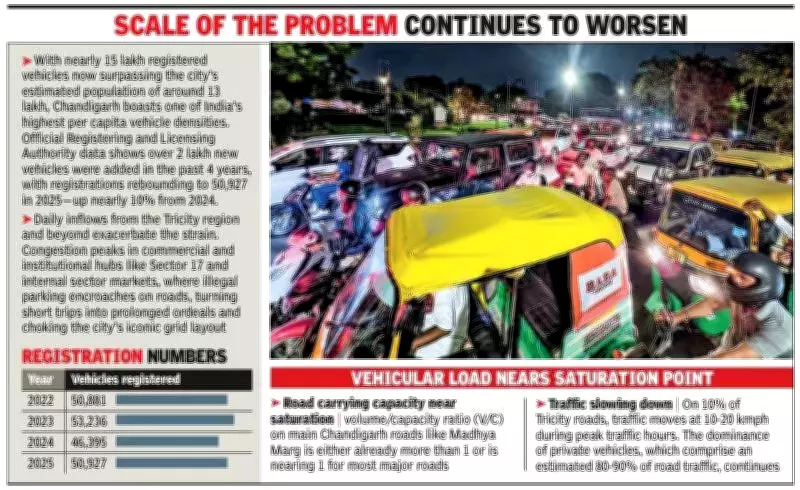
Chandigarh's traffic crisis continues to worsen dramatically. With nearly 15 lakh registered vehicles now exceeding the city's estimated population of around 13 lakh, Chandigarh has one of India's highest per capita vehicle densities.
Official Registering and Licensing Authority data reveals:
- Over 2 lakh new vehicles added in the past 4 years
- Registrations rebounded to 50,927 in 2025—nearly 10% higher than 2024
- Vehicle registration numbers: 2022 (50,881), 2023 (53,236), 2024 (46,395), 2025 (50,927)
Daily inflows from the Tricity region and beyond exacerbate the strain. Congestion peaks in commercial and institutional hubs like Sector 17 and internal sector markets, where illegal parking encroaches on roads, transforming short trips into prolonged ordeals and choking the city's iconic grid layout.
Additional concerning metrics include:
- Road carrying capacity near saturation: Volume/capacity ratio (V/C) on main Chandigarh roads like Madhya Marg is either already exceeding 1 or approaching 1 for most major arteries
- Traffic slowing dramatically: On 10% of Tricity roads, traffic moves at just 10-20 kmph during peak hours
- Private vehicle dominance: Estimated 80-90% of road traffic comprises private vehicles
The combination of soaring vehicle registrations, stalled infrastructure projects, and unimplemented policy solutions creates a perfect storm threatening Chandigarh's fundamental urban functionality and quality of life.