

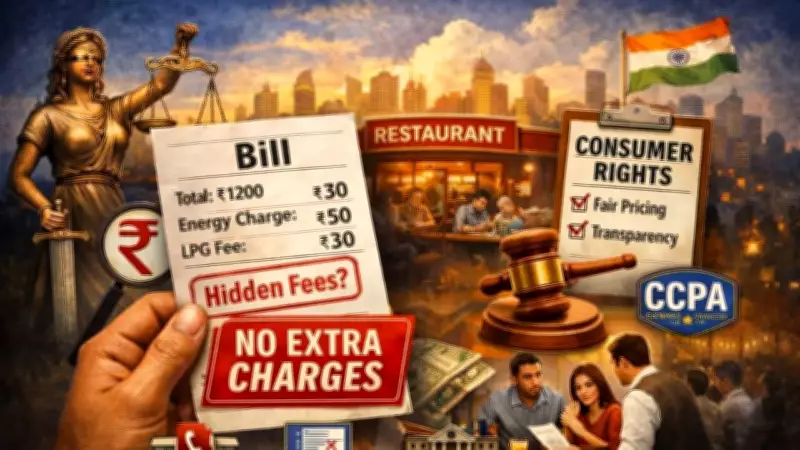
CCPA Takes Firm Stand Against Hidden Restaurant Charges
In a significant move for consumer protection, the Central Consumer Protection Authority (CCPA) has issued a clear directive against hidden charges in restaurant bills. The authority has declared that additional levies such as "LPG charges," "fuel surcharge," or "energy recovery fee" are not just questionable but outright illegal under the Consumer Protection Act, 2019.
The Principle of Price Transparency
At the heart of this ruling lies a fundamental consumer right: price transparency. The CCPA has emphasized that menu prices must represent the final payable amount, subject only to statutory taxes. Any additional charge imposed without explicit consumer consent constitutes an unfair trade practice under Section 2(47) of the Consumer Protection Act.
The authority's position builds upon its 2022 guidelines regarding service charges, where it clarified that service costs should be included in food prices. Extending this logic, the CCPA now states that operational expenses—whether for LPG, electricity, or fuel—are inherent to a restaurant's business model and must be factored into menu pricing from the outset.

The Problem of Relabeled Charges
Following previous regulatory action against mandatory service charges, some establishments have attempted to introduce similar fees under different names. Common examples include:
- Gas surcharge
- Fuel adjustment fee
- Energy cost recovery
The CCPA has made it clear that substance prevails over form. Simply renaming a charge does not make it legal. If imposed compulsorily without upfront disclosure, such fees remain unlawful.
Numerous complaints have emerged from metropolitan areas like Delhi and Bengaluru, where diners discovered unexpected "energy charges" added to their bills. When questioned, restaurant staff often claimed these were "standard practice"—a normalization of unfair conduct that the CCPA aims to dismantle.
Industry Concerns Versus Consumer Rights
The restaurant industry has expressed understandable concerns about rising operational costs. Factors like LPG price volatility and supply disruptions have strained profit margins, leading some establishments to argue that surcharges represent necessary cost recovery measures.
However, the law remains uncompromising. While businesses are free to revise their pricing structures, they cannot impose post-facto charges that alter the agreed price at billing. Transparency, once compromised, erodes consumer trust permanently. The correct legal approach for addressing increased expenses is straightforward: revise menu prices accordingly.
Consumer Rights and Available Remedies
The CCPA's advisory empowers consumers with clear recourse options when confronted with illegal charges:
- Demand immediate removal of the charge from the bill
- File a complaint through the National Consumer Helpline (1915)
- Use the e-Jagriti portal to approach consumer commissions
- Report the matter to district authorities
Recent enforcement trends indicate authorities are increasingly willing to act swiftly. In previous cases involving service charges, restaurants were directed to issue refunds and, in some instances, faced penalties—signaling a shift from advisory guidance to active enforcement.
A Broader Regulatory Shift
This development forms part of a larger transformation in India's consumer protection landscape. Recent years have witnessed:
- Crackdowns on misleading advertisements
- Regulation of e-commerce practices
- Action against mandatory service charges
- Strengthening of digital complaint mechanisms
The CCPA's latest stance reinforces a central theme: consumer rights are no longer passive concepts but actively enforceable protections. What might once have been dismissed as trivial billing issues are now recognized as systemic practices affecting millions of consumers.

Why This Matters Beyond Individual Bills
While individual surcharges of ₹20 or ₹50 might seem insignificant, the legal principle involved carries substantial weight. Permitting such practices would undermine pricing credibility, erode consumer trust, and compromise market fairness. A small illegality, when normalized, becomes a systemic flaw.
The CCPA's intervention draws a clear line not just against hidden charges but against a broader culture of opacity in commercial transactions.
Transparency as Strategic Advantage
For the hospitality industry, this regulatory clarity presents an opportunity rather than a constraint. Transparent pricing builds trust, enhances brand credibility, and encourages repeat business. In competitive markets, trust often becomes the decisive factor for consumers.
Forward-looking businesses will recognize that compliance serves not just legal requirements but strategic interests. Hidden charges may yield short-term gains but inevitably result in long-term reputational damage.
Restoring Honesty to Commercial Transactions
The CCPA's intervention reaffirms a fundamental truth: bills should reflect honesty rather than creative accounting. By addressing hidden charges, the authority reinforces the core principles of consumer law—fairness, transparency, and accountability.
This ruling extends beyond specific charges for LPG or fuel. It represents a broader commitment to ensuring commerce remains grounded in trust. Ultimately, in both marketplace interactions and legal frameworks, what consumers see should be what they pay.





