A recent audit by India's top financial watchdog has uncovered severe shortcomings in the system designed to protect and support millions of construction workers in Maharashtra. The Comptroller and Auditor General (CAG), in a report presented to the state legislature, highlighted critical failures in registration, safety enforcement, and fund utilisation over a five-year period.
Registration Failures and Institutional Weaknesses
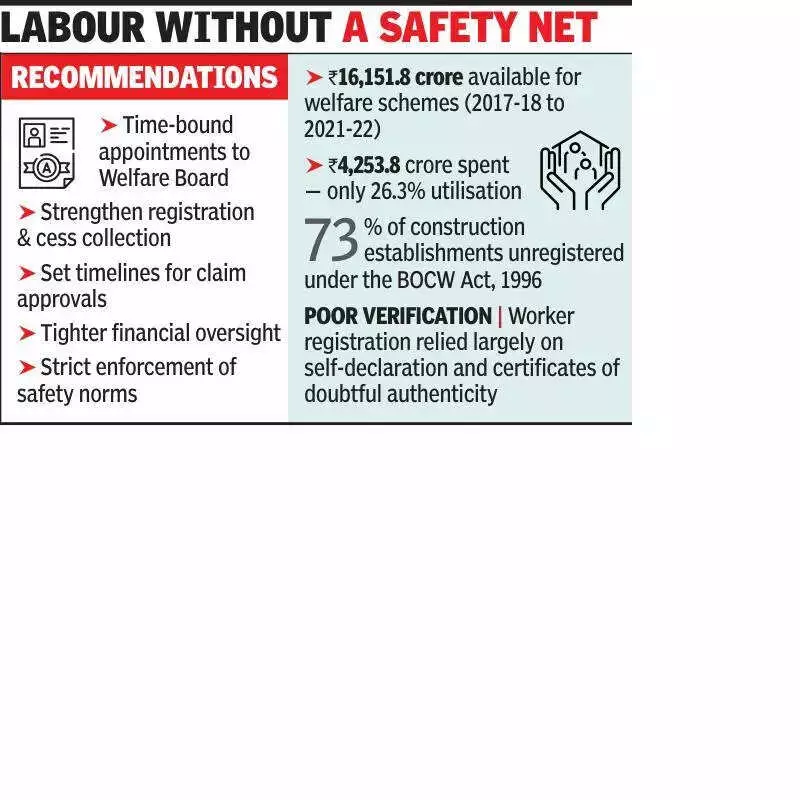
The audit, covering the years 2017-18 to 2021-22, found the system in a state of severe dysfunction. A staggering 73% of the construction workers examined were not registered with the welfare board, a fundamental requirement under the Building and Other Construction Workers (BOCW) Act of 1996. This denies them access to crucial benefits.
The registration process itself was flawed, relying heavily on self-declaration and employment certificates of questionable authenticity. This was the case even after the introduction of the Integrated Welfare Board Management System (IWBMS), raising serious concerns about ineligible individuals receiving benefits meant for genuine workers.

Institutional governance was found to be weak. The state advisory committee, a key oversight body, has not been constituted since 2015. Furthermore, the welfare board has been operating without representation from either employers or workers since June 2021, undermining its tripartite nature.
Massive Fund Under-Utilisation and Safety Neglect
The financial management of welfare funds was a major area of concern. The CAG report stated that only Rs 4,253.8 crores, or a mere 26.3%, of the available Rs 16,151.8 crores was actually spent on welfare schemes for workers during the audit period. This represents a large-scale failure to deliver promised support.
On the ground, safety compliance was widely neglected. Inspections revealed widespread non-adherence to health and safety norms at construction sites. Many establishments had not submitted mandatory safety policies, and sites with over 500 workers had not appointed safety committees and officers as required by law. Irregularities were also noted in the distribution of essential safety kits to workers.
The report also flagged specific financial irregularities, including excess payments of Rs 5 crore during the COVID-19 pandemic due to inadequate scrutiny of claims. Additionally, the board failed to formulate mandatory pension and group insurance schemes for workers.
Staff Shortages and Regional Disparities
Severe manpower shortages crippled the administration's ability to function. The audit noted vacancy rates of 32% for assistant labour officers and 61% for government labour officers. This shortage directly hampered inspections, grievance redressal, and the timely delivery of benefits to workers.
The data also exposed sharp regional inequalities in the coverage of the welfare scheme. While Kolhapur district had the highest number of registered workers at 1.9 lakh, followed by Pune (56,328) and Mumbai (21,111), Nandurbar had only 454 registered workers, indicating a stark urban-rural and regional divide.
Official Response and Recommendations
A member of the welfare board, reacting to the CAG's findings, stated that corrective steps are being initiated. The member assured that the recommendations would be followed and highlighted the impending implementation of the new labour codes, which will separate regulations under occupational safety, health, and social security codes.
The member added that a proposal to sanction posts is pending with the finance department. Currently, the board has about 40 lakh registered members, with renewal processes ongoing for 6-7 lakh workers. New initiatives, including forming MLA committees in each constituency for better registration, have commenced. The official claimed fund utilisation has improved to 70% this year, and the issuance of safety kits is underway.
Based on its audit, the CAG has made several key recommendations, including:

- Time-bound appointment of board members.
- Strengthening of worker and establishment registration processes.
- Development of a robust cess collection module.
- Establishing strict timelines for claim approvals.
- Implementing tighter financial oversight.
- Ensuring strict enforcement of safety norms at construction sites.
The overarching goal of these recommendations is to ensure that welfare benefits reach the genuine, deserving construction workers of Maharashtra.