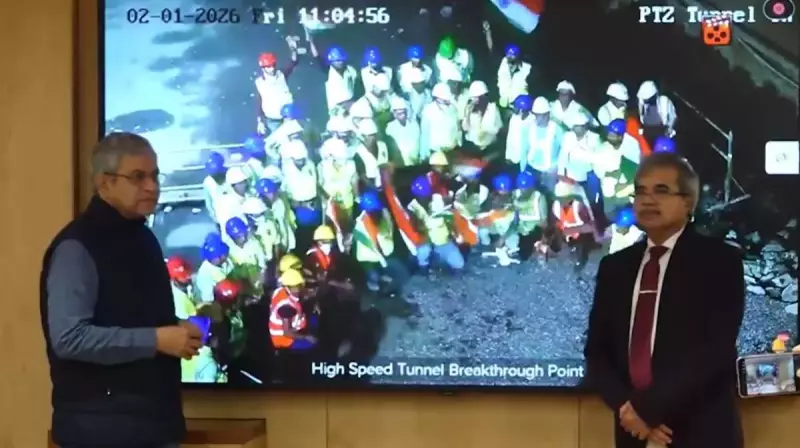
India's ambitious Mumbai-Ahmedabad bullet train project has achieved a significant engineering milestone, marking a major step forward in its construction. The National High-Speed Rail Corporation Limited (NHSRCL) successfully completed the first 'breakthrough' of a mountain tunnel on the route, specifically in the challenging terrain of Palghar district, Maharashtra.
A Pioneering Tunnel Breakthrough
This critical achievement involves the completion of tunneling work for the initial 350 meters of what will be a 350-meter-long tunnel. The breakthrough signifies that the tunneling crew has successfully excavated from one end to the designated breakthrough point. The tunnel is a crucial component of the 508-kilometer-long high-speed rail corridor, designed for trains operating at speeds of 320 kilometers per hour.
The construction employed a New Austrian Tunneling Method (NATM) for this specific section. This technique is often used in complex geological conditions and involves sequential excavation and immediate support. The work was carried out from the north portal of the tunnel, located near Zaroli village. NHSRCL officials have confirmed that this is the first mountain tunnel breakthrough for the entire project, highlighting its importance.

Overcoming the Sahyadri Range
The Mumbai-Ahmedabad bullet train corridor faces one of its biggest geographical challenges while passing through the ecologically sensitive and rugged Sahyadri mountain range. To navigate this, the project requires the construction of a total of 28 tunnels, with a combined length of approximately 56 kilometers. The recently breached tunnel in Palghar is the first among these to see a breakthrough, setting a precedent for the complex tunneling work ahead.
Most of these tunnels will be constructed using advanced Tunnel Boring Machines (TBMs), but the NATM was deemed suitable for this particular section. The successful execution demonstrates the project's adaptability to varying ground conditions and engineering requirements.
Project Timeline and Broader Progress
This milestone provides a substantial boost to the project's overall timeline. The NHSRCL is working diligently towards its goal of commencing operations on a priority section by 2026. While the initial plan aimed for a 2022 start, delays related to land acquisition, particularly in Maharashtra, pushed the schedule. The current focus is on making the 50-kilometer stretch between Surat and Bilimora in Gujarat operational first.
Beyond tunneling, the project is witnessing progress on multiple fronts. Significant portions of the viaduct (elevated track) have been erected, especially in Gujarat. The construction of major stations, bridges, and depots is also underway. The project is a joint venture between India and Japan, utilizing Japanese Shinkansen technology and financing through a soft loan from the Japan International Cooperation Agency (JICA).
The total estimated cost of the Mumbai-Ahmedabad High-Speed Rail (MAHSR) project is approximately ₹1.08 lakh crore. Upon completion, it will drastically reduce travel time between the two megacities from the current 6-8 hours to just about 2 hours, potentially revolutionizing inter-city transportation and boosting economic connectivity in the region.
The breakthrough in Palghar is more than just a construction update; it is a strong signal that the project is overcoming its most difficult physical obstacles. It reinforces the technical capabilities of Indian infrastructure companies and keeps the dream of India's first bullet train firmly on track for its revised operational target.