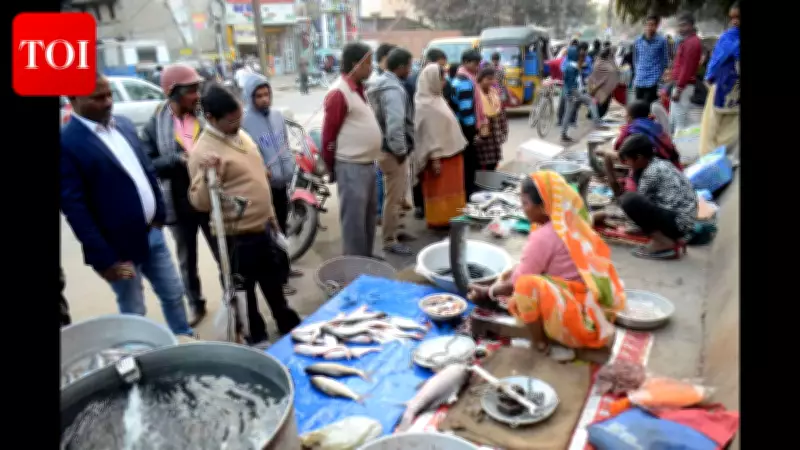
Bihar Government Revives Crackdown on Illegal Meat and Fish Shops in Urban Areas
In a renewed effort to enforce long-standing regulations, the Bihar government has issued a fresh directive in February 2026, mandating the closure of illegal and open-air meat and fish shops near educational institutions, religious sites, and crowded public spaces. This move aims to revive a regulatory framework that has existed for over a decade but has rarely been implemented consistently across the state.
Regulatory Framework and Government Directive
The initiative is spearheaded by the Urban Development and Housing Department (UDHD) under the Bihar Municipal Act (BMA), 2007, specifically Section 345(4). It seeks to address concerns ranging from public health and sanitation to civic order and social harmony. The directive, dated February 21, 2026, instructs urban local bodies (ULBs) to shut down unlicensed operations and ensure compliance with hygiene standards, including covered sales, proper drainage systems, and adequate ventilation.
This order echoes earlier notices issued in 2013 and 2014, when similar crackdowns were announced but implementation remained patchy across cities and towns. The latest communication signals a determined attempt by the state administration to revive a dormant regulatory regime.

Government Directive Details: A letter sent by the department’s principal secretary, Vinay Kumar, to heads of municipal corporations, councils, nagar panchayats, and other officials highlights that numerous meat and fish shops are operating illegally under various ULBs in violation of Section 345 of the BMA, 2007. The letter states, "These establishments either lack proper licenses or fail to comply with licensing conditions. Reports indicate open sales in unhygienic conditions, display of dead animals, and locations near religious sites, educational institutions, and crowded public spaces."
The directive instructs authorities to issue licenses to compliant shops under appropriate conditions while mandating the immediate closure of unlicensed or non-compliant operations under Section 345(4) of the Act. A follow-up communication dated February 16, 2026, from project officer Devendra Suman, joint secretary-cum-additional director, reinforces earlier orders, referencing prior letters issued between 2014 and 2025 aimed at regulating roadside and open meat shops.
Political Backing and Vision
The renewed drive has received strong political backing from Deputy Chief Minister Vijay Kumar Sinha, who oversees the UDHD portfolio. In public statements, Sinha has framed the initiative as part of a broader vision of building a "new Bihar" characterised by cleaner cities and improved governance standards.
He argued that open sale of meat, fish, and poultry near schools could influence young minds in undesirable ways, promote "violent tendencies" among children, harm social harmony, and disturb what he described as the "purity of sentiments" near religious places. However, Sinha clarified that the government is not attempting to regulate people’s dietary choices, stating, "We have no problem with the food, but strict measures have been taken to ensure that social interaction and the spirit of purity are not violated, no one's sentiments are hurt, and the environment is not polluted."
According to the minister, the policy has evolved through consultations with intellectuals and public feedback. The government intends to enforce the rules strictly through closures and penalties, while allowing licensed shops to operate in designated locations under proper hygiene norms.
Focus on Patna and Licensing Process
While the directive applies across Bihar’s urban centres, the most visible action is currently in the state capital, Patna. The Patna Municipal Corporation (PMC), acting under instructions from the UDHD, has rolled out a fresh licensing system for vendors across the city. Municipal commissioner Yashpal Meena said the civic body has begun a comprehensive survey across all six circles of the city, with notices issued to those selling in the open and licenses made mandatory.

Licensing Process: Under the new system, vendors must obtain a license from the municipal corporation by paying a registration fee of Rs 2,000 and submitting documentation proving the legitimacy of the shop premises. This includes property tax receipts for owned premises or a valid rent agreement for rented spaces. Sanitation inspectors conduct on-site inspections to verify documents and assess compliance with standards.
PMC’s PRO Priya Saurabh described the process as quick and transparent, with licenses issued within one to two days after successful verification and valid for one year. Renewal requires another Rs 2,000 payment and re-verification after one year.
Digital Tracking and Licensing Gap
Beyond licensing, the PMC is exploring digital solutions to improve monitoring, such as introducing a unique trade code or QR code for each licensed vendor to allow authorities to easily identify authorised shops and track compliance. Officials have warned that non-compliance will invite strict action, with flying squads and regular inspections becoming routine.
Ironically, the renewed enforcement effort highlights a significant licensing gap. In Patna, despite rules being in place for over a decade, the licensing mechanism has remained largely dormant. Official data reveals that only 17 shops were found to be licensed in the city—seven in the Patliputra circle and 10 in the New Capital circle—while hundreds of others operated without licenses, illustrating the gap between regulation and enforcement.
Debate and Concerns
As enforcement gathers pace, the policy has triggered a wider debate. Supporters argue that regulated vending will improve hygiene standards, reduce nuisance in crowded neighbourhoods, and bring order to an unregulated trade. Critics, however, question claims linking meat sales to behavioural changes among children, arguing they lack scientific basis, and worry that strict enforcement could disrupt the livelihoods of thousands of small vendors.
Implementation remains uneven across municipalities, with older reports indicating stalled license issuance in several towns for years, making roadside vending the norm. The renewed drive could push many vendors to relocate or shift to formal shops, while consumers may see gradual changes in how and where such products are sold.
Policy at a Crossroads
The issue has surfaced during discussions in the Bihar assembly budget session, where legislators have debated broader implications. Municipal bodies across the state have begun rolling out surveys, issuing notices, and planning enforcement measures in phases. For the government, the policy represents a push toward cleaner and better-regulated cities, but for vendors and consumers, the coming months will determine whether it becomes a workable system or another well-intentioned rule struggling to survive beyond official circulars.