Bengaluru Proactively Addresses Summer Water Stress with Rs 10.1-Crore Preparedness Plan
With temperatures in Bengaluru climbing earlier than usual this year, the Bangalore Water Supply and Sewerage Board (BWSSB) has taken a proactive stance by identifying 448 high-alert, water-stressed micro-pockets across the city. To prevent potential shortages, the board has launched a comprehensive Rs 10.1-crore summer preparedness plan, marking a shift from reactive emergency measures of previous years.
Mapping Vulnerabilities and Early Temperature Trends
Unlike in the past, when actions were triggered only after a surge in complaints, BWSSB officials have this time mapped vulnerable areas in advance. These are not large layouts or entire colonies, but small, concentrated micro-pockets within larger supply zones. Most of these identified pockets are interior stretches in north and east Bengaluru, where residents heavily depend on groundwater, and borewell sustainability remains uncertain.
According to the India Meteorological Department (IMD), daytime temperatures in Bengaluru are expected to hover between 29° and 30° Celsius. The city recorded 30° Celsius on Sunday, with areas around Kempegowda International Airport (KIA) likely to see a further rise in the coming days. Officials warn that these limited clusters could face critical drinking water access issues if groundwater levels fall sharply between March and May.

Decentralized Storage and Enhanced Logistics
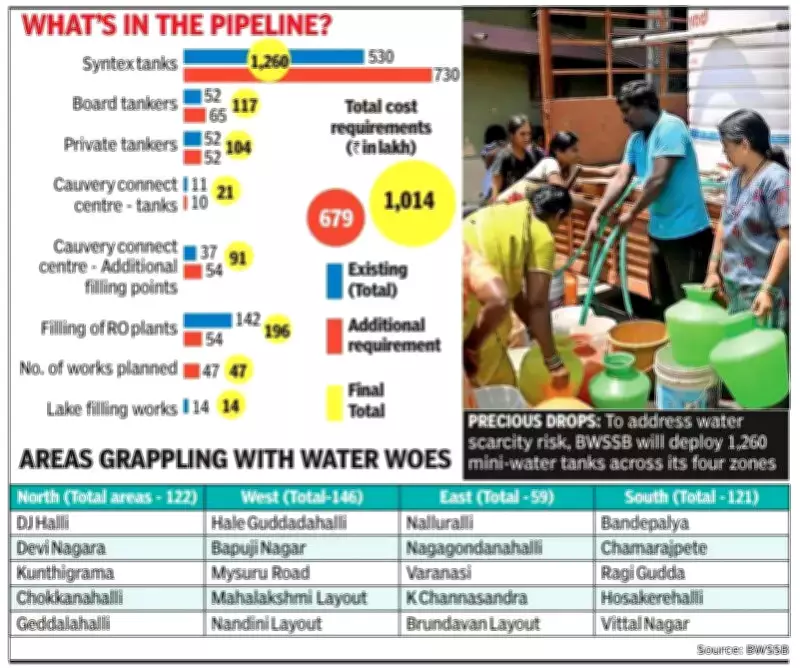
To mitigate the risk, BWSSB's strategy focuses on decentralized storage and quicker tanker turnaround. The plan includes deploying 1,260 mini-water tanks, each with a capacity of 5,000 litres, across its four zones to serve as local drinking water buffers in stress-prone areas. In addition, 117 BWSSB tankers have been earmarked for deployment, while 104 private tankers have been identified for backup if required. About 60 additional tankers have also been arranged in anticipation of rising demand, with standard BWSSB tankers carrying between 6,000 and 12,000 litres.
To improve distribution, 91 additional Cauvery water filling points are planned. The Board has also arranged filling support for 196 reverse osmosis plants across the city. Furthermore, 47 water infrastructure works and 14 lake-filling projects are underway to strengthen local water availability during peak summer.
Improved Cauvery Supply Capacity and Integration
BWSSB Chairman Ram Prasath Manohar V expressed confidence, stating, "I don't see much summer difficulty for the city; we are well prepared this year." He pointed to improved Cauvery supply capacity as a key factor. Under the Cauvery Stage V augmentation, BWSSB now has a total pumping capacity of 773 million litres per day (MLD), of which around 400 MLD is currently being utilized. "We still have more than 40% additional pumping capacity available. Even in a worst-case scenario where groundwater levels fall more than expected, we can match the requirement with Cauvery water," he added.
One of last year's challenges was the incomplete commissioning of newly added villages under the expanded BWSSB limits. According to Manohar, most of these areas have now been integrated into the supply network, with only four villages in the east and four in the north remaining pending due to land disputes. "Except those, all are fully commissioned," he said, noting that this reduces overdependence on borewells in peripheral areas.
Monitoring and Enforcement Measures
Manohar has directed chief engineers, assistant executive engineers, and water inspectors to conduct daily field visits to monitor supply on the ground. He also warned against misuse of Cauvery drinking water for non-essential purposes such as car washing, stating that violators will face penalties and enforcement will be strengthened during summer.
This early preparedness comes amid higher-than-normal February temperatures and uncertainty over groundwater levels. Last year, parts of east and north Bengaluru experienced borewells running dry, lengthening tanker queues, and surging private tanker prices. BWSSB's advance mapping and expanded logistics aim to prevent a repeat as peak summer approaches over the next two months.
Detailed Breakdown of Water-Stressed Areas and Resources
The 448 high-alert pockets are distributed across Bengaluru's zones:

- North Bengaluru: 122 areas, including DJ Halli, Devi Nagara, Kunthigrama, Chokkanahalli, Geddalahalli, and Narayanapura Colony.
- West Bengaluru: 146 areas, such as Hale Guddadahalli, Bapuji Nagar, Mysore Road, Mahalakshmi Layout, and Nandini Layout.
- East Bengaluru: 59 areas, like Nalluralli, Nagagondanahalli, Varanasi, K Channasandra, and Brundavan Layout.
- South Bengaluru: 121 areas, including Bandepalya, Chamarajpete, Ragi Gudda, Hosakerehalli, and Vittal Nagar.
The resource deployment includes:
- Syntex tanks: 530 existing, 730 additional, totaling 1,260.
- Board tankers: 52 existing, 65 additional, totaling 117.
- Private tankers: 52 existing, 52 additional, totaling 104.
- Cauvery connect centres: 11 existing tanks, 10 additional, totaling 21; and 37 existing filling points, 54 additional, totaling 91.
- Reverse osmosis plants: 142 existing, 54 additional, totaling 196 for filling support.
- Infrastructure works: 47 planned.
- Lake filling works: 14 planned.
The total cost requirement is Rs 1,014 lakh, with Rs 679 lakh allocated for additional needs. This comprehensive approach underscores BWSSB's commitment to ensuring water security for Bengaluru residents during the challenging summer months ahead.