In a significant move to secure its water future, Bengaluru has initiated a major project to reduce its dependence on the Cauvery river. The Bengaluru Water Supply and Sewerage Board (BWSSB) has floated a tender to supply a substantial 4 million litres of ultra-pure treated water every day to the sprawling Peenya Industrial Area (PIA). This initiative is designed to promote wastewater reuse and free up precious freshwater for the city's households.
Project Details and Infrastructure
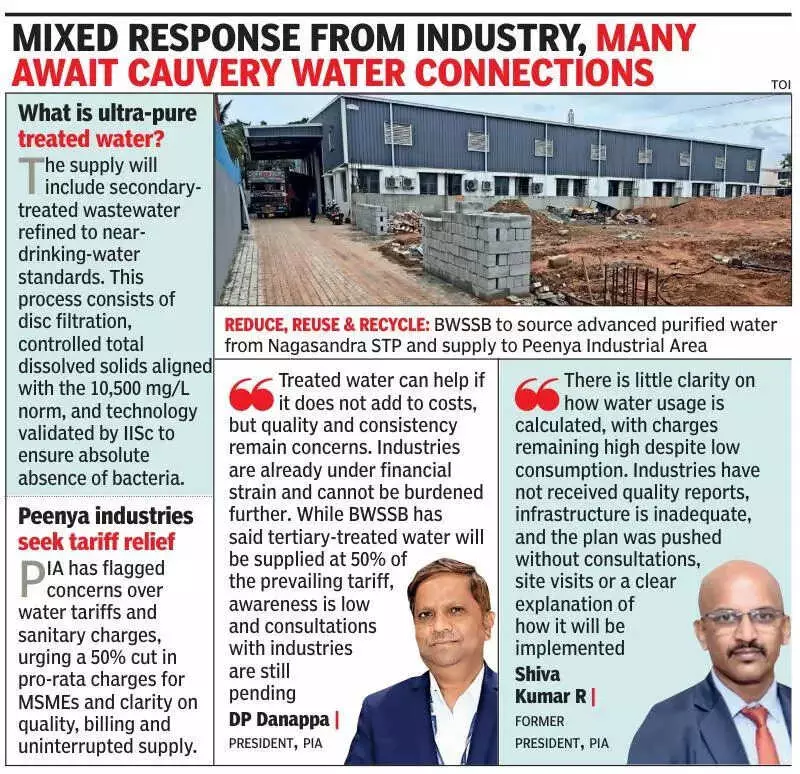
The ambitious plan involves sourcing advanced purified water from the Nagasandra Sewage Treatment Plant (STP). A dedicated 27-kilometre pipeline will be constructed to transport this non-potable water directly to the industrial hub. According to officials, the treated water will be strictly used for industrial needs that do not involve production, such as flushing toilets, cleaning premises, and similar purposes.
The estimated cost for setting up this alternative water supply system is around Rs 20 crore. This budget will cover the construction of a sump-cum-pump house, installation of necessary pumping machinery, and a 5 lakh-litre overhead storage tank. BWSSB Chairman Ram Prasath Manohar emphasised that using fresh Cauvery water for industrial processes is neither sustainable nor economical. He stated that the project's core aim is to prioritise Cauvery water for drinking, thereby benefiting both industries and residents.

Addressing Peenya's Long-Standing Water Woes
Peenya, developed in phases between 1970 and 1974 after land acquisition in 1969, is one of India's largest industrial estates. It is home to roughly 3,500 industries and provides employment to over 8 lakh people. For decades, the area has grappled with acute water shortages, making this new initiative critically important.
BWSSB officials have indicated that the pipeline network will be laid strategically in zones with higher demand and user concentration. With tenders already issued, construction is slated to begin next month and is expected to be completed within a four-month timeframe.
Mixed Reactions from the Industrial Community
The proposal has elicited a varied response from Peenya's industrialists. While some welcome the principle of water conservation, others have expressed reservations and scepticism.
Bijju Gopinath, who manages a manufacturing unit in Peenya Stage III, voiced a common concern. He pointed out that many industries have already paid for Cauvery water pipeline connections, which remain undelivered. He questioned the push for a separate treated water pipeline amid an existing drinking water crisis and highlighted the added financial burden.
Conversely, some industrialists see merit in the plan. Jacob Crasta, an eco-friendly packaging manufacturer in Peenya Stage II, acknowledged that if water quality is reliably assured, using treated water could significantly ease pressure on the scarce freshwater supply. He noted that even partially meeting daily requirements for sanitation in large units with many employees would be a positive step.
To address concerns and build trust, BWSSB officials have informed industries that the tertiary-treated water will be supplied at 50% of the prevailing tariff. They have also recognised the need for better awareness and have promised to conduct outreach programs before expanding the initiative on a wider scale.