

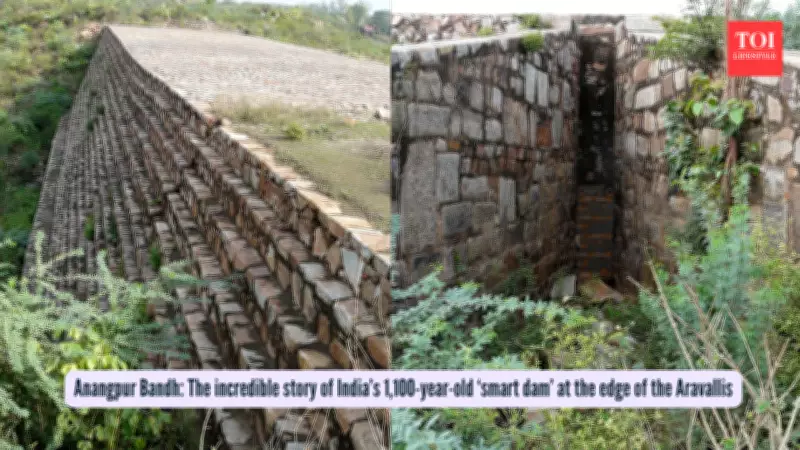
Ancient Anangpur Dam: A Millennia-Old Lesson in Sustainable Water Wisdom
India has consistently demonstrated remarkable foresight in water management throughout its history, from sophisticated ancient town planning to historic stepwells and reservoirs that transformed arid landscapes long before modern technology emerged. In our current era dominated by concrete infrastructure, pipelines, and mechanical pumps, rediscovering these outstanding human-built technologies feels like uncovering a precious treasure trove of knowledge.
The 1,100-Year-Old Marvel in Delhi's Rugged Backyard
Situated in the Aravalli hills lies a remarkable 1,000-year-old engineering marvel that quietly whispers lessons about living harmoniously with nature across centuries. The Anangpur Dam, located near Anangpur village in Faridabad on the Delhi-Haryana border, dates back over 1,100 years to the Tomar Dynasty. Historical evidence suggests it was likely commissioned by King Anangpal Tomar I during the 8th century CE, an early ruler who established his capital in this region.
This ancient ruler constructed hydraulic wonders amid the challenging Aravalli terrain specifically to address persistent water scarcity issues. The dam stands as powerful proof that our ancestors engineered sophisticated sustainability solutions without modern blueprints or electricity, fundamentally shaping settlements in what is now Delhi's rugged backyard.

Engineering Genius Without Modern Blueprints
Archaeological research and comprehensive surveys conducted by the Archaeological Survey of India (ASI) have revealed the dam's gravity-fed design, which measures 19.8 meters in height. The structure features western steps that climb 27.43 meters eastward, spanning an impressive 101.2 meters in total length. Constructed from stone masonry sourced from local quarries and bound together with brick and earth, the dam perfectly hugs the natural slope of the landscape.
Remarkably, no modern engineering blueprints guided this construction. Experts have painstakingly pieced together its architectural genius through meticulous stone analysis and comprehensive water channel studies. Built strategically across a monsoon-fed ravine, the dam performs multiple crucial functions: it captures seasonal runoff, slows water flows to allow sediment settling, stores precious rainwater, and systematically recharges groundwater aquifers.
Historical evidence strongly suggests that this sophisticated water management system once irrigated agricultural fields and supported a thriving, sustainable settlement in an otherwise challenging environment.
Ahead of Its Time: Zero-Energy Watershed Management
The dam's design embodies principles remarkably similar to contemporary watershed management concepts, where natural hill formations funnel water into carefully designed basins, creating a completely self-sustaining hydrological cycle that operates without pumps or external power sources—a truly "zero-energy" system centuries ahead of its time.
The Tomar rulers predated Delhi's massive urban expansion by centuries, yet they laid crucial foundations for later waterworks including hauz tanks and baolis that would become characteristic of the region. Unlike more visually dramatic historical sites, Anangpur's subtle engineering brilliance shines through its complete reliance on rainfall patterns and its demonstrated capacity to foster early communities in areas prone to severe dry spells.
The ASI officially recognizes the Anangpur Dam as among India's oldest surviving dams, designating it as a protected monument that represents a perfect blend of geological understanding, acute environmental observation, and practical hydrological knowledge.
Modern Relevance Amid Urbanization Pressures
Today, this ancient marvel faces significant threats from relentless urbanization as land values in surrounding areas skyrocket to crores. Yet, reviving and learning from such traditional water management systems could provide crucial solutions to Delhi's escalating water crisis, where groundwater levels continue to plummet dangerously and the Yamuna River faces unprecedented strain.

The Anangpur Dam stands as a timeless testament to sustainable engineering, offering invaluable lessons for contemporary water management challenges through its demonstration of working with nature rather than against it—a principle that remains profoundly relevant more than a millennium after its construction.





