Ahmedabad Municipal Corporation Greenlights Ambitious Rs 18,518-Crore Budget for 2026-27
The Ahmedabad Municipal Corporation's standing committee has given its approval to a substantial budget of Rs 18,518 crore for the fiscal year 2026-27. This comprehensive financial plan is now set to proceed to the general board for final ratification. Notably, the budget was cleared without any increase in property or vehicle taxes, providing relief to residents while funding extensive urban development.
Flagship Initiatives: Beggar-Free City and Ahmedabad Eye
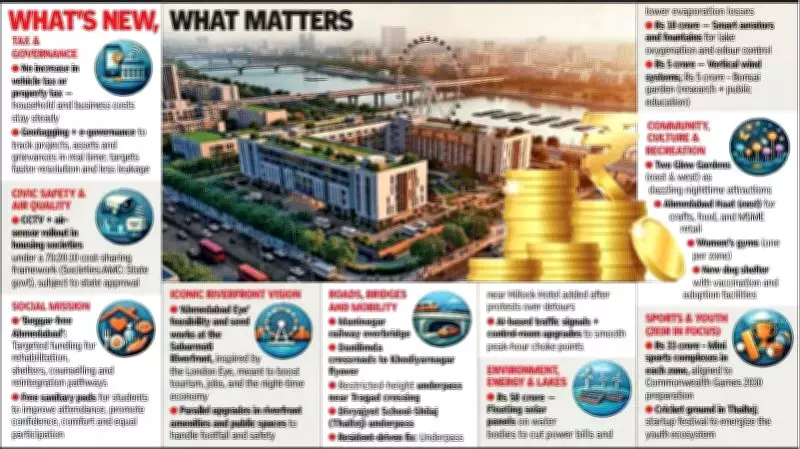
At the heart of this budget is a bold vision to transform Ahmedabad into a beggar-free city, marking a significant social welfare commitment. Additionally, the proposal includes funding for a feasibility study to explore the creation of an 'Ahmedabad Eye' observation wheel on the Sabarmati Riverfront. This project is inspired by London's iconic landmark and aims to boost tourism and civic pride.
Enhanced Security and Environmental Monitoring
A key component of the budget is a novel shared-funding scheme designed to enhance security and air quality across residential societies. The plan proposes a 70:20:10 cost-sharing model, where housing societies would contribute 70%, the Ahmedabad Municipal Corporation 20%, and the state government 10%, subject to state approval. This initiative aims to install CCTV cameras and air-quality sensors throughout the city, improving safety and environmental health.

Infrastructure and Mobility Upgrades
The budget allocates significant resources to infrastructure development, with a focus on drainage and stormwater system overhauls, new pumping stations, and water distribution networks. Town-planning schemes in newly developing areas are also prioritized. To address traffic congestion, Rs 20 crore is earmarked for AI-based traffic signals and control-room upgrades, along with trials for smart and green parking in public buildings.
A Rs 50-crore mobility package supports the construction of bridges, flyovers, and underpasses. Key projects include the Maninagar railway overbridge, a flyover from Danilimda crossroads to Khodiyarnagar, a restricted-height underpass at Tragad, and an underpass from Divyajyot School to Shilaj (Thaltej). Two public-private partnership corridors, the Nima Farm-Mumatpura underpass and CTM Crossroads-Anaj Market Gate, each receive Rs 10 crore.
Public Health and Community Facilities
Public health infrastructure receives a major boost with a Rs 50 crore allocation for a super-specialty medical institute in Nikol. New urban health centres worth Rs 32 crore, physiotherapy units in Sabarmati and Chandlodia, cervical cancer treatment support, and free sanitary pads in schools are also funded. Community-scale improvements include women's gyms, community halls, and dog shelters, enhancing quality of life for residents.
Environmental Sustainability Projects
Environmental initiatives are a cornerstone of the budget, with Rs 50 crore dedicated to a floating solar project aimed at generating cleaner energy and reducing evaporation. An additional Rs 20 crore is allocated for waste-to-CNG conversion, Rs 20 crore for lake interlinking and flood mitigation, and Rs 5 crore for a bonsai garden that combines research with public outreach.
Governance and Citizen Feedback
The budget accelerates geotagging and e-governance platforms to map municipal assets, track works, and handle complaints in real time. These measures are designed to plug leakages and ensure efficient service delivery without delays. It incorporates Rs 1,500 crore in amendments shaped by citizen feedback, such as adding an underpass near the Hillock Hotel after residents protested detours caused by road closures.
In a notable decision, the standing committee rejected the relocation of the slaughterhouse in the Walled City, reflecting responsiveness to local concerns. Overall, this budget represents a holistic approach to urban development, balancing infrastructure, security, health, and environmental goals for Ahmedabad's future growth.