Prime Minister Narendra Modi's planned physical rally in West Bengal's Nadia district took an unexpected turn on Saturday, forcing a last-minute shift to a virtual address. The change in plans, however, did not dilute the core political objectives of his communication, which were sharply focused on two critical damage-control exercises ahead of the elections.
Fog Grounds Rally, But Not the Message
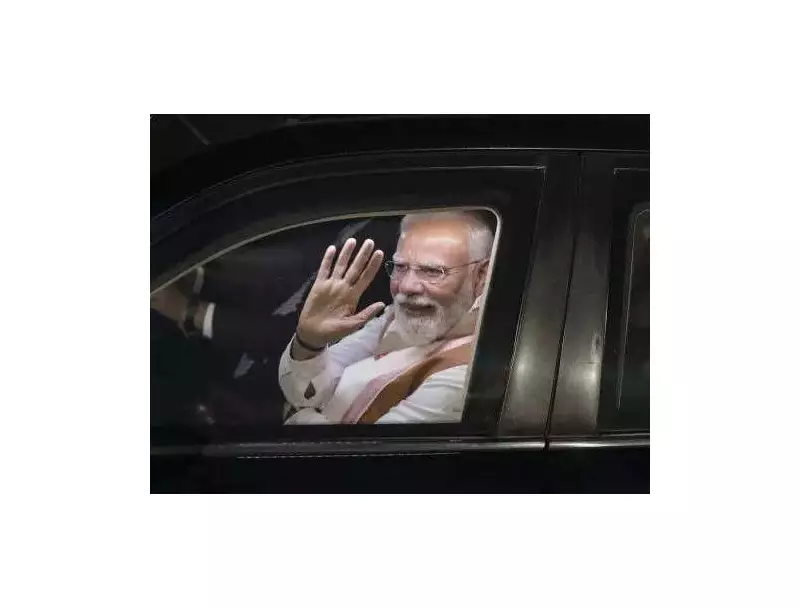
Heavy fog over Taherpur in Nadia district prevented the Prime Minister's helicopter from landing, leading to the cancellation of his scheduled public meeting. Modi had to return to Kolkata's airport. From there, he delivered an 18-minute virtual speech to the intended audience. The incident highlighted the logistical challenges of campaigning but set the stage for a speech rich in political nuance.
Courting the Crucial Matua Community
A significant portion of the Prime Minister's address was dedicated to the Matua community, a key demographic with substantial influence in districts like Nadia and North 24 Parganas. The community has expressed growing anxiety over the ongoing Special Intensive Revision (SIR) of the voters' list.

Modi paid rich tributes to Matua icons like Harichand Thakur, Guruchand Thakur, and Baroma. He praised Harichand Thakur for teaching the "virtue of karma" and lauded the community for advancing its philosophy of social development. He also mentioned Sri Chaitanya as an icon of "love and compassion."
However, the speech did not directly address the community's specific fear of being disenfranchised. Data shows that over 2.7 lakh voters in Nadia (6.1% of the electorate) and more than 7.3 lakh in North 24 Parganas (8.8%) have been classified as "unmapped," meaning they couldn't establish a link to the 2002 electoral roll. Matua elders believe a large portion of these are from their community. BJP seniors privately acknowledge that the party's strong performance in the 2021 assembly polls and 2024 general elections owes much to Matua support, making the current concerns a sensitive issue.
On Infiltration and Political Accusations
While speaking on the SIR, Modi linked it to the issue of infiltration, a topic with resonance in border districts. He accused the ruling Trinamool Congress of being soft on the matter. "I can see them shouting 'go back Modi' slogans. But they are tight-lipped when it comes to saying 'go back' to the infiltrators," he said. Modi alleged that infiltrators, who are "trying to control Bengal," are close to the Trinamool's heart, which is why the party is opposing the SIR exercise.
Correcting the 'Bankim-da' Cultural Misstep
The Prime Minister also engaged in clear damage control regarding a recent cultural faux pas. Days after referring to Bankim Chandra Chattopadhyay as "Bankim-da" in the Lok Sabha—a casual reference that drew criticism for disrespect—Modi carefully honored the author. He praised the creator of "Vande Mataram" and referred to him as "Rishi Bankim-babu," using two honorifics. He stated that Bengal was blessed with a sage like "Rishi Bankim-babu" who sowed the seeds of emancipation in British-ruled India. This was a direct response to the Trinamool's accusation that the BJP is "culturally alien to Bengal."
Development Pitch and Attack on Trinamool
Modi positioned the BJP as the sole party capable of ensuring Bengal's development. After virtually inaugurating a four-lane highway project, he blamed the Trinamool for creating a "mahajangalraj (rule of the jungle)" in the state. "There is no dearth of money, intention or schemes for the state. But the local administration runs on cuts and commissions. Projects worth thousands of crores are stalled," he alleged. He also contrasted this with the NDA's landslide victory in Bihar, implying a similar change was needed in Bengal.
The virtual address, therefore, served as a strategic blend of outreach, rebuttal, and promise, aimed at consolidating the BJP's base and addressing its vulnerabilities in a crucial electoral state.